Dogs and heat in Dubai: how to protect yours
Dogs and heat in Dubai: real temperatures, walking hours, water, scorching ground, breeds at risk, warning signs and what UAE law requires.
By the Loulou Air team · · 8 min read
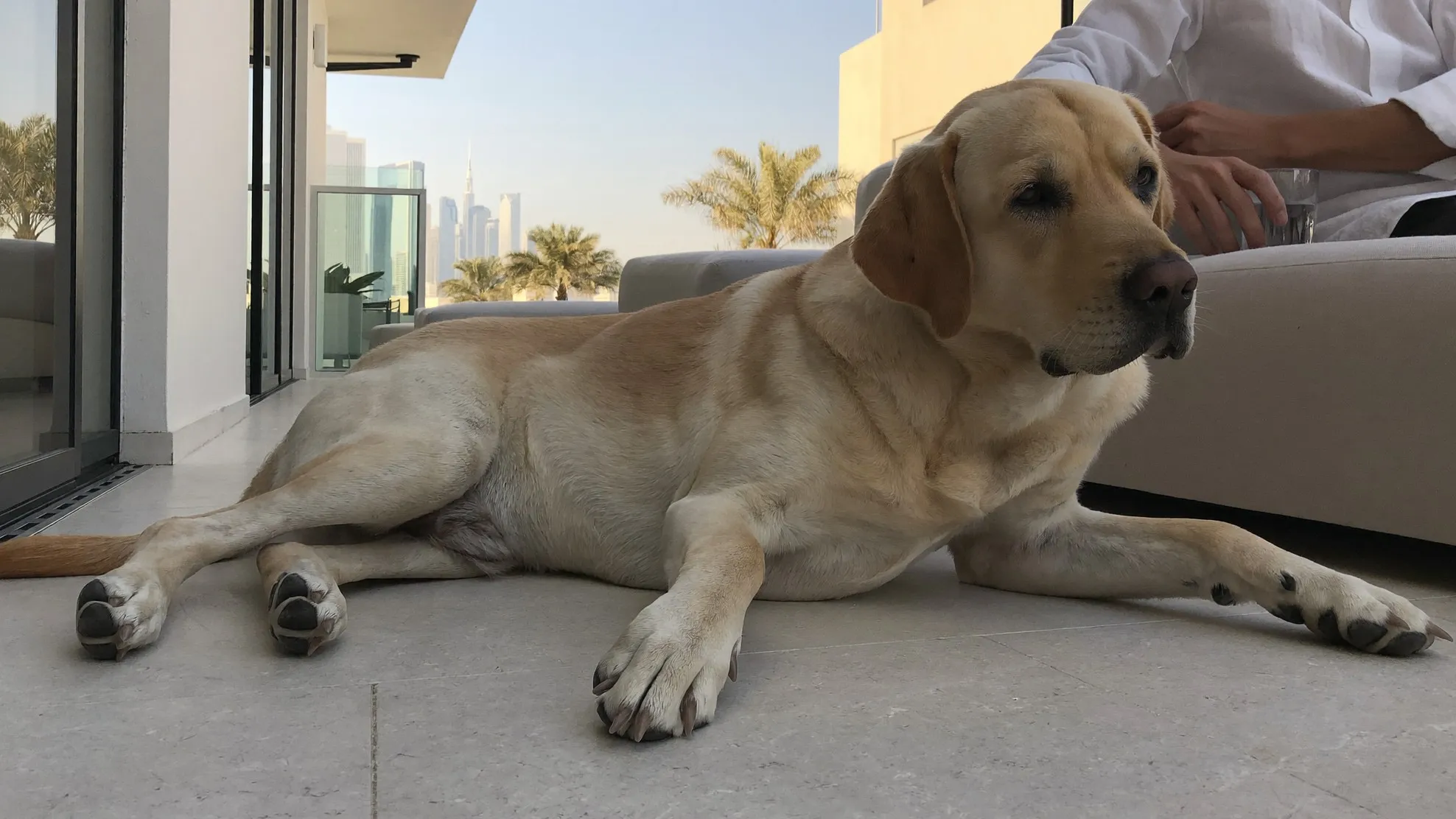
In Dubai, heat is a matter of planning: walks early in the morning or late in the evening, water renewed often, the ground checked before your dog walks on it, and a cool, ventilated shelter for the rest of the day. The national weather service’s climate normals put the average daily maximum above 40 °C in July and August, and UAE federal law requires a keeper to provide access to water and to check the animal every day. Heat also matters before you land: on scheduled flights to Dubai, a dog travels as cargo. On a private flight it stays in the cabin with you, never in the hold.
How hot does Dubai get?
The average daily maximum tops 40 °C in July and August. Dubai’s climate normals published by the World Weather Information Service of the World Meteorological Organization, fed by the National Center of Meteorology of the UAE, give an average maximum of 40.6 °C in July and 40.4 °C in August, over the 1974-1991 period.
| Month | Average maximum | Average minimum |
|---|---|---|
| January | 24.0 °C | 13.7 °C |
| April | 32.4 °C | 20.1 °C |
| June | 38.8 °C | 26.1 °C |
| July | 40.6 °C | 28.9 °C |
| August | 40.4 °C | 29.3 °C |
| October | 35.1 °C | 22.7 °C |
Two figures matter more than the afternoon peak. From April to October the average maximum stays above 32 °C, so the constraint lasts seven months. And the average minimum reaches 29.3 °C in August, which narrows the window for comfortable walks to the very start of the morning. Winter is the city’s other face, with an average maximum of 24.0 °C in January.
When should you walk your dog in Dubai?
At the coolest hours, early in the morning or later in the evening. The French Ministry of Agriculture advises keeping play and walks to the coolest hours of the day, and warns that heated asphalt and tarmac can burn paw pads. Its summer guide asks owners to keep up physical activity suited to the temperature, and to check both the paw pads and the surface underfoot.
Test the ground with your hand. The RSPCA advises placing the back of your hand on the pavement or any hard surface to check its temperature before walking your dog on it, and favouring grass. It also gives a useful sense of scale: dogs are ten times more likely to suffer heat-related illness from exercising in hot weather than from overheating in a car.
Where to walk is a separate question. Lead rules, beaches and parks are covered in our guide Dubai with your dog.
How much water does a dog need in the heat?
Clean water at will, renewed several times a day. The French agriculture ministry requires that an animal always have clean water available, offered without limit, and its summer guide specifies renewing it every four hours. It also advises shading the sleeping area, at least in part, keeping it well ventilated and adding extra airflow if needed.
Out and about, the RSPCA recommends carrying a portable water dispenser and offering small amounts of water every 15 to 20 minutes, without letting the dog drink while panting heavily, as that can cause bloating and vomiting. The French guide also mentions wetting the animal’s body to cool it down.
Then the rule with no exception: never leave your animal alone in a vehicle. The ministry’s summer guide is explicit that it must not be shut inside even for a short moment, even with enough water and the windows ajar.
Which dogs cope worst with Dubai’s heat?
Snub-nosed dogs, along with dogs that are overweight, unfit, or living with heart or respiratory conditions. The RSPCA cites a study by Nottingham Trent University and the Royal Veterinary College finding that brachycephalic dogs such as pugs and bulldogs are at higher risk of heatstroke, because panting is less effective with a shorter snout. It adds that unfit or overweight dogs, and those with heart or respiratory disease, heat up faster and take longer to cool down.
Aviation reaches the same conclusion. IATA, the international air transport association, writes that carrying snub-nosed dogs such as boxers, pugs, bulldogs and Pekinese is not recommended in the hot season, as these animals have difficulty maintaining a normal body temperature in hot weather. Emirates SkyCargo goes further: its Emirates Pets leaflet states that the snub-nosed cat and dog breeds it lists, and any of their crosses, are not permitted for carriage except under specific conditions during the winter season, from November to April. Our article Flying with a snub-nosed dog sets out what the airlines require.
What are the signs of heatstroke in a dog?
Heavy panting with difficulty breathing, excessive drooling, a dog that is lethargic, drowsy or uncoordinated, then collapse or vomiting. Those are the signs the RSPCA asks owners to watch for. Its immediate advice: stop moving, give water, find shade, and keep an eye on the dog until it has recovered. If the condition worsens, it is an emergency.
The French ministry’s summer guide also asks owners to watch for signs of dehydration, such as excessive tiredness or difficulty eating, and to call a vet at the slightest doubt. The RSPCA notes that a dog cools itself by panting, drinking and seeking shade, and that if it cannot do so its body temperature can spike as far as death. The ministry writes likewise that excess heat can, in some cases, kill the animal.
No treatment, no sedative and no cooling method is decided here: those are questions for a vet.
What does UAE law say about animals and heat?
It requires the keeper to provide shelter from the weather, water and a daily check, on pain of a fine. Federal Law No. 16 of 2007 concerning animal protection, amended by Federal Law No. 18 of 1 November 2016 and published by the UAE Ministry of Climate Change and Environment, requires in its Article 2 that owners and care providers take preventive action to keep animals away from damage or harm, and to avoid causing them pain or suffering. The same article obliges them to inspect the animal at least once a day, to provide health care and to have it checked by a vet.
Two articles bear directly on heat. Article 5 provides that animals not raised in constructions shall be given shelter from changes in the weather and an adequate sleeping place. Article 6 requires that they be able to reach an appropriate source of water constantly, or be provided with the clean water they need daily. Article 7 adds that animals shall be transported in a way that ensures their safety, without exposure to injury.
The penalties are in the law itself. Article 14 provides for up to one year’s imprisonment and a fine of up to AED 200,000, or either penalty, for causing damage, harm or suffering to an animal, and Article 14 Bis 2 for a fine of up to AED 100,000 for breaching the law’s other obligations.
Where do you find a vet in Dubai?
Dubai Municipality runs its own veterinary clinics, alongside the private sector. Its Veterinary Services Section describes itself as in charge of protecting animal health and welfare in Dubai, with preventive and curative services for all kinds of animals. It names three municipal clinics, at Al Khawaneej, Al Lisaili and Hatta, a single number, 800900, and an email address, [email protected]. For pets at Al Khawaneej, the published hours run Sunday to Thursday from 7.30 a.m. to 2.30 p.m. and Friday from 8 a.m. to 11.30 a.m.; requests go through the municipality’s website. In the first half of 2026 it reports 6,585 vaccinations for cats and dogs and 4,100 pets registered.
Gather this before you leave rather than in an emergency: the French ministry’s summer guide advises telling your own vet about the trip and noting the details of an emergency veterinary clinic where you will be staying. Entry requirements for the UAE are gathered on our United Arab Emirates travel requirements page.
How do you avoid the cargo hold in hot weather?
By choosing a flight where your dog stays in the cabin with you. On scheduled flights to Dubai, Emirates states that for all itineraries ending in Dubai, animals must be transported as cargo, and that animals are not permitted in the cabin of its flights, apart from falcons on certain routes and guide dogs for the visually impaired.
Loulou Air, a brand of AEROAFFAIRES, a private aviation broker since 1991, offers Pay-per-Seat private jets for your dog and you: you pay for your seat, not the jet, and every ticket covers one human and their dog. Your dog flies in the cabin with you, at your feet for the whole flight, never in the hold, and none of the weight limit imposed by scheduled airlines applies; capacity depends on the aircraft and the number of animals on board, and a broker approves each dog case by case. Boarding is through a private aviation terminal, with no queues, the crew is briefed on welcoming animals, and water, bowls and blankets are provided on board. Entry requirements are due on every flight, private ones included, and our brokers check every dog’s file before departure.
See flights to Dubai or talk to a broker; how these flights work is set out in Flying private with your dog.
Frequently asked questions
Can you walk a dog in Dubai in summer?
Yes, but at the coolest hours, early in the morning or late in the evening, as the French Ministry of Agriculture advises for hot weather. Check the ground temperature with the back of your hand before walking your dog, using the test the RSPCA describes. Carry water and a folding bowl.
What is the average maximum temperature in Dubai?
40.6 °C in July and 40.4 °C in August, according to the climate normals published by the World Meteorological Organization’s World Weather Information Service, from National Center of Meteorology data for the UAE. From April to October the average maximum stays above 32 °C, over the 1974-1991 period.
Can a snub-nosed dog travel to Dubai in summer?
IATA advises against it: it writes that carrying snub-nosed dogs is not recommended in the hot season, as they struggle to maintain a normal body temperature. Emirates SkyCargo accepts the snub-nosed breeds it lists, and their crosses, only under specific conditions from November to April. Discuss it with your vet before booking anything.
Sources
Rules change: check them against these sources before every trip.
- WMO - World Weather Information Service, Dubai (data from the National Center of Meteorology)
- Federal Law No. 16 of 2007 concerning animal protection, amended by Federal Law No. 18 of 2016 (text published by MOCCAE)
- French Ministry of Agriculture - Precautions during a heatwave
- French Ministry of Agriculture - Summer guide for pet owners
- RSPCA - Hot weather walks and dogs
- IATA - Traveling with pets
- Emirates - Rules and charges for travelling with animals
- Emirates SkyCargo - Emirates Pets leaflet
- Dubai Municipality - Veterinary Services Section
- Dubai Municipality - Nearly 183,700 veterinary services in H1 2026