Private jet with your dog: costs, how it works
Flying private with your dog in the cabin: what a whole aircraft costs, Pay-per-Seat seat prices, private terminals and the entry rules that stay.
By the Loulou Air team · · updated · 8 min read
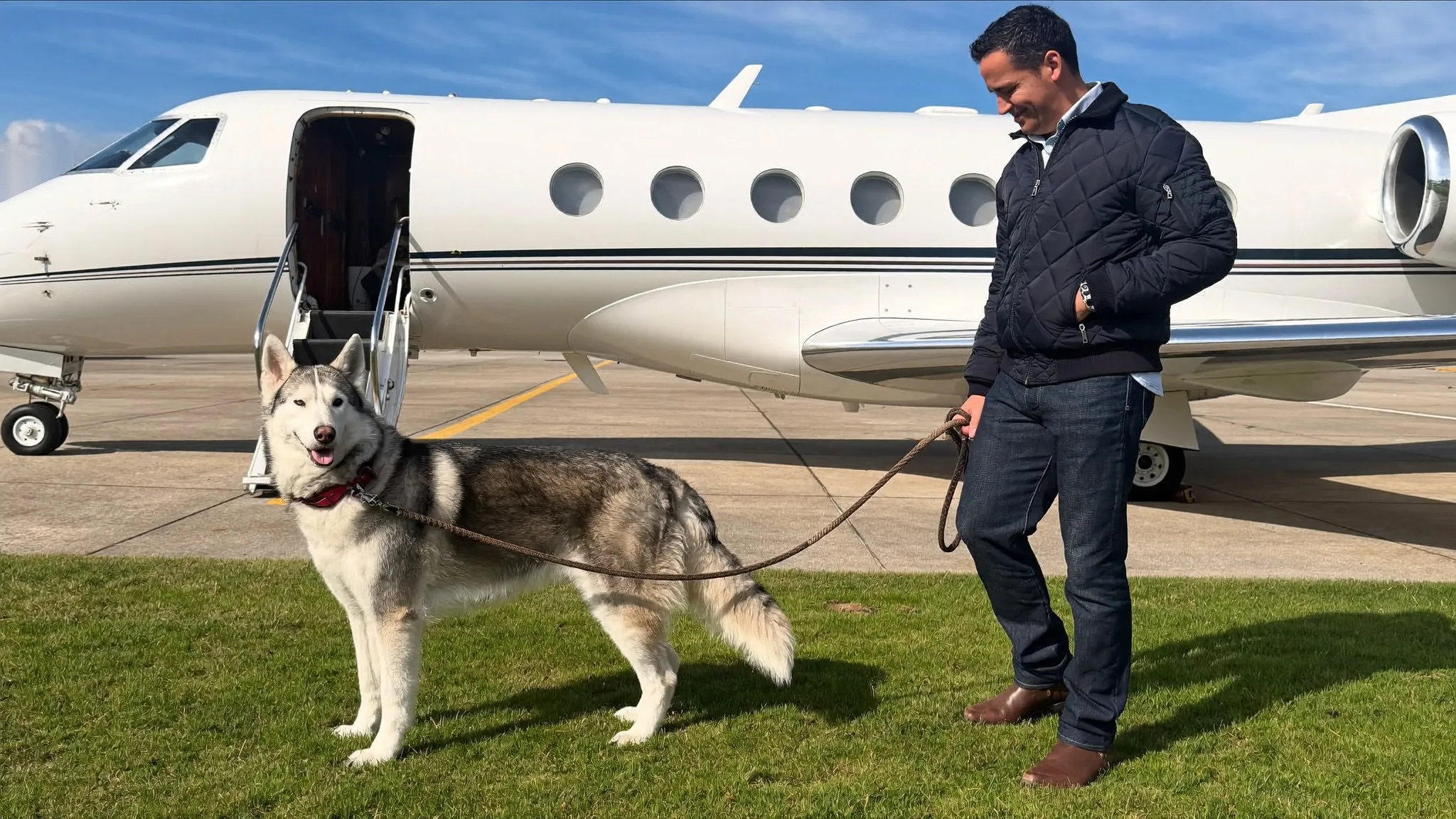
Yes, your dog can fly on a private jet, in the cabin with you: on a private flight, the weight limit of scheduled airlines does not apply, and carriage conditions are set by the operator of the aircraft. The price depends above all on the format: a whole aircraft, or a single seat on a shared flight. Here is what each option costs and how the journey works, from booking to the customs desk. With Loulou Air, this journey is Pay-per-Seat: you pay for your seat on a shared private jet flight, not for the jet.
Shared private flight or full charter: what is the difference?
Two formats exist, and they answer different needs. In a traditional charter, you hire the whole aircraft: you choose the date, the departure time and the route, and you pay for the aeroplane whether there are two of you on board or twelve.
A shared flight works differently. A flight is opened on a date fixed in advance, and its seats are sold individually: this is Pay-per-Seat. You pay for your seat, not the aircraft. That is the principle behind Loulou Air, a brand of AEROAFFAIRES, a private aviation broker since 1991: each ticket covers one seat for a human and their dog, and the flights are operated by certified airlines.
The trade-off with Pay-per-Seat is the date, which is set by the flight rather than by you. On our flights, a departure threshold is shown from the moment seats go on sale. Until it is reached the flight is not confirmed, and if it is still not reached by the cut-off date the flight is cancelled and seats are refunded in full.
How much does a private jet with your dog cost?
It depends on the format: a whole aircraft is paid for in full, while on a shared flight you only pay for your seat. AEROAFFAIRES, a private aviation broker, puts the cost of a private jet flight hour at EUR 1,800 to 20,000, depending on the aircraft. On a transatlantic flight of almost eight hours, a whole aircraft therefore runs to tens of thousands of euros, or more. The footballer Sergio Reguilón spoke of EUR 110,000 to bring his dog from Spain to the United States by private jet rather than in the hold, Paris Match reported in May 2026.
With Pay-per-Seat, you only pay for your seat. On Loulou Air flights on sale on 12 October 2026, it costs EUR 10,000 from Paris to New York, EUR 8,500 from Paris to Dubai and EUR 6,200 from New York to Los Angeles, taxes and airport charges included. Each ticket includes a seat for one human and their dog. Current prices are shown on each flight.
On a scheduled flight, a dog costs much less, between 40 and 200 euros per journey in the cabin, but only if it weighs under about 8 kg with its carrier: the details are in Flying with a dog: what it really costs. Above that, it is the hold or cargo.
Why can a dog travel in the cabin on a private flight?
Because there is no carrier-bag gauge and no hold-baggage rule to satisfy. On a scheduled airline, a dog too heavy for the cabin moves to the hold or to cargo, which is the subject of our guide Pet in cabin: weight limits, fees and airlines. In private aviation the question is framed differently, because carriage is governed by the operator’s conditions rather than by an airline’s commercial scale.
Private flying belongs to what airport authorities call general aviation. Los Angeles World Airports, which runs Van Nuys Airport, defines it as all flying other than scheduled air carrier service or the military. It is a category of its own, with its own airports, terminals and habits.
On Loulou Air flights there is therefore no weight limit of the kind scheduled airlines impose, because the dog does not travel in the hold. Capacity depends on the aircraft and on how many animals are on board, and a broker reviews each dog’s file before the booking is confirmed.
What is a private aviation terminal?
It is a building separate from the airline terminals, run by a company known as an FBO, or fixed base operator. The Port Authority of New York and New Jersey, which operates Teterboro Airport, describes FBOs as airport service centres responsible for passenger handling, aircraft fuelling, parking, maintenance and de-icing, as well as ground handling, towing and baggage handling.
In practice this changes three things for a traveller with a dog.
The scale. Teterboro has three FBOs, according to the Port Authority. Van Nuys has four, according to Los Angeles World Airports: Castle & Cooke Aviation, Clay Lacy Aviation, Jet Aviation and Signature Aviation. That is a long way from the dozens of gates in an airline terminal.
No scheduled service. Teterboro does not accommodate publicly available scheduled air carrier operations, because of its role as a general aviation reliever airport. Van Nuys is likewise dedicated to noncommercial air travel. There are no airline check-in queues and no crowded gate rooms.
Ground services. Everything goes through the FBO, including what is centralised elsewhere. The Port Authority notes that there is no central parking facility at Teterboro: parking is handled by each FBO, which you contact directly.
Do the entry rules change when you fly private?
No, and this is the most important point in this guide. The destination country applies its entry rules to your dog whatever aircraft brings it in.
In the United States, the CDC, the federal health authority, states that every dog entering or returning to the country must be accompanied by a CDC Dog Import Form receipt. The same page sets a minimum age of six months and requires a microchip readable by a universal scanner. The form is completed by the person bringing the dog in, which means you, not the operator of the flight.
The CDC’s instructions to carriers apply explicitly to commercial air carriers and general aviation operators alike: a private flight is not a separate regime. Those instructions require the carrier to create an air waybill for each dog brought into the United States, unless the CDC has granted a waiver, and to check before boarding that the dog holds its form receipt. The full sequence, including the arrival airport, is set out in our United States travel requirements.
Coming back into Europe, the check is a customs one. France’s food safety directorate states that pets arriving from third countries are subject to customs control on entry into the European Union, with customs officers carrying out documentary and identity checks at points open to international passenger traffic. The arrival airport therefore has to be a place where that check can happen, which is a question to settle before booking rather than on landing.
For the United Arab Emirates, entry conditions are set out in our United Arab Emirates travel requirements. All of our destination guides are gathered on the travel requirements page.
How many dogs can travel on the same flight?
The answer depends on the aircraft, but a regulatory limit also exists, and it is not widely known. The French food safety directorate’s guidance sets the non-commercial threshold for a movement from a third country at five animals at most per owner or authorised person, all species combined.
Beyond five animals, the same document states that the movement becomes commercial: it must be declared to the border control post of the veterinary and phytosanitary border inspection service at the point of arrival, under specific health conditions. The threshold applies per owner, not per flight, so several passengers each travelling with one dog each remain within the non-commercial framework.
On the aircraft side, the number of dogs accepted is shown on each flight. If you are travelling with two dogs or more, say so when you enquire, because their space is reserved at the same time as yours.
What happens before departure?
Your dog’s file is reviewed with a broker before the booking is confirmed. On our Pay-per-Seat flights you pick a date, you reserve your seat, and an AEROAFFAIRES broker calls you back to check your dog’s file and complete the booking. The flight is confirmed as soon as its departure threshold is reached, and you are told straight away.
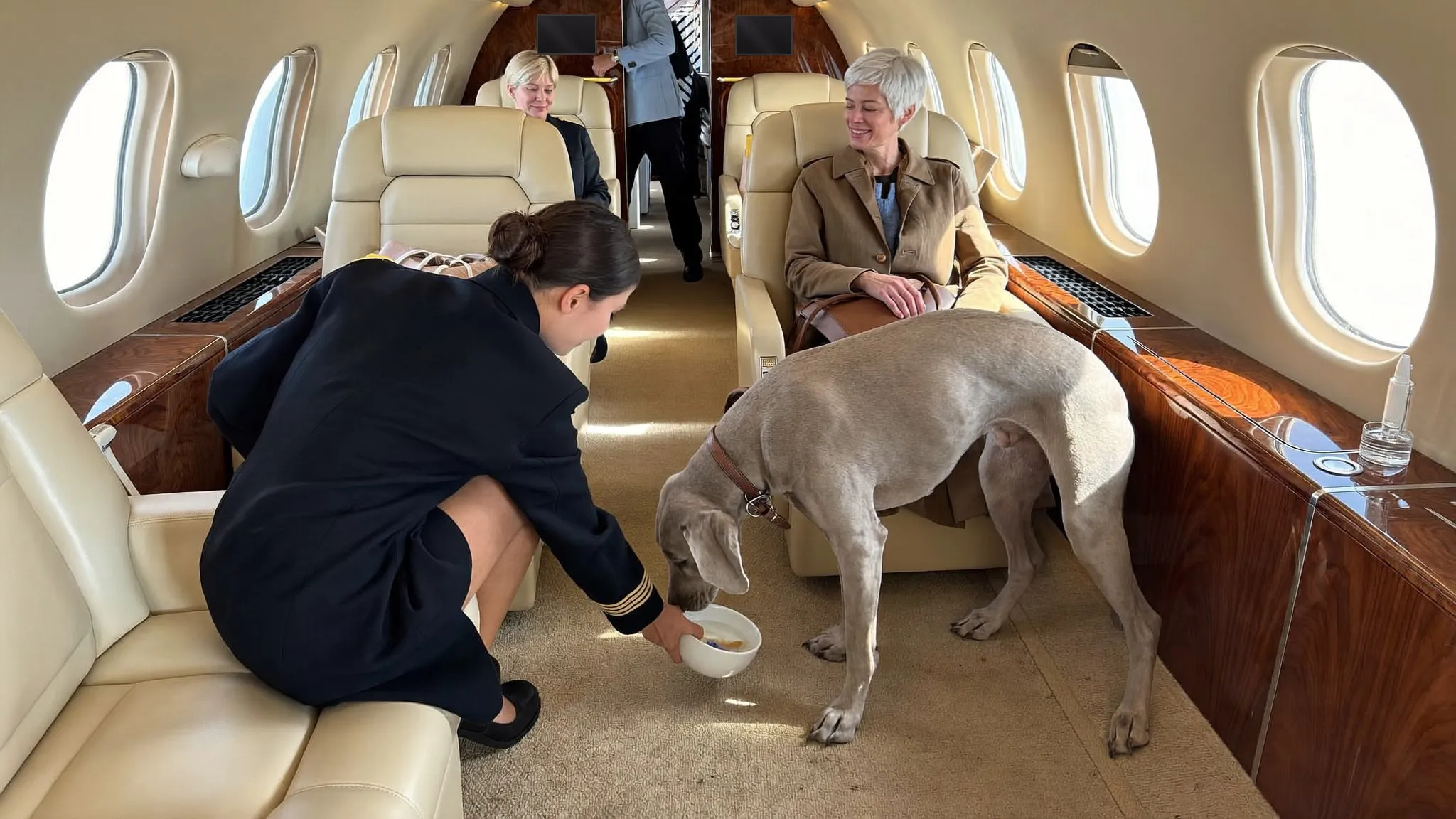
On the day, boarding goes through the private aviation terminal, with no queue. The crew is briefed on receiving animals, and water, bowls and blankets are provided on board.
Our flights serve New York, Dubai and Los Angeles: see our open flights, including our Paris to New York, Paris to Dubai and New York to Los Angeles routes. For another destination, we open new flights every month: talk to a broker about the trip you are planning. For a whole aircraft, our sister company AEROAFFAIRES offers full charters.
Frequently asked questions
Can you take a private jet with your dog?
Yes. On a private flight your dog travels in the cabin with you, and the weight limit of scheduled airlines does not apply: carriage conditions are set by the operator of the aircraft. You can charter a whole aircraft, or buy a seat on a shared flight.
How much does a private jet with your dog cost?
A whole aircraft is paid by the flight hour, EUR 1,800 to 20,000 depending on the aircraft according to AEROAFFAIRES. With Pay-per-Seat you only pay for your seat: EUR 6,200 to 10,000 depending on the route on our flights on sale on 12 October 2026, each ticket including your dog’s place.
Can a 10 kg dog fly in the cabin?
Rarely on a scheduled flight: Air France, KLM, Transavia, Iberia, Corsair and TAP stop at 8 kg including the carrier, and Vueling at 10 kg including the carrier. On a private jet that threshold does not exist: capacity depends on the aircraft and on how many animals are on board.
Sources
Rules change: check them against these sources before every trip.
- AEROAFFAIRES — Is it really more expensive to fly private? (in French)
- Port Authority of New York and New Jersey — Teterboro Airport
- Los Angeles World Airports — Van Nuys, General Description
- CDC — Information for Air Carriers on Dogs Being Imported into the U.S.
- CDC — Frequently Asked Questions on Dog Importations
- CDC — CDC Dog Import Form and Instructions
- DGAL — Non-commercial import of pets from third countries (22 April 2026)