Frankfurt with your dog: the rules
EU pet passport, four breeds banned from entering Germany, leads, RMV transport and trains: the official rules for coming to Frankfurt with a dog.
By the Loulou Air team · · 8 min read
Taking your dog to Frankfurt needs little paperwork: Germany is in the European Union, so a microchip, an EU pet passport and a valid rabies vaccination are enough. Two rules specific to Germany are worth checking before you leave: four dog breeds may not enter the country, and unvaccinated puppies are not admitted. Here is what the official pages say, read on 17 October 2026.
What paperwork does a dog need for Frankfurt?
Three things, the same as for any trip between EU countries: a microchip, an EU pet passport for companion animals and a rabies vaccination that is still valid.
The European Commission sets the order of steps, which matters as much as the steps themselves. The microchip must be implanted before the vaccination for that vaccination to count. The dog must be at least 12 weeks old on the day of its first injection, and you must then wait at least 21 days before travelling. The EU pet passport is compulsory for movements between EU countries, and how to get one is covered in EU pet passport for dogs.
Germany’s federal agriculture ministry says the same: for a trip inside Europe the animal needs the EU-Heimtierausweis, which carries the microchip number and proof of rabies vaccination, and up to five animals not intended for transfer to a new owner may travel together. It also notes that new European rules have applied to private pet travel since 22 April 2026, under Delegated Regulation (EU) 2026/131.
One requirement you can forget: Germany asks for no tapeworm treatment on entry. The Commission requires it only for Finland, Ireland, Malta, Norway and Northern Ireland.
Can a puppy enter Germany?
Not before it has been vaccinated against rabies, and Germany grants no exception. EU rules let member states accept a puppy under 12 weeks that has not been vaccinated, or a puppy of 12 to 16 weeks that has been vaccinated but is not yet immune. The European Commission publishes the list of countries that use this option: Bulgaria, Croatia, Czechia, Estonia, Finland, Lithuania, Luxembourg, Romania, Slovakia, Slovenia and Switzerland. Germany is among those that do not, as is France.
Add the two waiting times together, twelve weeks before vaccinating and then twenty-one days, and a puppy is not compliant for Germany until it is about fifteen weeks old. The subject is covered in How old does a puppy have to be to fly?
Which dog breeds are banned from Germany?
Four, together with their crossbreeds. The federal law of 12 April 2001 bans bringing or importing into Germany dogs of the pit bull terrier, American Staffordshire terrier, Staffordshire bull terrier and bull terrier breeds, as well as their crossbreeds with each other or with other dogs. It adds a second ban: dogs of further breeds presumed dangerous under the law of the federal state where they are to be kept permanently may not be brought into that state.
The penalties fall on the person bringing the animal in: up to two years’ imprisonment or a fine, one year where the offence is negligent, and the attempt is punishable. The dog itself may be confiscated.
Hesse, the state Frankfurt belongs to, adds its own rules. The Regierungspräsidium Darmstadt explains that the public safety ordinance of 22 January 2003 on keeping and handling dogs, last amended on 30 November 2022, presumes the breeds it lists to be dangerous, along with their crossbreeds and with dogs that have shown themselves dangerous through their behaviour, for instance by biting a person without provocation. Keeping such a dog requires a permit from the local public order authority, which asks the keeper for proof of competence and a positive temperament test for that dog.
Can a listed breed come to Frankfurt on holiday?
Yes, temporarily and under conditions, if the owner does not live in Germany. The implementing regulation of 3 April 2002 allows a banned dog to be brought in temporarily when it stays for no more than four weeks with an accompanying person whose residence is not in Germany. The competent state authority can extend that stay on request, to avoid undue hardship.
The file has to be precise. On request, the accompanying person produces documents establishing the dog’s identity, whose entries for date of birth, sex, breed and coat colour are officially confirmed by the country of origin; official confirmation of the tattoo or chip number is enough where the dog is permanently identified. An official certificate confirming that the dog has not come to notice as dangerous is also required, and the temporary nature of the stay has to be made credible. The same regulation provides other exceptions, outside tourism, for service dogs, guide dogs for the blind, assistance dogs and rescue dogs.
Does your dog have to be on a lead in Frankfurt?
Not everywhere, but in a good many places. Answering a written question in the Hessian Landtag, the minister for the environment and agriculture states that there is no general lead requirement across the state. Two rules take its place. Once cities and municipalities have designated publicly accessible land, in particular parks, gardens and green areas as well as pedestrian zones, a lead becomes compulsory there for every dog, under section 9 of the public safety ordinance on dogs. And the Hessian hunting act forbids letting dogs and cats run unsupervised in a hunting district, which covers fields and woodland.
Two duties apply throughout Hesse, dangerous dog or not. The Regierungspräsidium Darmstadt points out that dogs may not be allowed to run unsupervised outside their keeper’s fenced property, on pain of a fine. The official administrative guidance on the same ordinance adds that, outside that fenced property, the dog wears a collar, or a harness, showing the keeper’s name, address and, where applicable, telephone number. For a dog treated as dangerous, a lead of no more than two metres is compulsory outside the fenced property and the home, including the corridors, stairwells and lifts of apartment buildings.
Where a lead is required generally, the Hessian minister adds that enough large free-run areas must be provided. The city itself decides which areas are covered, so check with it before letting your dog off the lead.
Dogs on Frankfurt’s underground, trams and trains
On city and regional transport a dog rides free, on a lead. The RMV, the transport authority for the Rhine-Main region, carries dogs free of charge when they are on a lead and accompanied by a suitable person, and asks for a muzzle on dogs that could endanger other passengers. Guide dogs for the blind may be taken at any time, and other animals are only carried in suitable containers.
On long-distance trains the rule changes. Deutsche Bahn carries small animals up to the size of a domestic cat free of charge in a carrier, which has to fit under the seat or in the rack above it. A dog travelling outside a carrier must be on a lead and wear a muzzle, and it pays half the fare: you add it to the booking as a traveller of the type “Hund”. No seat reservation is possible for a dog, which stays in front of, under or beside your seat. Guide dogs and marked assistance dogs travel free and without a muzzle.
Where can your dog relieve itself at Frankfurt Airport?
Nowhere in a space designed for it: the airport states that there is no designated pet relief area, either in the airport or in the transit areas, and asks travellers to bring something to clean up droppings, to keep the animal on a lead and not to let it run free in transit.
For a connection, everything depends on where the dog sits on the aircraft. A dog travelling in the cabin follows its owner into the passenger transit area and reaches the onward flight with them. An animal carried in the hold stays in its box, in a room set aside for it, when the connection is under three hours, with a visual check and water if needed; beyond that the airport takes it to the Animal Lounge, operated by Lufthansa Cargo, and the owner cannot see it during the transit. What a dog goes through in the hold is set out in Dogs in the cargo hold: the real risks.
How do you keep a large dog out of the hold?
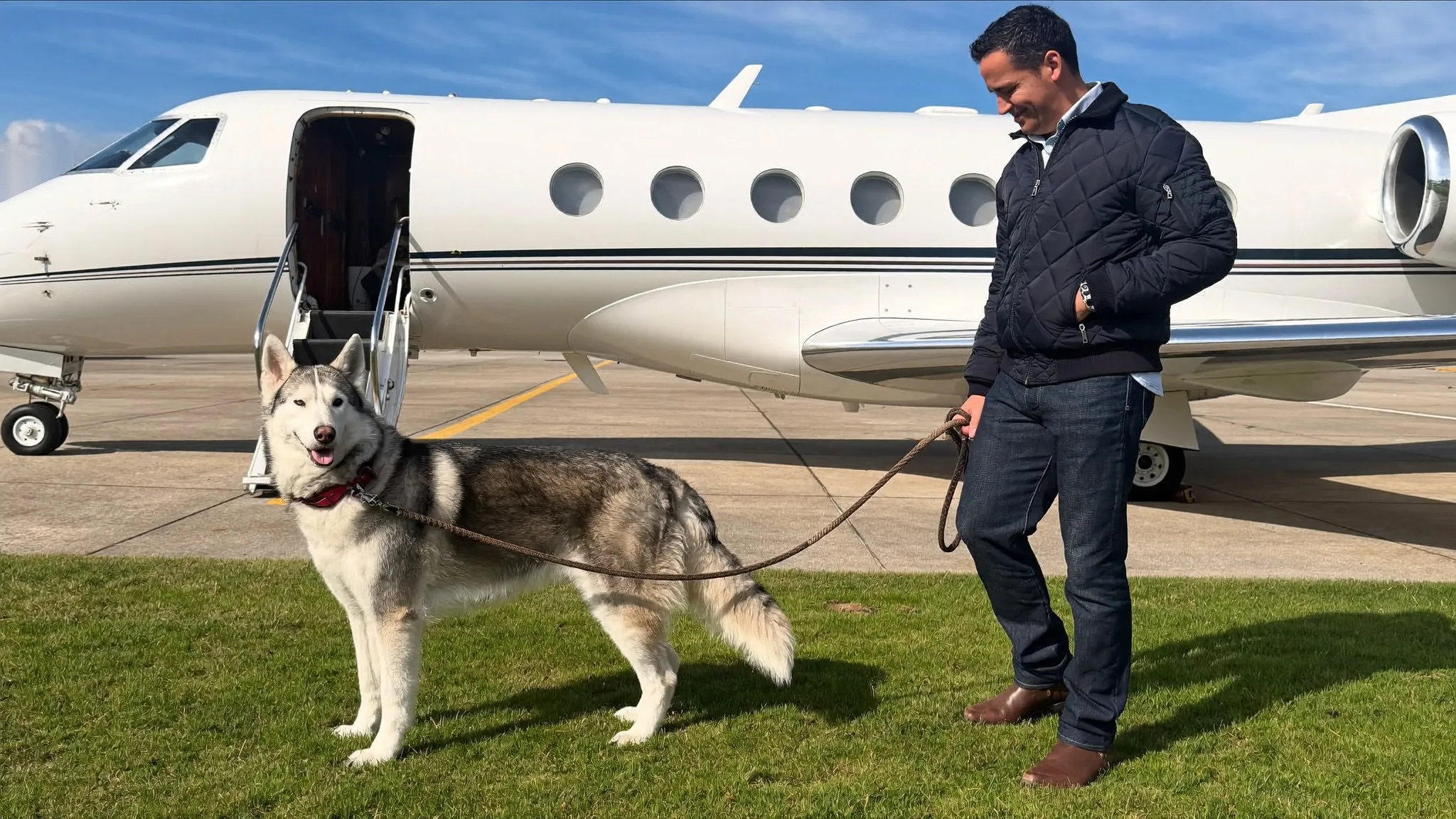
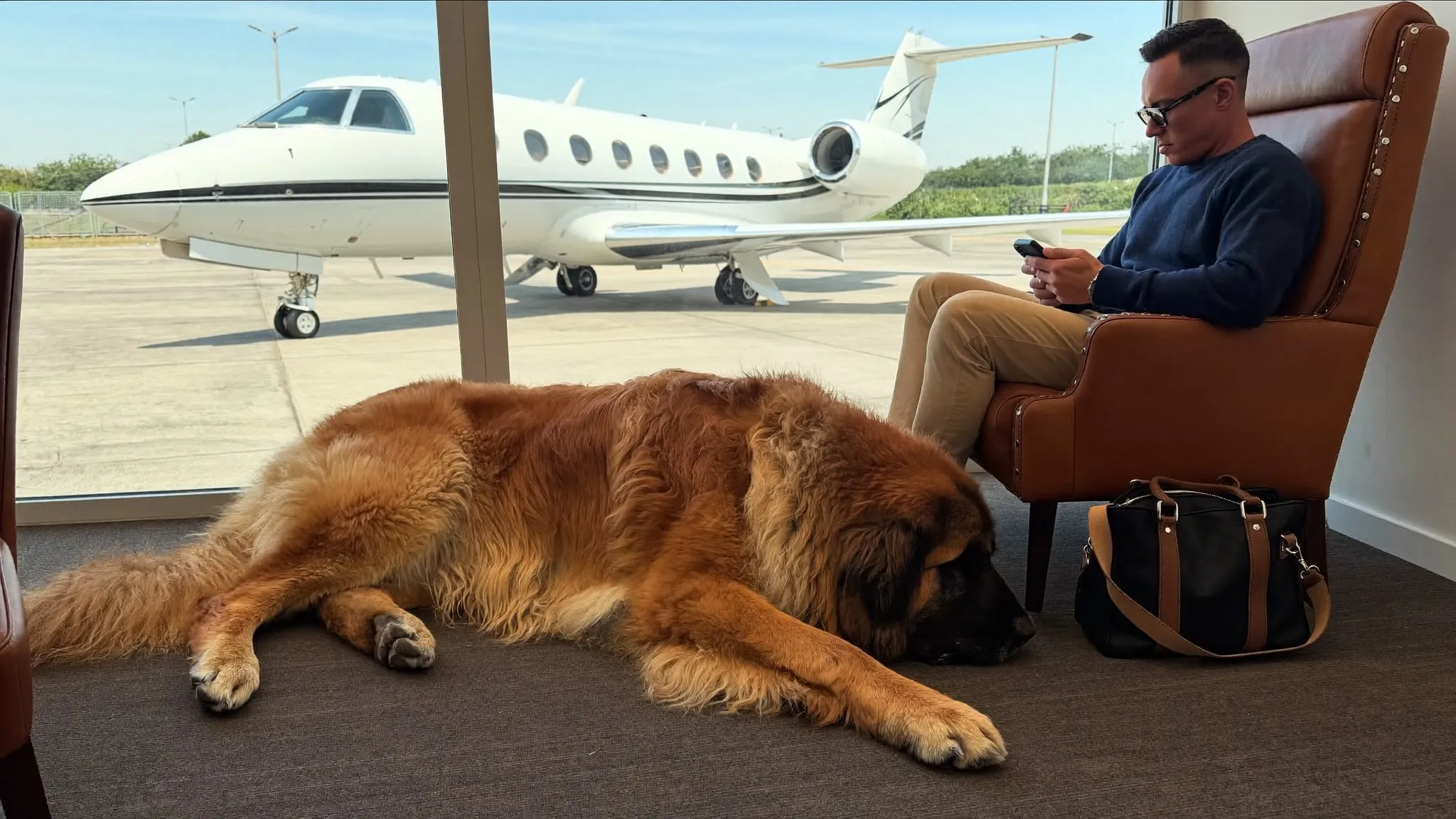
By flying private: the dog stays in the cabin with its owner, never in the hold, and spends the flight at your feet. Loulou Air, an AEROAFFAIRES brand and a private aviation broker since 1991, sells Pay-per-Seat private jets for your dog and you: you pay for your seat, not the jet, and one ticket covers one person and their dog. There is none of the weight limit imposed by scheduled airlines, because your dog does not travel in the hold: capacity depends on the aircraft and the number of animals on board, and a broker approves every dog case by case. Boarding is through a private aviation terminal, with no queues and no separation, and the crew is briefed on welcoming animals. The requirements described here remain due on every flight, private ones included, and our brokers check every file before departure.
Our routes currently serve New York, Dubai and Los Angeles: see the open flights. We open new flights every month, so tell us where you want to go by going to talk to a broker; and for a whole aircraft, our sister company AEROAFFAIRES offers full charter.
Frequently asked questions
Does my dog need a passport to travel to Frankfurt?
Yes. The European Commission makes the EU pet passport compulsory for movements between Union countries, and Germany’s federal agriculture ministry confirms that the animal needs one for a trip inside Europe. It carries the microchip number and proof of rabies vaccination, and any authorised vet can issue it.
Does my dog have to wear a muzzle on public transport in Frankfurt?
It depends on the train. On RMV transport, only dogs that could endanger other passengers have to wear one. On Deutsche Bahn long-distance trains, a muzzle and a lead are compulsory for any dog that is not travelling in a carrier, with guide dogs and marked assistance dogs excepted.
Who sets the rules for my dog on the aircraft?
Your carrier. Veterinary authorities set the dog’s paperwork, not its place on board: cabin weight, carrier dimensions and travel in the hold are each airline’s own call, as Pet in cabin: weight limits, fees and airlines explains. Country requirements are on our travel requirements pages, and our other city guides are in the blog, including Milan and Amsterdam.
Sources
Rules change: check them against these sources before every trip.
- European Commission — Travelling with pets in the EU
- BMLEH — Tipps zur Reiseplanung mit Tieren
- BMLEH — Haus- und Zootiere
- Hundeverbringungs- und -einfuhrbeschränkungsgesetz of 12 April 2001
- Hundeverbringungs- und -einfuhrverordnung of 3 April 2002
- Regierungspräsidium Darmstadt — Hundeverordnung
- Verwaltungsvorschrift zur Durchführung der HundeVO (VVHundeVO), StAnz. 2026 p. 58
- Hessian Landtag — Drucksache 20/11372, minister's answer (10 August 2023)
- RMV — Beförderung von Sachen und Tieren
- Deutsche Bahn — Taking dogs and other pets on the train
- Deutsche Bahn — How can I take my animal with me?
- Frankfurt Airport — FAQ Animals