How old does a puppy have to be to fly?
About 15 weeks in the EU (rabies shot at 12 weeks, then 21 days), six months for the US: a puppy's real minimum age to fly, by the official rules.
By the Loulou Air team · · 7 min read

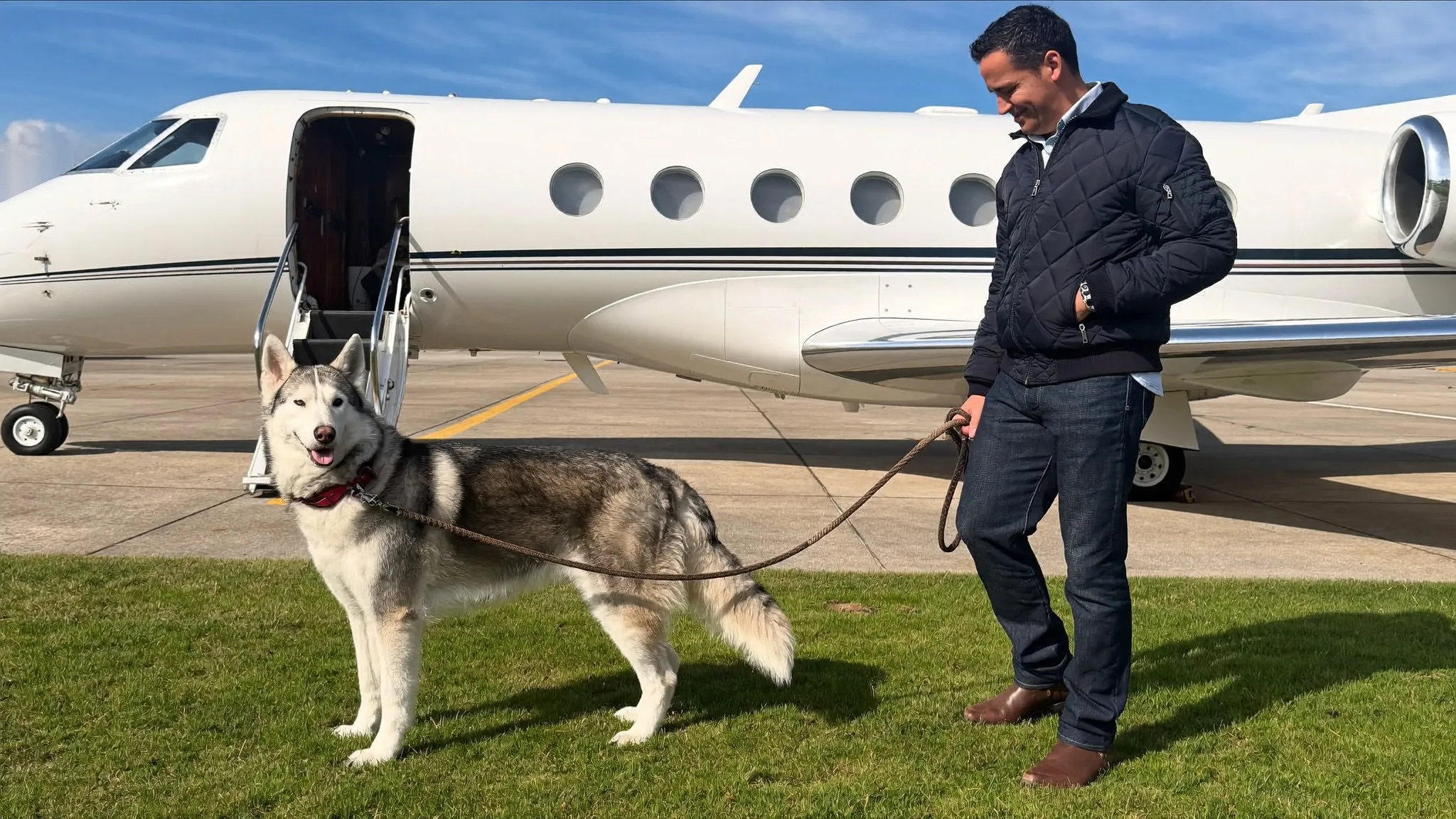
A puppy is ready to fly when its paperwork is valid, not when it is weaned. Inside the European Union that means about 15 weeks in practice, and six months to enter the United States. The airline is not what sets that age first: the health rules of the country you are arriving in are. Here are the official ages and what they mean for your plans. On a private flight your puppy travels in the cabin with you, at your feet, never in the hold, which is what Loulou Air sells on a Pay-per-Seat basis.
How old must a puppy be to fly?
Inside the European Union, plan on 15 weeks for a puppy that is fully in order. The age comes from two health deadlines stacked on top of each other, not from a boarding rule.
The European Commission sets the conditions for pet travel between EU countries, now in Commission Delegated Regulation (EU) 2026/131. For a rabies vaccination to count, the animal had to be at least 12 weeks old on the date the vaccine was given, and the period of validity of the vaccination starts not less than 21 days after the primary vaccination protocol is completed.
The French government’s own public-service portal states it the same way: the rabies vaccine can be given from 12 weeks, or three months, and takes effect at least 21 days later. The same page notes that it has to be boosted every year.
Twelve weeks, then 21 days: a puppy vaccinated at the earliest possible date is in order at 15 weeks, not before. If you have a departure date in mind, work backwards from it with your vet.
One more condition is easy to miss and expensive to get wrong: the date the vaccine is given must not come before the date the microchip was implanted or read. Microchip first, vaccine second. A puppy vaccinated before it was chipped has to be vaccinated again. Our article on the EU pet passport covers the paperwork in full.
Why not before 12 weeks?
Because the vaccine does not protect a younger puppy. The Canadian Food Inspection Agency puts it plainly to anyone buying a puppy: dogs cannot be effectively vaccinated against rabies before 12 weeks of age, and a shot given earlier does not follow proper vaccination guidelines, so the animal is not protected.
The US CDC follows the same logic and adds a useful detail: the first rabies vaccination must be given on or after 12 weeks, that is 84 days, of age, or in line with the manufacturer’s recommendations if the vaccine is licensed for older dogs, for instance 16 weeks. Some products are only licensed from 16 weeks, so the minimum age also depends on the vaccine your vet uses.
The same page is stricter again for a dog that has been in a country at high risk of rabies in the previous six months: vaccines given before 12 weeks of age are not accepted at all, whatever the manufacturer’s licence says.
Can an unvaccinated puppy travel in Europe?
Not into France. The European Commission uses the term “young dogs” for dogs under 12 weeks old that have had no rabies vaccination, or between 12 and 16 weeks old, vaccinated but not yet fully protected, and leaves each country to decide whether to admit them.
The official table is unambiguous. Ten member states accept them for non-commercial movements: Bulgaria, Croatia, Czechia, Estonia, Finland, Lithuania, Luxembourg, Romania, Slovakia and Slovenia, with Switzerland alongside them. France says no, for commercial and non-commercial movements alike. Austria, Belgium, Germany, Italy, the Netherlands, Portugal, Spain and Sweden also refuse.
Where a country does allow it, conditions apply. The puppy must travel either with an owner’s declaration stating that from birth until departure it has had no contact with wild animals of species susceptible to rabies, or with its mother, on whom it still depends and whose passport shows she was vaccinated before the birth. The French public-service portal sets out that arrangement for Czechia.
One limit has no exception at all: young dogs cannot be moved into the EU from a non-EU country or territory for any purpose. A puppy bought outside Europe and too young to be protected will not come home with you. Entry rules from non-EU countries impose the same 12-week age at vaccination, and the animal must be healthy and fit to travel.
Why the United States asks for six months
Because the American rule is about the dog’s age on arrival, not about its vaccine. The CDC, the federal health authority, says it in one line: dogs must be at least 6 months old at time of entry or return to the U.S. No vaccination record, however thorough, makes up for a five-month-old puppy.
Two further conditions carry the same weight: the dog must appear healthy upon arrival and carry a microchip that a universal scanner can read. On top of that comes the receipt for the CDC Dog Import Form, which we explain in our article on the CDC Dog Import Form and on our United States travel requirements page.
Airlines pass the rule on, because they are the ones who deny boarding. La Compagnie, which flies Paris to New York, lists the CDC rules in force since 1 August 2024 in its special services, with a minimum age of six months.
Canada takes yet another approach: its official import tool sorts pet dogs into three age brackets, under 3 months, 3 to 8 months, and 8 months and over, each with its own requirements. Our article on taking your dog to Canada sets out that framework.
What minimum age does the airline add?
One of its own, on top of the arrival country’s. It never replaces it: whichever of the two is stricter is the one that applies.
TAP Air Portugal publishes both thresholds. In the cabin, its mandatory conditions require that pets be at least 10 weeks old. In the hold, each carrier may hold an animal with a minimum age of 12 weeks, or 10 weeks for the Azores, Madeira and Spain. The airline even sets out lighter paperwork for animals aged 10 to 12 weeks travelling to Portugal or Spain, or travelling in the cabin.
Take the principle rather than one airline’s figures: check the minimum age on your own airline’s official page, then compare it with the age the arrival country demands. A 10-week-old puppy an airline is happy to carry is still turned away at the French border, which does not admit young dogs that are not yet protected.
What to prepare before a puppy’s first flight
The paperwork first, in the order the rules impose. For travel inside the European Union, the French public-service portal lists three conditions that all have to be met: microchip identification, an EU pet passport issued by a vet, and a valid rabies vaccination. The same page caps the number of animals that may travel with you on a non-commercial trip at five.
Arriving from a non-EU country, the official animal health certificate is valid for 10 days from the date it is issued until the documentary checks at the point of entry, so the vet appointment belongs as close to departure as possible.
On health and behaviour, ask your vet rather than a forum: only your vet knows your puppy, its condition and its vaccine. What the journey itself is like is covered in our articles on keeping your dog calm on a flight and on water, food and toilet breaks in the air. Our travel requirements by destination summarise the documents country by country.
What if your puppy flew in the cabin, at your feet?
It can, on a shared private flight, once its file is in order. Loulou Air, a brand of AEROAFFAIRES, a private aviation broker since 1991, sells individual seats on private jets: that is the Pay-per-Seat principle, you pay for your seat, not the jet, and every ticket covers one seat for a human and their dog. Your dog stays in the cabin with you for the whole flight, never in the hold, with none of the weight limit imposed by scheduled airlines. Boarding is through a private aviation terminal, with no queues, and the crew is briefed on welcoming animals: water, bowls and blankets are provided.
Age is the one thing that is not negotiable. Travel requirements apply to every flight, private ones included, and our brokers check every dog’s file before departure.
See our open flights or talk to a broker, who will check your puppy’s file with you. We open new routes every month: tell us where you want to go. For a whole aircraft, our sister company AEROAFFAIRES arranges full charters.
Frequently asked questions
Can a three-month-old puppy travel within the European Union?
Rarely, because three months is the minimum age for the vaccination, not for the journey. The vaccine only becomes valid 21 days after the primary course, so a puppy vaccinated on the day it turns 12 weeks is in order at 15 weeks. France does not admit puppies that are not yet protected.
What is the minimum age to take a puppy to the United States?
Six months on arrival. The CDC requires every dog to be at least six months old when it enters or returns to the United States, along with a readable microchip and the receipt for its import form. The rule applies to private flights exactly as it does to scheduled ones.
Does the puppy have to be microchipped before being vaccinated?
Yes, and the order matters. The date of the vaccination must not come before the date the microchip was implanted or read, so a puppy vaccinated before it was identified has to be vaccinated again, which pushes the trip back by several weeks.
Sources
Rules change: check them against these sources before every trip.
- European Commission — Travelling with a pet within the EU
- European Commission — Young Animals
- European Commission — Bringing a pet into the EU from a non-EU country
- Service-Public (France) — Travelling abroad with a pet
- CDC — Dogs arriving from rabies-free or low-risk countries
- CDC — Frequently asked questions about dog importation
- Canadian Food Inspection Agency — Importing dogs
- Canadian Food Inspection Agency — Bringing animals to Canada
- TAP Air Portugal — Pets
- La Compagnie — Special services