How do dogs go to the bathroom on a plane?
On a scheduled flight, a dog relieves itself in its carrier, on absorbent bedding. What IATA, US rules and vets say on toilet breaks, water and food.
By the Loulou Air team · · 8 min read
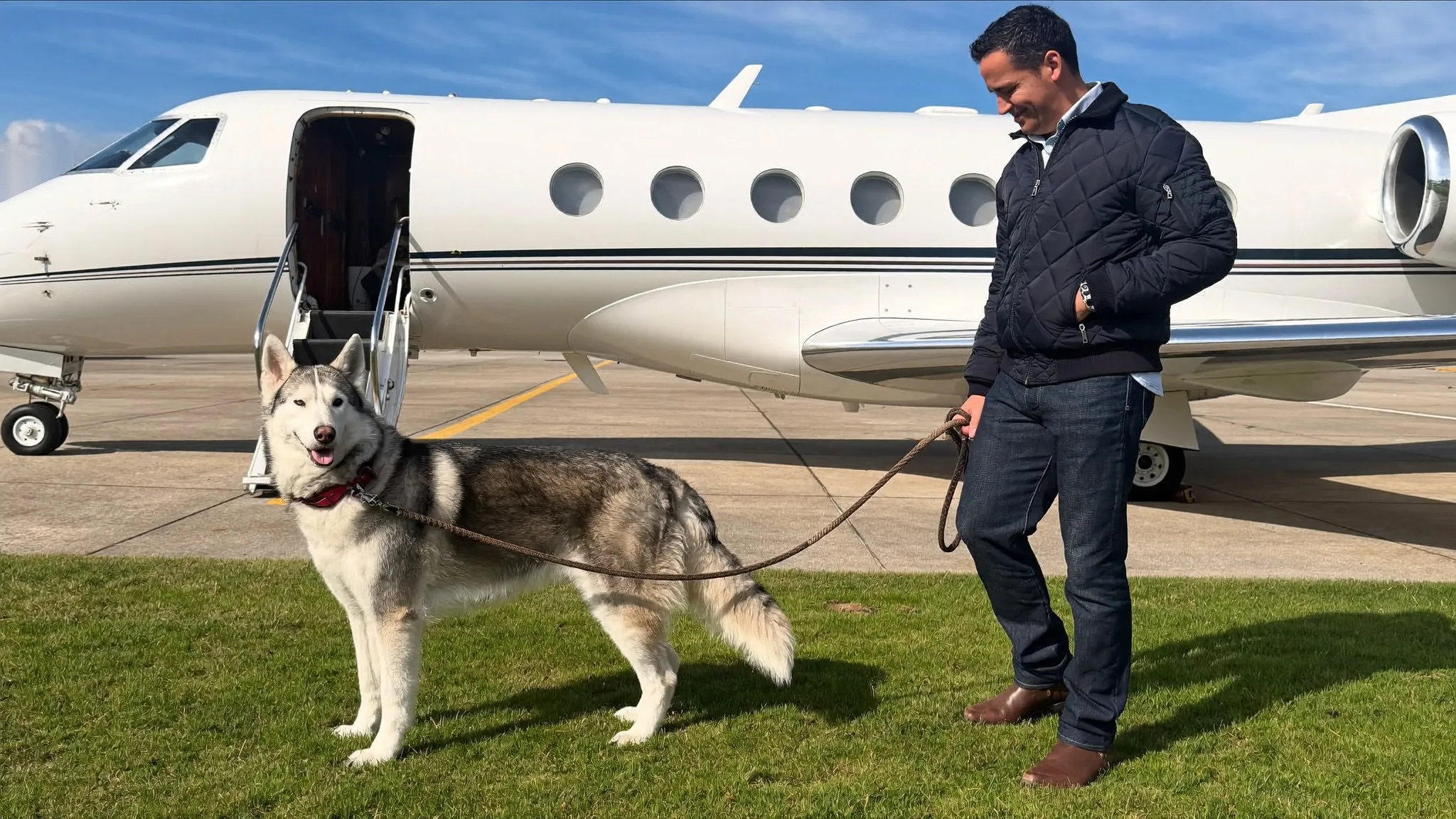
A dog on a plane picks neither the moment it drinks nor the moment it relieves itself: everything is decided before boarding, and inside its travel container. Air transport bodies and veterinary centres agree on the essentials: a light meal well before departure, water until the last moment, and absorbent bedding that can hold an accident. Here is what the official sources actually say, and what changes on a Pay-per-Seat private flight with Loulou Air, where water, bowls and blankets are provided on board.
Can a dog relieve itself during a flight?
No. It has nowhere to go but its container. Alaska Airlines answers the question plainly in its pet travel FAQ: there are no options for your pet other than the carrier, and the airline suggests packing spare bedding, puddle pads, wet wipes and a plastic bag to seal soiled bedding in.
IATA starts from the same constraint in its 15 July 2026 guidance for passengers flying with a dog in the cabin: the travelling container must be able to contain any faeces or urine produced by the animal. It adds that the container must be clean and leak-proof, and that absorbent bedding must be provided.
Two rules rule out improvising on board. IATA states that dogs must not be removed from their travel containers during the flight and that the container should not be opened. Alaska Airlines applies that to the letter in the cabin: the pet must stay in its carrier, head and tail included, with the door secured, in the boarding area, in walkways, in lounges and on board the aircraft.
On a long-haul flight, then, a dog either goes in its container or holds on. Several layers of absorbent bedding keep it from lying in its own urine, the same FAQ notes.
When and where should you walk your dog before boarding?
As late as possible, right before it goes into its container. Alaska Airlines advises taking your pet for a pre-flight potty trip at an airport animal relief area, and leaving enough time for that trip before closing the carrier. The airline also recommends giving the dog a pre-flight workout.
In the United States these areas are covered by regulation. The federal rule on the accessibility of airport facilities requires airlines, in cooperation with the airport operator and in consultation with local service animal training organisations, to provide animal relief areas for the service animals of passengers departing, connecting or arriving. Alaska Airlines publishes its own list of pet relief areas at the airports it serves, with their location, their surface and whether they sit before or after security. Check that last point for your departure airport: an area before security means planning the walk earlier.
How long before a flight should you feed a dog?
A light meal at least two hours before the flight, and no more than that. That is IATA’s recommendation, which adds a short drink and exercise immediately before the dog goes into its container.
Alaska Airlines lands on the same margin in its FAQ: a small meal a few hours before the flight is appropriate, and may even be required by the airline, especially on a long flight or when the animal travels in the hold. The same page advises against large meals, unfamiliar food, treats and human food before travel, to avoid stomach upsets, vomiting and diarrhoea. The airline’s general advice is to avoid overwatering and overfeeding.
Cornell’s Riney Canine Health Center is more cautious still and advises not feeding the animal in the four to six hours before travel, to reduce the risk of nausea. The PDSA, the British veterinary charity, advises for car journeys not to feed a pet prone to travel sickness right before setting off, and to leave it time to digest.
The sources differ on the margin, not on the principle: no full bowl at boarding time.
Can you give your dog water during the flight?
In the cabin, yes, but it depends on the airline. Alaska Airlines writes that pets travelling in the cabin can be given water by their owners, while noting that each airline has its own protocols for water and food, based on things such as the length of the trip and the temperature. IATA, for its part, asks that the container not be opened during the flight, so ask your airline what it allows, and when.
Before take-off the rule is clear: IATA writes that you can and should keep giving your dog water right up to the time of travel.
In the hold, water comes down to equipment. Alaska Airlines requires a food dish and an empty water dish attached inside the kennel, and its FAQ specifies that the water dish must attach to the kennel door and be fillable without opening the carrier.
For the journey to the airport, the French Ministry of Agriculture recommends offering fresh water regularly and letting the animal stretch its legs, and never leaving it shut in a vehicle or an untempered space, even briefly. The PDSA suggests a non-spill water bowl so the animal has access to water for the whole trip.
What do the rules say for a dog in the hold?
In the United States, they set out food and water precisely. Federal regulations bar a carrier from accepting a dog without written certification from the consignor that the animal was offered food and water in the four hours before delivery. That certification is attached to the outside of the kennel, must state when the animal was last fed and watered along with instructions for the next 24 hours, and the text is explicit that instructions for no food or water are not acceptable unless directed by the attending veterinarian.
The same rules set the intervals: a dog aged 16 weeks or more must be offered food at least once every 24 hours, a puppy under 16 weeks at least once every 12 hours, and every dog potable water at least once every 12 hours. For carriers, those periods run from the date and time written on the certificate.
At the counter, this is what it looks like at Alaska Airlines: food and water offered no more than four hours before check-in, a record to sign to certify it, and enough food and water for the whole journey. Owners may attach food to the top of the kennel, but staff only feed the animal if it is in their care for more than 24 hours, and only provide water beyond 12 hours. The other risks of the hold are covered in our article Dogs in the cargo hold.
What if your dog is sick or has an accident?
You plan for it with equipment, not with medication. Alaska Airlines advises a towel, a blanket or a puddle pad in the kennel, and spare bedding carried with you.
On motion sickness, the same FAQ is reassuring: a pet that is not prone to car sickness will most likely be fine in flight, though turbulence can be stressful because it is unfamiliar. The PDSA notes that some animals are sick even on an empty stomach, and points owners to their vet: no treatment is decided alone. The rest of the preparation is in our article Dog stress on a flight.
Cornell finally advises packing a portable water bowl and enough food for the trip, with extra, and sticking to the dog’s usual feeding and walking schedule.
What if your dog could drink at your feet all flight?
That is what a private flight changes: your dog travels in the cabin with you, never in the hold, and stays at your feet for the whole journey. Loulou Air, a brand of AEROAFFAIRES, a private aviation broker since 1991, offers Pay-per-Seat travel on shared private jet flights: you pay for your seat, not the jet, and each ticket covers one human and their dog. On board, the crew is briefed on welcoming animals, and water, bowls and blankets are provided. There is none of the weight limit imposed by scheduled airlines, because your dog does not travel in the hold: capacity depends on the aircraft and on the number of animals on board, and a broker validates every dog case by case. Entry requirements still apply on every flight, private ones included, and our brokers check every dog’s file before departure.
See our open flights or speak to a broker, who will go through your dog’s file with you. We open new routes every month, so tell us where you want to go. For a whole aircraft, our sister company AEROAFFAIRES arranges full charters, and the rules by country are set out on our travel requirements pages.
Frequently asked questions
Can my dog come out of its carrier to relieve itself in flight?
No. IATA states that dogs must not be removed from their travel containers during the flight and that the container should not be opened, and Alaska Airlines requires the pet to stay in its secured carrier on board. Its FAQ puts it plainly: there are no options other than the carrier, which is why absorbent bedding matters.
Can you feed a dog on board a scheduled flight?
IATA puts the meal before the flight: a light meal at least two hours before departure, with a short drink and exercise immediately before the dog goes into its container. Alaska Airlines advises against large meals and treats before travel, to avoid vomiting and diarrhoea. What is allowed at your seat depends on your airline, so ask them.
Should you put a water bowl in the kennel?
In the hold, yes: Alaska Airlines requires a food dish and an empty water dish attached inside the kennel, with the water dish fillable without opening the door. In the cabin, the airline says owners may give their pet water, but IATA asks that the container not be opened in flight, so check your airline’s rule before you travel.
Sources
Rules change: check them against these sources before every trip.
- IATA — Guidance for Passengers Traveling with their Dog or Cat in the Cabin, edition 1, 15 July 2026
- IATA — Traveling with Pets
- 9 CFR 3.14 — Consignments to carriers and intermediate handlers (govinfo, 2025 edition)
- 9 CFR 3.17 — Food and water requirements (govinfo, 2025 edition)
- 14 CFR 382.51 — Accessibility of airport facilities, US Department of Transportation (govinfo, 2024 edition)
- Alaska Airlines — Pet travel
- Alaska Airlines — Pet relief areas at airports
- Alaska Airlines — Pets in cabin
- Alaska Airlines — Pets in baggage compartment
- Alaska Airlines — Traveling with pets, frequently asked questions
- Cornell University College of Veterinary Medicine, Riney Canine Health Center — Traveling safely with your dog
- PDSA — Safe car travel for pets
- French Ministry of Agriculture — Travelling with your pet