Dogs in the cargo hold: the real risks
The hold is pressurised and usually heated, but heat on the ground, handling and flat faces are the real risks. What airlines and regulators say.
By the Loulou Air team · · updated · 8 min read
Putting a dog in the cargo hold worries most owners, and that worry is not unfounded: airlines publish restrictions that show exactly where the danger lies. The animal hold is pressurised and ventilated, but it is not always heated, and the riskiest part of the trip happens on the ground. Here is what the official texts and the airlines actually say, and what you can control. There is also a way to avoid the hold without the weight limits of scheduled airlines: a shared private flight, where your dog travels in the cabin with you.
What is the animal hold, exactly?
It is a compartment separate from ordinary baggage, pressurised in flight and ventilated. IATA, the airline industry body, says pets travel “as special baggage in a heated and ventilated hold”, and that cats and dogs often do better there than in the cabin because it is quieter and darker. US animal welfare rules go further: during air transport, animals must be held in cargo areas heated or cooled as necessary, and those areas must be pressurised whenever the aircraft is not on the ground, unless it is flying below 8,000 ft.
The catch is that holds are not equal. Air Canada says your pet travels “in the pressurized cargo compartment of most of our aircraft”, while also noting that temperature-controlled and ventilated compartments are available only on certain aircraft. It advises against carrying animals as checked baggage on its Airbus A319-100, A320-200 and A321-200: the cargo compartment is not heated and temperatures can drop to 2 °C. TAP Air Portugal puts the typical temperature range of its hold at 10 °C to 19 °C.
What are the real risks for a dog in the hold?
The best documented risks are not those of the flight itself but of the hours around it, and the US rules show where they sit.
Ground temperature. In an airport animal holding area, the ambient temperature must not fall below 45 °F (7.2 °C) or rise above 85 °F (29.5 °C) for more than four consecutive hours. While the dog is moved between the terminal and the aircraft, it must not be exposed to more than 85 °F, or to less than 45 °F, for more than 45 minutes without an acclimation certificate.
Handling. The same text bans placing a crate with a live dog on unattended or elevated conveyor belts, and bans tossing, dropping or needlessly tilting it.
Monitoring in flight. If the cargo area is accessible during the flight, the carrier must check on the animals at least every four hours; if it is not, only at loading and unloading. On a long-haul flight, nobody sees your dog between take-off and landing.
Incidents happen and are counted. In the United States, carriers operating at least one aircraft with more than 60 seats must report to the Department of Transportation any loss, injury or death of an animal during air transport, then publish yearly totals by category alongside the number of animals carried. The same rule states that animals travelling at a passenger’s seat in the cabin are not covered: a dog in the cabin is not in the airline’s custody.
Why are flat-faced dogs most at risk?
Because they regulate heat poorly and breathe less well, and airlines say so plainly. TAP Air Portugal refuses brachycephalic dogs in the hold, meaning those whose short, flat snouts cause breathing limitations, and states that this carries a risk of death within the hold’s usual temperature range. Air Canada also refuses them, citing increased risks of heat stroke and breathing problems when exposed to extreme heat or stressful situations.
TAP’s list goes well beyond the obvious breeds: alongside bulldogs, boxers and pugs it includes the Cavalier King Charles Spaniel, the Chihuahua, the Chow Chow, the Pekingese, the Shih Tzu and mastiffs. An exception applies if a veterinary certificate confirms the dog has had surgery to improve its condition, or does not show the characteristics of its breed. IATA, for its part, advises against carrying snub-nosed dogs in the hot season and requires a container 10 % larger for them.
Why the hold closes by season
Because the airline controls neither the weather on the ground nor which aircraft is assigned to the flight. Air Canada explains that, since not all its aircraft have temperature-controlled and ventilated baggage compartments, it may not be able to carry a pet when summer temperatures exceed 29.5 °C.
That produces a calendar of bans by destination: no pets in the hold to the United Arab Emirates (Dubai) all year, to India from 1 March to 31 October, to Greece and Italy from 1 July to 31 August, and to fifteen hot US airports including Miami, Phoenix and Orlando from 1 May to 30 November. Cold closes the hold differently: from 1 November to 31 March, and whenever the temperature is 0 °C or below, the airline accepts no dog under 4.5 kg in the hold of any of its aircraft. These dates are Air Canada’s own, but the principle holds everywhere: the season and the aircraft decide as much as the owner does.
The crate: what airlines check hardest
It is the most common reason for refusal at check-in, and the easiest to avoid. IATA sets the principle: the container must let the animal turn about normally while standing, stand and sit erect, and lie in a natural position. Corsair spells out the practice: a rigid, air-transport-approved crate without wheels, with a centralised locking system closing at the top and bottom of the door, hinges extending at least 1.6 cm, and a shell bolted together, clips and side fastenings being banned. Metal crates are refused, as is any crate with cracks, missing parts or visible damage. TAP adds ventilation on at least three sides and an absorbent floor lining; no muzzle or leash may be left inside.
US rules add a detail people forget: the crate must be marked “Live Animals” in letters at least one inch high with arrows showing which way is up, and must have a leak-proof bottom with absorbent litter. For breeds classed as dangerous or strong, requirements rise again: TAP requires a wooden or metal container, Air Canada a reinforced one made of welded mesh, metal, wood or a synthetic material other than plastic.
Should you sedate your dog?
No, not on your own initiative: every source consulted agrees on this. IATA continues to endorse recommendations not to sedate or tranquilise animals in transit in order to prevent panic attacks or destructive behaviour. It explains that a sedated animal can lose its righting ability and its sense of balance, and become exposed to injury or airway obstruction through an abnormal posture.
TAP says it does not endorse tranquillisers or sedatives, which can cause a drop in blood pressure and be fatal. Corsair advises giving no medication or tranquilliser without veterinary advice. If sedation is still considered for valid medical reasons, IATA says it must be done under a vet’s direction, with the drug, time and dose noted on the health certificate. The decision belongs to your vet, who should hear about the flight weeks in advance.
How to cut the risk
By acting on what you control: the aircraft, the timing, the crate and the preparation.
- Get the dog used to the crate. IATA suggests buying it weeks or months before departure and letting the animal get used to being in it.
- Pick the flight and the hour. Air Canada recommends travelling early morning or late evening in hot weather, and choosing a non-stop flight to limit time in the hold. Seasonal and aircraft restrictions are published: read them before buying the ticket.
- Book early. Corsair asks to be told at least 72 hours before departure, TAP at least 24 hours.
- Manage meals. IATA advises cutting food the day before while still giving water, and walking the dog before check-in; Corsair suggests feeding 4 to 6 hours before departure. US rules then require water at least every 12 hours and food at least every 24 hours for a dog of 16 weeks or older.
- Label and reassure. IATA recommends two IDs on the collar, one permanent and one with your contact details at destination. Corsair suggests putting a piece of your clothing in the crate.
- Call it off if the dog is not fit. A dog that is obviously ill, injured or in distress must not be transported, except to receive care.
The last option is to avoid the hold altogether: that is the subject of the next section.
How can a large dog avoid the hold?
By flying on an aircraft where it stays in the cabin with you. On scheduled flights the cabin is for small dogs in a carrier under the seat; above the limit, most airlines send the dog to the hold or ship it as cargo, or refuse it, as set out in our article Pet in cabin: weight limits, fees and airlines.
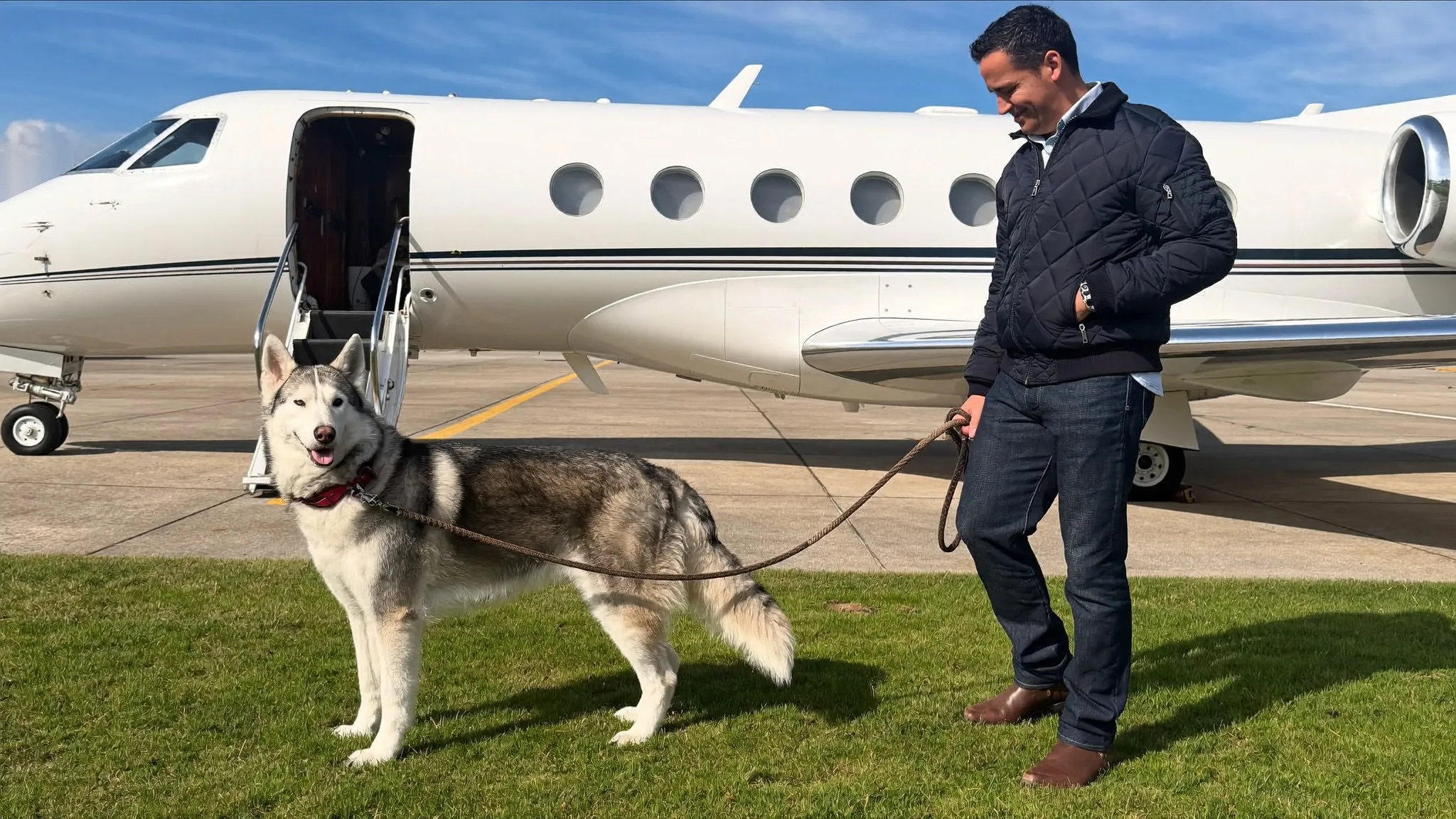
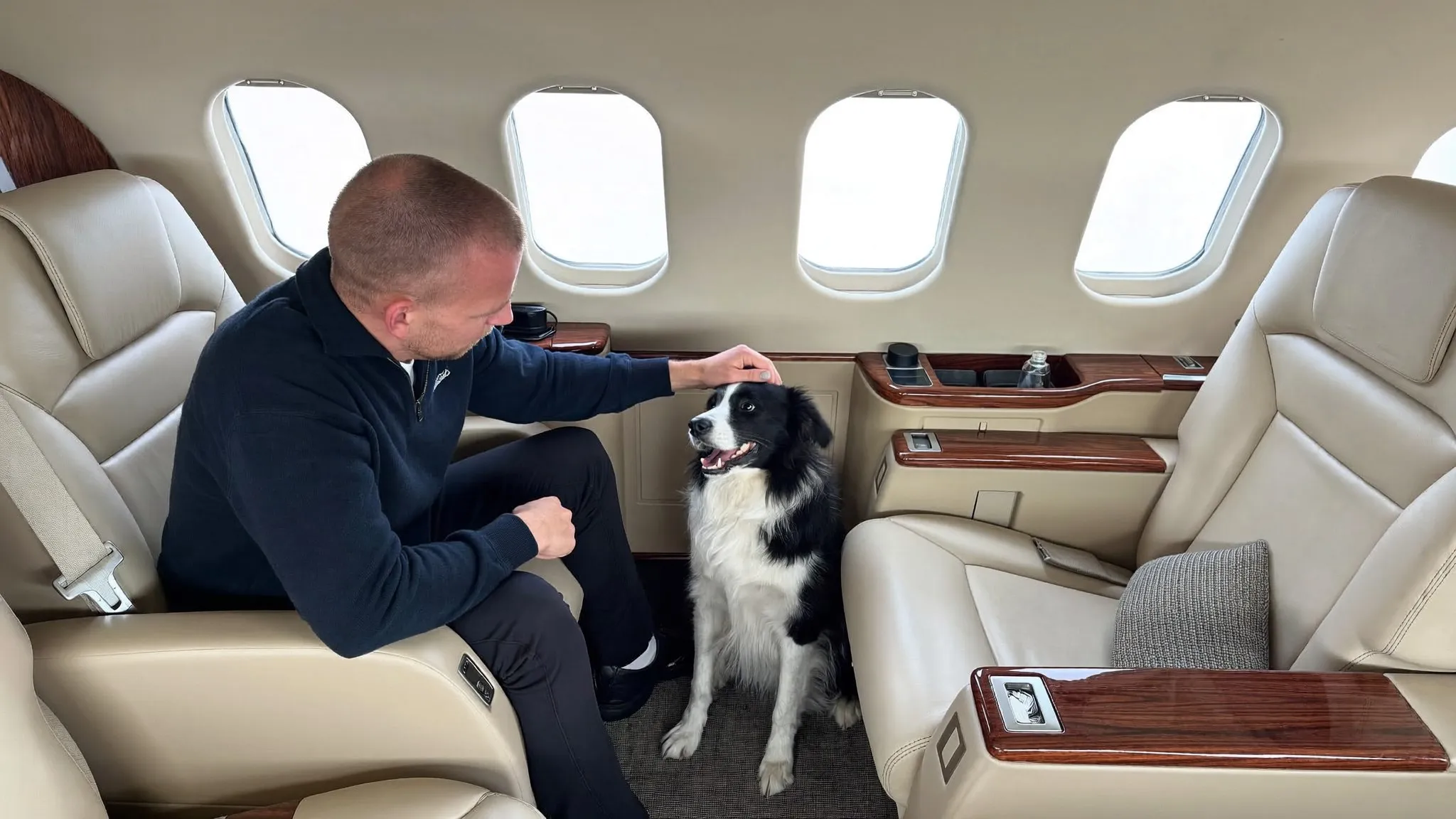
Private aircraft have no animal hold. That is the principle behind Loulou Air, a brand of AEROAFFAIRES, a private aviation broker since 1991: Pay-per-Seat private jets for your dog and you. On our shared flights you pay for your seat, not the jet, and your dog travels in the cabin, at your feet, for the whole flight. There is none of the weight limit imposed by scheduled airlines: capacity depends on the aircraft and the number of animals on board, and a broker confirms each dog case by case. Boarding goes through a private aviation terminal with no queues, and the crew is briefed on welcoming animals.
See our open flights or talk to a broker, who will go through your dog’s file with you. How it all works is explained in Flying private with your dog, and the entry rules, which apply either way, on our travel requirements by destination pages.
Frequently asked questions
Is the cargo hold heated and pressurised?
It is pressurised in flight: US rules require it whenever the aircraft is not on the ground, except below 8,000 ft. Heating depends on the aircraft: Air Canada states that temperature-controlled and ventilated compartments exist only on some of its fleet, and that on its A319, A320 and A321 the hold is not heated, with temperatures as low as 2 °C.
Which dog breeds are banned from the hold?
It depends on the airline, but flat-faced dogs are refused by both TAP Air Portugal and Air Canada, on lists running from bulldogs to Shih Tzus by way of boxers, pugs and Chihuahuas. Breeds classed as dangerous or strong are not banned everywhere, but do require a reinforced crate.
How long before the flight should you drop the dog off?
In the United States a carrier may not accept a dog more than four hours before scheduled departure, extendable by two hours by agreement. IATA advises checking in early when the animal travels in the hold, so it can be taken somewhere quiet and dimly lit, and reconfirming the booking at least 48 hours before departure.
Sources
Rules change: check them against these sources before every trip.
- IATA — Traveler's Pet Corner
- 9 CFR 3.16 — Primary conveyances (motor vehicle, rail, air, and marine)
- 9 CFR 3.19 — Terminal facilities
- 9 CFR 3.20 — Handling
- 9 CFR 3.14 — Consignments to carriers and intermediate handlers
- 9 CFR 3.15 — Primary enclosures used to transport live dogs and cats
- 9 CFR 3.17 — Food and water requirements
- 9 CFR 3.18 — Care in transit
- 14 CFR 235.3 — Reports by air carriers on incidents involving animals during air transport
- TAP Air Portugal — Traveling with pets
- Corsair — Travelling with a pet
- Air Canada — Travelling with your pet