Restricted dog breeds and air travel
France's two dangerous-dog categories, the airlines that refuse these dogs, the reinforced crate required in the hold and the UK entry rule.
By the Loulou Air team · · 8 min read
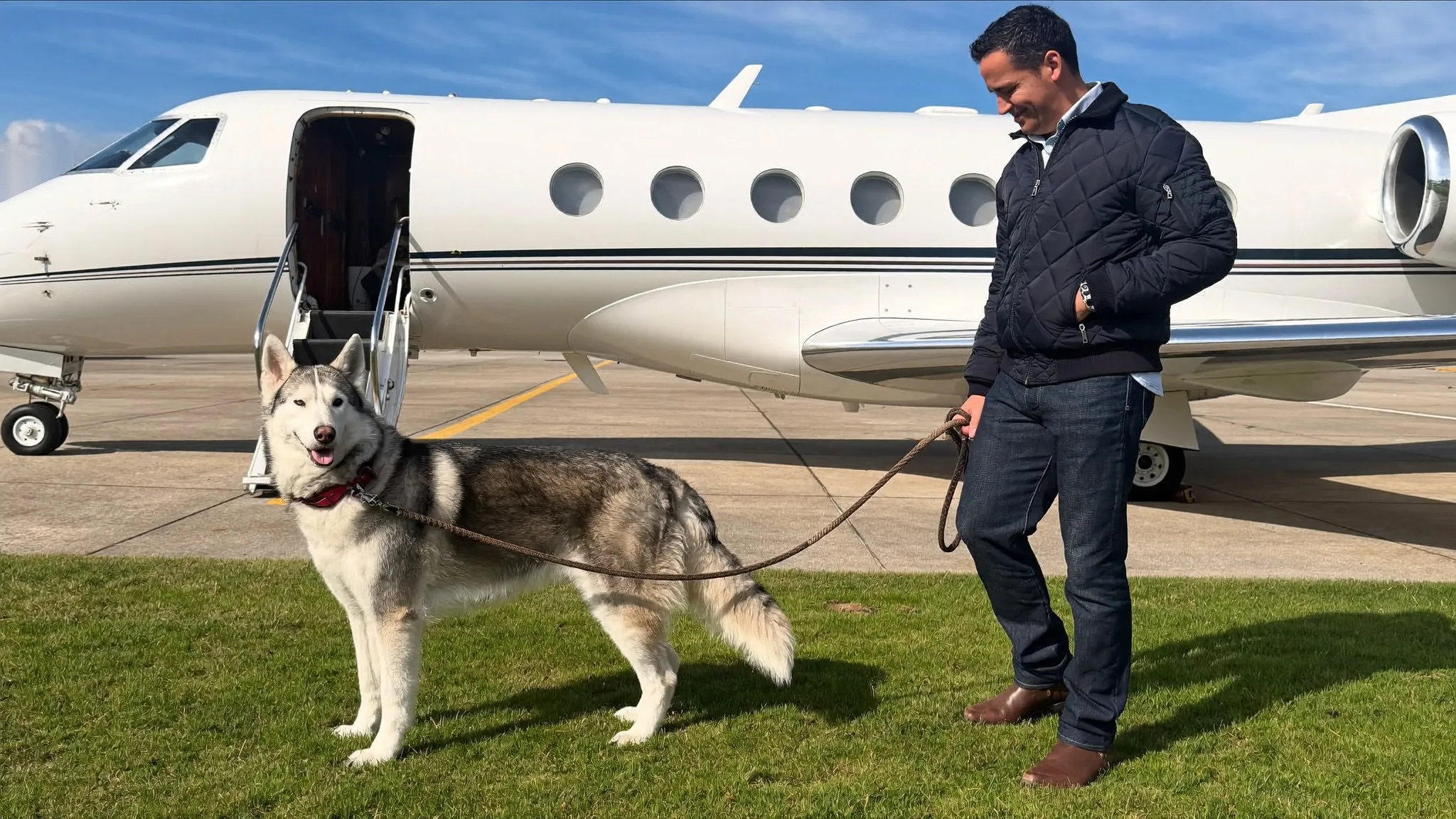
A dog listed in one of France’s two dangerous-dog categories can fly, but the answer depends on the airline and on the country you are landing in, not on a single rule. French law governs how the dog is kept and walked: a detention permit, a leash, a muzzle, and places where category 1 dogs may not go. In the air, each airline’s own conditions of carriage decide, and several of them refuse these dogs outright. For a large dog the scheduled cabin will not take, there is another route: a Pay-per-Seat private jet, where the dog stays at your feet and a broker reviews each file case by case.
Which dogs count as category 1 or category 2 in France?
The two categories turn on the dog’s racial type and on whether it has a pedigree. service-public.gouv.fr, the French government’s official information service, describes them as follows.
- Category 1, attack dogs: crossbreeds that resemble the American Staffordshire terrier (the dogs commonly called pit bulls), the Mastiff (boerbulls) or the Tosa, and that have no pedigree.
- Category 2, guard and defence dogs: the American Staffordshire terrier, the Rottweiler and the Tosa entered in a recognised stud book, plus pedigree-less crossbreeds resembling the Rottweiler.
Two details matter when you plan a trip. The same dog falls into one category or the other depending on whether it has a pedigree, and the call is not yours to make: only a veterinarian is competent to determine an animal’s racial type. The same page also notes that a dog in neither category can still be dangerous.
What paperwork do you need before you fly?
The dog’s full administrative file, which an airline may ask to see at check-in. service-public.gouv.fr lists these obligations.
- A detention permit, issued free of charge by the mayor of your commune of residence. A provisional permit is issued for a dog under 8 months old and runs until the dog is 12 months old.
- Microchip identification, registered with Icad, the French national database.
- An up-to-date rabies vaccination, which is also the basis of any trip abroad, as our article on the EU pet passport explains.
- Third-party liability insurance, under which your own family members count as third parties.
- A certificate of aptitude, earned on a one-day course at your expense. It attaches to you rather than to the dog: a new owner has to obtain their own.
- A behavioural assessment by an approved veterinarian: the page sets it between 8 months and 1 year of age for a category 2 dog, and it is also required if the dog bites someone.
- Neutering, required for category 1 dogs only.
The penalties are heavy: keeping a category 1 or category 2 dog without a permit carries up to 6 months’ imprisonment and a 7,500 euro fine, and an unneutered category 1 dog a 15,000 euro fine. Failure to identify the dog is punished by a 750 euro fine, lack of insurance by up to 450 euros.
Leash, muzzle and places off limits: what does the law say?
The rules differ sharply between the two categories.
A category 1 dog has no access to public transport, to public places other than the public highway, or to premises open to the public. On the public highway and in the common areas of an apartment building, it must be leashed and muzzled.
A category 2 dog keeps that access, but on condition: you must keep it on a leash and fit a muzzle on the public highway, in common areas, in public places, in premises open to the public and on public transport.
One point is easy to miss if the dog travels in the hold: the muzzle and leash that are compulsory on the ground are forbidden in the crate. TAP Air Portugal writes that pets “must not wear any muzzle or leash, nor should these items be left inside the carrier”. Plan where you will put them at check-in.
Which airlines refuse category dogs?
Several airlines publish breed restrictions, and the most explicit for a flight out of France is Corsair.
Corsair. Category 1 dogs without French stud-book papers (non-LOF American Staffordshire terriers of the pit bull type, non-LOF Tosas, Mastiffs and Boerbulls) are “strictly forbidden on all Corsair flights (cabin, hold, cargo)”. Category 2 dogs are accepted on conditions: proof of breed, third-party liability insurance, a valid detention permit, and an adult owner travelling with the dog. In the cabin, Corsair also applies its usual ceiling, a total weight of under 8 kg including the carrier. Ten further breeds, among them the bullmastiff, cane corso, Great Dane, dogo argentino, dogue de Bordeaux and presa canario, require an adult escort and proof of breed issued by the Société centrale canine, to be shown at check-in.
TAP Air Portugal. The airline bars the American Staffordshire terrier, the Staffordshire bull terrier, the American Bully and mastiffs, cane corso included, from the hold. It also classes the fila brasileiro, dogo argentino, pit bull terrier, Rottweiler and Tosa Inu as potentially dangerous breeds, which need a special crate in the hold.
Air Canada. Breeds classed as strong must travel in the hold in a special reinforced container or crate. The airline adds that it reserves the right to refuse any animal that shows aggressive behaviour or destroys its cage.
Vueling. The airline publishes no breed list, but it never carries animals in the hold, and it refuses animals whose characteristics, violent behaviour among them, may disturb other passengers or pose a danger.
Delta. The airline’s pet travel page sets out no breed restriction: its cabin conditions turn on age, health, size and the kennel.
For cabin weight ceilings and carrier dimensions airline by airline, the detail is in our article Flying with a dog over 8 kg.
What crate does a category dog need in the hold?
A sturdier one than the standard model, because airlines treat these dogs as a particular risk.
For an animal aged 6 months or more belonging to a potentially dangerous breed, TAP requires a special wooden or metal box, the container known as CR82. The requirement does not apply to assistance dogs. Air Canada asks for a reinforced container built from weld or wire mesh, metal, wood or a synthetic material other than plastic.
On top of that come the general rules of IATA, the International Air Transport Association: the crate must give the animal enough space to turn about normally while standing, and animals over 14 kg must be crated individually. The risks of the hold are set out in our article Dogs in the cargo hold: the real risks.
Which countries refuse these dogs on arrival?
The destination country can bar a dog your airline would have carried. The United Kingdom is the best-known case in Europe.
Five types of dog are banned there: the pit bull terrier, the Japanese Tosa, the dogo argentino, the fila brasileiro and the XL Bully. GOV.UK states that the ban follows the dog’s appearance rather than its breed name: “Whether your dog is a banned type depends on what it looks like, rather than its breed or name.” On entry the rule is plain: you cannot bring a banned breed of dog into Great Britain unless it already has a valid Certificate of Exemption. The rest of the entry conditions are in our article Taking your dog to the United Kingdom.
Other destinations publish their own lists. For the United Arab Emirates, see our article Banned dog breeds in Dubai and our United Arab Emirates travel requirements. Check the arrival country’s rule before you buy a ticket: our travel requirements by destination gather the conditions country by country.
How do you keep a guard dog out of the hold?
By choosing a flight where the dog stays in the cabin with you, once a broker has reviewed its file. On scheduled flights the cabin stops at a small dog in a bag under the seat in front, so an adult guard dog means the hold, cargo, or a refusal. In private aviation there is no animal hold: that is the principle behind Loulou Air, a brand of AEROAFFAIRES, a private aviation broker since 1991. Pay-per-Seat private jets for your dog and you: you pay for your seat, not the jet, and every ticket covers one seat for a human and their dog, in the cabin with you, never in the hold. None of the weight limit imposed by scheduled airlines applies, since the dog does not travel in the hold; capacity depends on the aircraft and on how many animals are on board, and our brokers check every dog’s file before departure, case by case.
Our flights serve New York, Dubai and Los Angeles: see our open flights, and we open new flights every month, so tell us where you want to go by talking to a broker. For a whole aircraft, our sister company AEROAFFAIRES offers full charters; entry requirements, meanwhile, are still due on every flight, private ones included.
Frequently asked questions
Can a category 1 dog enter an airport?
French law bars category 1 dogs from public transport, from public places other than the public highway, and from premises open to the public. A category 2 dog keeps that access provided it is leashed and muzzled. Ask the airport and the airline before the day of departure.
Do you need the detention permit to board?
At least one airline asks for it in writing: Corsair carries a category 2 dog only against a valid detention permit, proof of breed and third-party liability insurance. Carry the whole file, behavioural assessment included, in your hand baggage.
Can a Rottweiler travel in the cabin?
Not on scheduled airlines: the cabin is for dogs whose carrier fits under the seat in front, usually 8 kg including the bag. TAP also classes the Rottweiler among potentially dangerous breeds, which need a special crate in the hold. On a private flight the dog travels in the cabin, and a broker validates each dog case by case.
Sources
Rules change: check them against these sources before every trip.
- service-public.gouv.fr — Dangerous dogs of category 1 or 2 (in French)
- Corsair — Animal transport
- TAP Air Portugal — Pets
- Air Canada — Travelling with pets
- Vueling — Travelling with pets
- Delta — Pet travel
- IATA — Traveling with pets
- GOV.UK — Banned dogs
- GOV.UK — Bring your pet dog, cat or ferret to Great Britain