Taking your dog to the UK: the entry rules
Microchip, rabies vaccination, pet passport, tapeworm treatment and approved routes: the official rules for bringing a dog into Great Britain.
By the Loulou Air team · · 8 min read
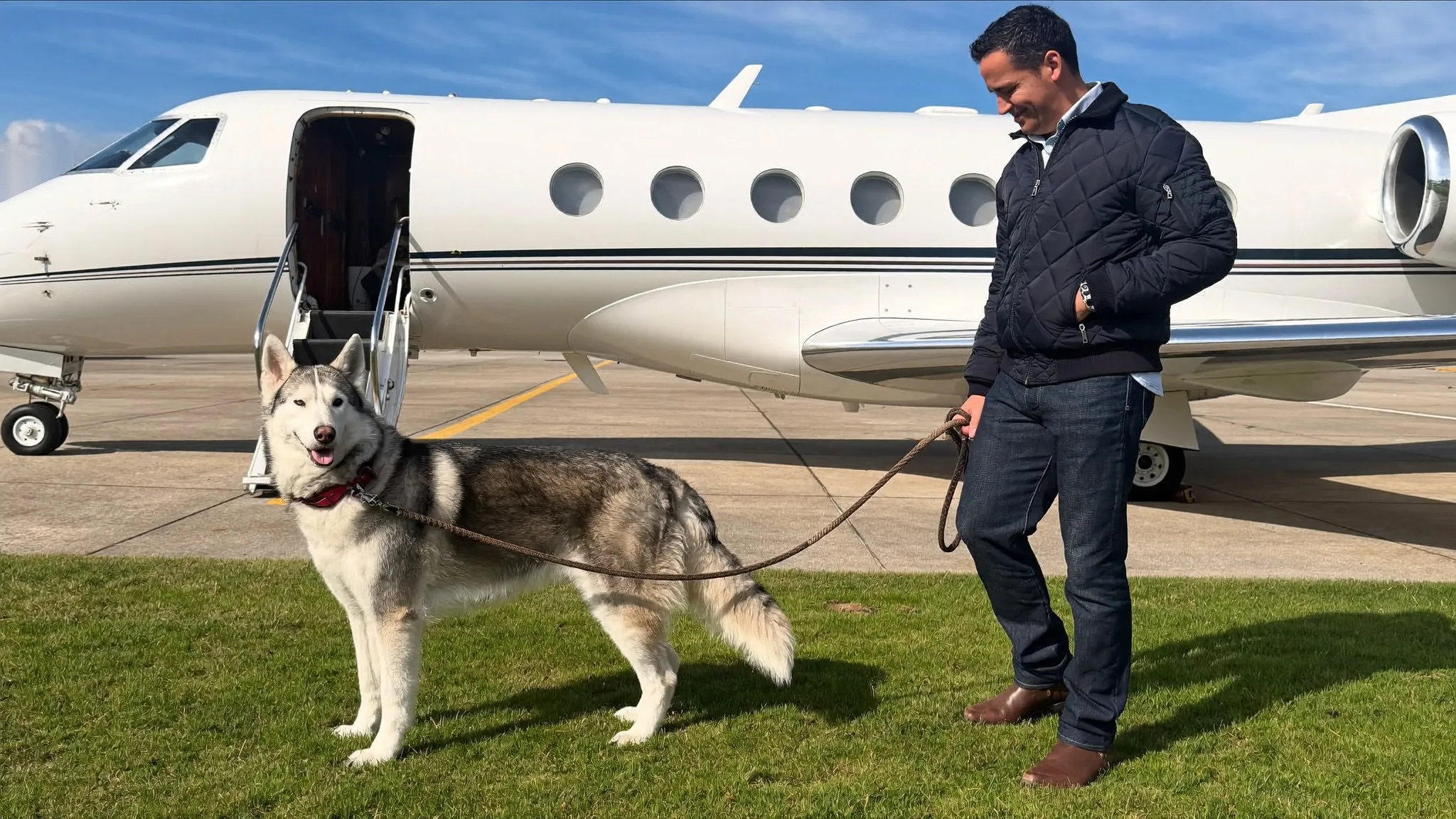
Bringing a dog into Great Britain takes five steps, all of them checked on arrival: a microchip, a rabies vaccination, a travel document, a tapeworm treatment given by a vet, and an approved route. The UK government warns that a dog that has not been properly prepared may be put into quarantine for up to four months. On aircraft, GOV.UK also states that pets travel as cargo unless you are flying on a chartered private plane, or travelling with a guide or assistance dog: on Loulou Air’s shared Pay-per-Seat private jet flights, you pay for your seat, not the jet, and your dog stays in the cabin, at your feet.
Which travel document does your dog need for Great Britain?
If you are travelling from an EU country, your dog’s EU pet passport is enough. GOV.UK accepts four documents for a dog coming from the EU: a pet passport issued in an EU country, an animal health certificate issued in Great Britain within the last six months, a Great Britain pet health certificate, or a pet passport issued in Great Britain before 1 January 2021.
The passport must be issued by an authorised vet, and your dog will only be allowed in if the passport is filled in correctly and the entry requirements are met. Besides the EU, the official list of countries whose passports are accepted includes Switzerland, Norway, Iceland, Andorra, Monaco, Gibraltar and San Marino. Travelling from Northern Ireland, the Channel Islands or the Isle of Man, no passport or certificate is needed at all.
One step is easy to overlook: you also have to fill in a declaration stating that you are not going to sell your dog or transfer its ownership. How the passport itself works is covered in our article on the EU pet passport.
Microchip and rabies vaccination: which comes first?
The microchip first, the vaccination at the same time or later. Your dog must be microchipped before, or at the same time as, its rabies vaccination, otherwise it will have to be vaccinated again. The order of the dates in the passport therefore matters as much as the procedures themselves.
The chip must also be readable. Staff check it if it meets the international standards ISO 11784 and ISO 11785; if it does not, you may have to bring your own microchip reader, which is worth confirming with your travel company. A dog whose chip cannot be read is refused entry or put into quarantine. A tattoo only counts as identification if it was done on or before 3 July 2011, is still clearly legible, and the rabies vaccination came after it.
Two waiting periods apply to the vaccination. The vet needs proof that your dog is at least 12 weeks old before vaccinating, and you then have to wait at least 21 full days after the first vaccination, or after the last dose of the first course, with day 1 being the day after the injection. Some vaccines take longer: GOV.UK gives the example of a vaccine given on 1 October that takes 30 days to work, so travel is only possible from 1 November. The vaccine must be an inactivated or recombinant vaccine, approved in the country where it is given.
For a dog that is already vaccinated, boosters must be up to date. A missed booster means restarting the course, while no waiting period applies after a booster given with no break in cover.
Tapeworm treatment: the step that stops dogs at the border
A vet must treat your dog for tapeworm every time it enters Great Britain and record it in the passport or certificate, no more than 5 days (120 hours) and no less than 24 hours before you enter. This is the easiest requirement to get wrong, because it turns on a window of a few hours. GOV.UK gives this example: a dog treated at 1pm on Monday must arrive after 1pm on Tuesday, and cannot arrive after 1pm on Saturday.
The product must be approved for use in the country where it is given, and must contain praziquantel or an equivalent proven to be effective against the Echinococcus multilocularis tapeworm. Check that the vet has completed the “Echinococcus treatment” section with the name and manufacturer of the product, the date and the time of treatment, their stamp and their signature. A dog that does not meet this rule can be refused entry or put into quarantine.
One exemption exists: coming directly to Great Britain from Finland, Ireland, Northern Ireland, Malta or Norway, no treatment is required. If your journey is delayed beyond the 120 hours, a new treatment may be needed.
Do you have to use an approved route?
Yes, apart from a few territories. Only carriers and routes approved by the Animal and Plant Health Agency, the UK animal health authority, may be used to bring a dog in. No approved route is required if you are travelling from a UK country, the Channel Islands, the Isle of Man or the Republic of Ireland.
This list moves: the official page’s history shows updates almost every week, the most recent dated 22 September 2026. GOV.UK says you should check with your travel company that it is still approved, and that routes may only operate at certain times of the year.
Before booking, GOV.UK suggests asking the company whether it will accept your dog, how many animals it will take, and whether it needs proof that your dog is fit to travel, such as a letter from a vet. Two further points: you can only bring a pet in by private boat if you are travelling from Ireland or Northern Ireland, and there are more approved routes for people travelling with guide or assistance dogs.
Will your dog travel in the hold?
As cargo, in most cases. The official page on routes is blunt: pets have to travel as cargo on a plane, unless you are flying on a chartered private plane, or travelling with a guide or assistance dog. The official list of air routes confirms this in its very structure, by splitting into two categories.
The commercial airlines, around sixty of them, “transport pets in the hold of the plane”, each with its permitted arrival airports: Heathrow, Gatwick, Manchester, Edinburgh, Glasgow and Newcastle. The charter airlines run to several hundred entries, a far longer list built around business aviation airports: Biggin Hill, Farnborough, London Luton, London Oxford, Blackbushe and Lydd. For your own journey, both the carrier and the arrival airport have to appear on the list.
We have covered the hold on scheduled flights in Dogs in the cargo hold and Pet in cabin: weight limits, fees and airlines.
Which dogs are banned in the UK?
Five types of dog are banned, and the ban applies at the border too: you cannot bring a banned type of dog into Great Britain unless it already holds a valid Certificate of Exemption.
The types concerned are the Pit Bull Terrier, the Japanese Tosa, the Dogo Argentino, the Fila Brasileiro and the XL Bully. The test matters as much as the list: whether a dog is a banned type depends on what it looks like, rather than on its breed or its name. A dog registered under another breed can therefore be treated as a banned type, and it is the owner’s responsibility to prove otherwise.
What happens on arrival, and on the way back to France?
On arrival, your dog’s microchip and documents are checked, and the check may happen before boarding, for example by sea or through the Eurotunnel. A dog with the wrong documents, or one that has not been properly prepared, can be put into quarantine or sent back to the country it travelled from, at your expense.
For the return leg into the EU, your dog travels on its EU pet passport. The French Ministry of Agriculture states that, for a return to the Union, the passport is enough on three conditions: it was filled in before leaving the Union, there has been no change to the rabies vaccination cover, and any antibody test presented was carried out in the EU before departure.
Great Britain is named among the countries exempt from the rabies antibody test, alongside Guernsey, Jersey, the Isle of Man and Gibraltar, so no blood test is needed to come back, unlike other destinations covered in Rabies antibody test for dogs. On arrival in France, you do not have to send documents or book an appointment with customs, but you must present yourself to officers with the required paperwork. Requirements by country are gathered on our travel requirements pages.
What if your dog travelled in the cabin, at your feet?
That is what a shared private jet flight allows, and it is the principle behind Loulou Air, a brand of AEROAFFAIRES, a private aviation broker since 1991: Pay-per-Seat private jets, where you pay for your seat, not the jet. Every ticket covers one seat for a human and their dog, who travels in the cabin with you, never in the hold, and stays at your feet for the whole flight. None of the weight limit imposed by scheduled airlines applies, because your dog does not travel in the hold; capacity depends on the aircraft and the number of animals on board, and a broker confirms each dog case by case. Boarding is through a private aviation terminal, with no queues, and the crew are briefed on welcoming animals. Entry requirements remain due on every flight, private ones included, and our brokers check every dog’s file before departure.
Our flights currently serve New York, Dubai and Los Angeles: see the open flights. We open new flights every month, so tell us where you want to go and talk to a broker; for a whole aircraft, our sister company AEROAFFAIRES arranges full charters.
Frequently asked questions
Is an EU pet passport enough to take a dog to the UK?
Yes, from an EU country. GOV.UK accepts a passport issued by an authorised vet in an EU country, provided it is filled in correctly and the entry requirements are met. A Great Britain pet health certificate is the alternative for countries that do not issue passports.
How long before travel does a dog need its rabies vaccination?
At least 21 full days before arrival, with day 1 being the day after the injection, and the dog must be at least 12 weeks old when vaccinated. Some vaccines take longer to work, up to 30 days in the example GOV.UK gives, so ask your vet for the exact waiting period.
What happens if a dog arrives without the tapeworm treatment?
It can be refused entry or put into quarantine, at the owner’s expense, and that quarantine can last up to four months. The treatment must be given by a vet no more than 5 days and no less than 24 hours before entry, with the date and time recorded in the passport.
Sources
Rules change: check them against these sources before every trip.
- GOV.UK — Bringing your pet dog, cat or ferret to Great Britain
- GOV.UK — Travel routes for pets
- GOV.UK — Microchip
- GOV.UK — Rabies vaccination and boosters
- GOV.UK — Tapeworm treatment for dogs
- GOV.UK — Which pet travel document you need
- GOV.UK — Pet passports
- GOV.UK — Arriving in Great Britain
- GOV.UK — Pet travel: approved air, sea and rail carriers and routes
- GOV.UK — Pet travel: airlines and airports you can use
- GOV.UK — Banned dogs
- French Ministry of Agriculture — FAQ on importing pets from third countries