EU pet passport for dogs: how to get one
Microchip, rabies shot, the 21-day wait, lifetime validity and the new model since April 2026: what the rules actually require for your dog.
By the Loulou Air team · · updated · 6 min read

An EU pet passport is issued by a vet, and by nobody else. It records your dog’s identification and rabies vaccination, and it is compulsory when you move your dog from one EU country to another. Here is what to do, in what order, and what changed in spring 2026.
What is an EU pet passport?
It is a veterinary document that follows your dog for life. The European Commission explains that it contains a description of the animal, the microchip number, the animal’s medical record and the contact details of the owner and of the vet who issued it.
Its purpose is narrow: to prove, at a check, that your dog is identified and properly vaccinated against rabies. The Commission states that it is compulsory for movements between EU countries.
The document itself does not need renewing. The Commission says it is valid for life, as long as the health information in it, such as the rabies vaccination, is kept up to date. So the passport does not expire; the vaccination recorded inside it does.
How do you get an EU pet passport for your dog?
Book an appointment with a vet, because there is no other route. The European Commission states that you can get the passport from any vet authorised by the competent authorities.
The order of the steps matters, and this is where owners most often lose weeks.
1. Identification first. Your dog must be identified by a microchip. A tattoo is still accepted if it was applied before 3 July 2011 and is clearly legible. If you live in France, this is not only a travel formality: the Ministry of Agriculture states that dogs must be identified before the age of four months, and the number is recorded in the national database run by I-CAD on behalf of the ministry.
2. The rabies vaccination, after that. The rule is strict: the European Commission states that for the vaccination to be valid, the dog must have been microchipped before the injection is given. A dog vaccinated before being chipped has to be vaccinated again. French guidance says the same: the vaccination must be carried out after the identification to be recognised as valid.
3. The waiting period. Your dog must be at least 12 weeks old for the first rabies vaccination, and you must then wait at least 21 days before travelling.
4. The passport. The vet fills it in and records the microchip number and the vaccination dates.
How far ahead should you plan?
Allow at least three weeks between the vaccination and departure, and longer if your dog is not yet microchipped. The French Ministry of Agriculture states that the rabies vaccine is legally valid at the earliest 21 days after the date of vaccination where the animal is not already up to date.
For a puppy the arithmetic is longer. The first vaccination cannot happen before 12 weeks, and 21 days must then pass, so a puppy cannot travel within the EU on a valid rabies vaccination much before about 15 weeks of age. A few member states do allow young unvaccinated animals in under conditions, but the European Commission lists France, Belgium, Germany, Spain and Italy among the countries that do not.
If your dog is already vaccinated, the thing to watch is the booster. The European Commission states that boosters must be given before the previous vaccination expires for protection to remain continuous. A late booster counts as a fresh start, and the 21-day wait applies again: the EU rules provide that a revaccination is to be treated as a primary vaccination if it was not given during the period of validity of the previous one. A valid passport carrying an expired rabies vaccination is worth nothing at a check, so look at the booster date well before you travel.
How much does an EU pet passport cost?
There is no official price. The passport is billed by the vet, and veterinary fees are not regulated in France. The Rural Code provides that veterinary fees are set with tact and moderation, taking into account the nature of the care given and the particular circumstances.
The cost therefore varies from practice to practice, and the passport is not the only line on the bill: the microchip and the vaccination are charged separately.
You are not left in the dark, though. The same text requires the vet to give you the price of the service where it is set in advance or, failing that, a method of calculating it or a quote. The vet must also answer any request for information about fees or about the cost of a treatment. Ask for the full figure before the appointment.
What changed on 22 April 2026
The European legal framework was replaced. Regulation (EU) 576/2013, which used to govern non-commercial pet movements, is no longer in force; it has given way to the texts adopted under the EU animal health law, applicable since 22 April 2026.
Two of them bear directly on your passport. Implementing Regulation (EU) 2026/705 of 20 March 2026 establishes the new model identification documents for non-commercial movements of pet animals. Delegated Regulation (EU) 2026/132 of 20 January 2026 revises the traceability rules for dogs, cats and ferrets.
Do you need a new passport for your dog? Not for now. Article 6 of Regulation 2026/705 provides that a passport drawn up to the old model is treated as compliant if it was issued before 1 January 2028.
The substantive conditions have not moved: microchip, rabies vaccination after identification, a minimum age of 12 weeks for the first shot and a 21-day wait before the movement.
Is the passport enough everywhere?
No. The EU pet passport covers movements inside the European Union, not beyond it.
Two limits are worth knowing before you book.
Some countries require a tapeworm treatment. If you are travelling with your dog to Finland, Ireland, Malta, Norway or Northern Ireland, the European Commission states that it must be treated against the tapeworm Echinococcus multilocularis between 24 and 120 hours before travel. A vet administers the treatment and records it in the passport.
The number of animals is capped. You can travel with up to five pets. Above that number, the Commission requires proof that they are taking part in a competition, an exhibition or a sporting event.
Outside the EU, the passport is never sufficient on its own. For the United States, the entry rules are set out on our travel requirements page and in our article on the CDC dog import form. For the United Arab Emirates, see our UAE travel requirements. Coming back into France from a non-EU country has its own rules, which we cover in bringing your dog home from the US.
And for a trip outside Europe with your dog?
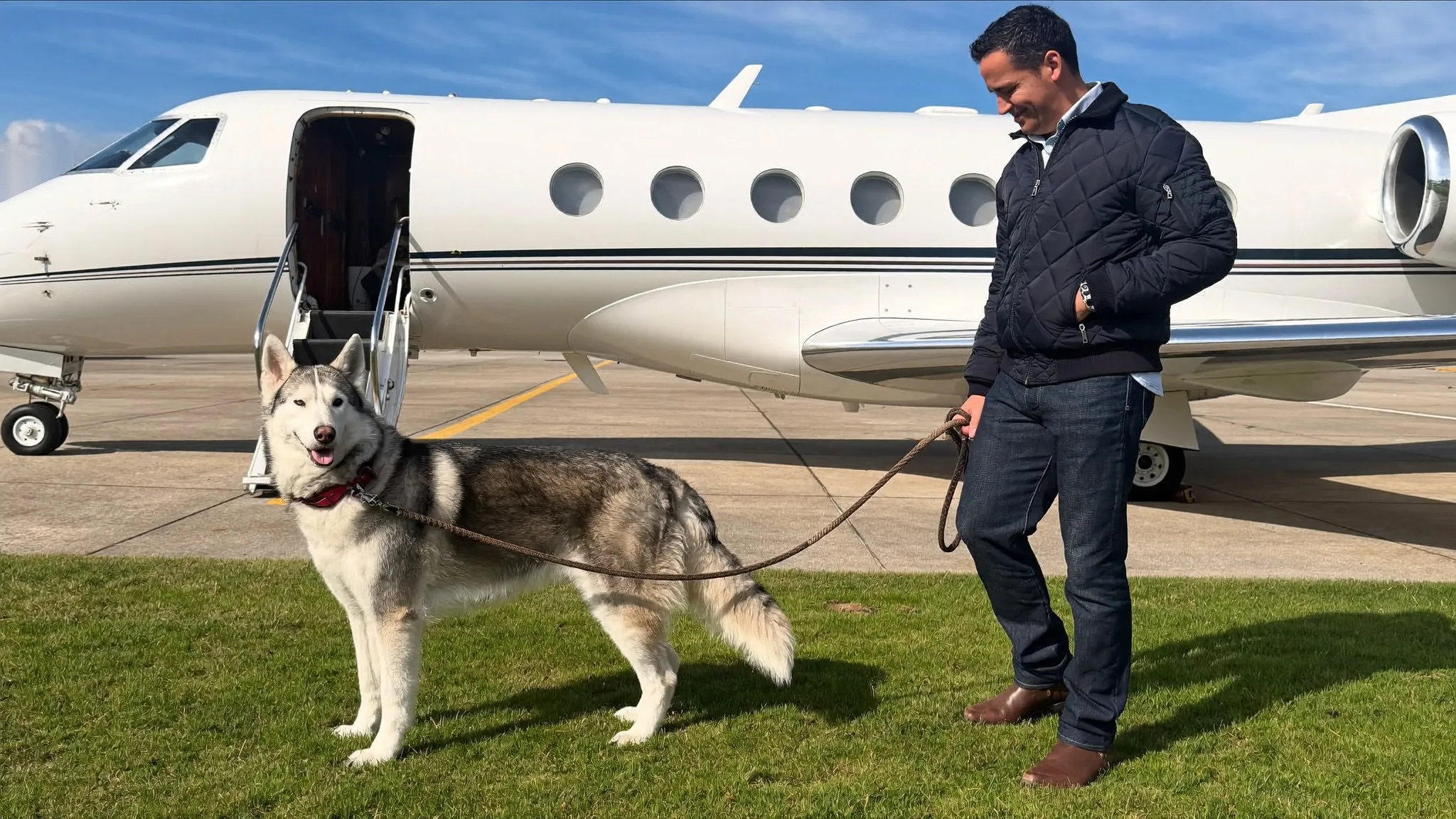
Outside the European Union, other formalities come on top of the passport, and the journey matters as much as the paperwork. Loulou Air, a brand of AEROAFFAIRES, a private aviation broker since 1991, offers Pay-per-Seat travel on shared private jet flights: you pay for your seat, not the jet, and your dog travels in the cabin, at your feet, never in the hold, without the weight limits of scheduled airlines. Our flights serve New York, Dubai and Los Angeles, and our brokers check your dog’s file before every departure. The rules for these destinations are set out on our travel requirements by destination pages.
See our open flights or talk to a broker.
Frequently asked questions
Who can issue my dog’s EU pet passport?
A vet, and only a vet. The European Commission specifies that the vet must be authorised by the competent authorities. No town hall, no government office and no online service issues this document.
My dog is tattooed. Is that enough?
Yes, but only if the tattoo was applied before 3 July 2011 and is still clearly legible. For every other dog, only a microchip is accepted for travel within the EU. If you are unsure, ask your vet to check that the tattoo can still be read before you book.
Can I have my dog vaccinated and leave the next day?
No. You must wait at least 21 days after the first rabies vaccination before travelling. The same wait applies when a booster has been given late, after the previous vaccination had already expired.
Sources
Rules change: check them against these sources before every trip.
- Service-public.fr - Travelling abroad with a pet (in French)
- French Ministry of Agriculture - Travelling with a pet (in French)
- French Ministry of Agriculture - Pet identification (in French)
- European Commission - Travelling with pets and other animals in the EU
- Regulation (EU) 576/2013 (no longer in force)
- Implementing Regulation (EU) 2026/705 establishing model identification documents
- Delegated Regulation (EU) 2026/132 amending Regulation (EU) 2019/2035
- Delegated Regulation (EU) 2026/133, Annex VII - Validity of the rabies vaccination
- French Rural Code, article R242-49 - Veterinary fees (in French)