CDC Dog Import Form: how to fill it in
How to file the CDC Dog Import Form online: one per dog, up to the day you fly. Who submits it, what it asks, and how long the receipt stays valid.
By the Loulou Air team · · updated · 7 min read

The CDC Dog Import Form stops more trips to the United States than any other piece of paperwork, even though it is a single online submission. The CDC, the US federal public health agency, states that every dog entering or returning to the country must have a receipt for this form. Here is who files it, when, what it asks for, and what to do with the receipt.
What is the CDC Dog Import Form, and who files it?
It is an online declaration, submitted before the trip, which the CDC calls the CDC Dog Import Form. Its instructions page is specific about who is responsible: the form “should be completed by the person importing (bringing) the dog into the United States (the importer, owner, or shipper)”. Your vet does not file it, and neither does the airline. You do.
The rule works in both directions. The CDC’s frequently asked questions state that all dogs entering or returning to the US must be accompanied by a CDC Dog Import Form receipt. An American dog coming home after a summer in France needs exactly the same document as a French dog crossing for the first time.
One detail that trips people up: you need one form per dog. The CDC says a form is required for each dog you bring in, so a single receipt never covers two animals.
When should you submit it?
There is no deadline. The CDC says you can fill out the form on the day of travel. For a departure from a dog rabies-free or low-risk country, it recommends completing it “a few days or up to six months before travel”.
Its FAQ page makes the same point, strongly recommending that you fill the form out ahead of your travel dates so you have plenty of time. That is the sensible approach: the receipt is emailed to you, and a mistyped address is far easier to fix three days before departure than at the airport.
None of the official pages consulted sets a minimum lead time in hours, or explains what to do if your flight changes after you have submitted. If in doubt, submit a fresh form rather than travelling on a receipt that no longer matches your itinerary.
What does the form ask for?
The form has four sections, as described by the CDC: the person importing the animal, the animal, the travel details, and the signature.
For the animal, you give its name, age in years or months, sex, breed, and colour and markings. The microchip number is required for dogs coming from a high-risk country for dog rabies, along with a photo showing the dog’s face and body, in .jpg, .jpeg or .png format and no larger than 10MB.
For travel, you enter the country or area of departure, the arrival date and, for air travel, the carrier and flight number. The US port of entry is requested for dogs from high-risk countries; for other dogs it does not appear on the receipt at all.
The signature section is a set of statements to read and a box to tick confirming that you understand them.
What is the receipt for, and how long does it last?
The receipt is the document you will be asked for twice. The CDC says you must show it “to the airline if the dog is traveling by air and to U.S. Customs and Border Protection on arrival in the U.S.”. Printed or on your phone, either works.
How long it lasts depends on where the dog has been:
- From a dog rabies-free or low-risk country: the receipt is valid for six months from the date it was issued, for multiple entries to the US from that same country.
- From a high-risk country: the receipt is valid for one entry only.
Watch how the six months work. The CDC states that the receipt is valid for six months unless the dog visits a high-risk country, or a different dog rabies-free or low-risk country, during that time. A weekend in Italy is enough to void it, and you will need a new one.
Airlines have their own checklist. The CDC page for air carriers, updated on 7 April 2026, requires them to confirm before boarding that the dog appears healthy, appears to be at least six months of age, has a microchip, and has a CDC Dog Import Form receipt. For a dog from a high-risk country, the airline must also confirm that the port of entry printed on the receipt is the airport the aircraft is scheduled to arrive at.
What else does the dog need?
For a dog that has only been in dog rabies-free or low-risk countries over the past six months, the CDC sets three conditions on top of the receipt: the dog must appear healthy on arrival, be at least six months old at the time of entry or return, and have a microchip that can be detected with a universal scanner.
The CDC then adds a line that makes planning a departure from France much simpler: for these dogs, the CDC Dog Import Form is the only required documentation. No rabies vaccination certificate is demanded by the CDC, and no blood test. These dogs may also enter at any airport, seaport or land border crossing.
Does France qualify? Yes. The CDC publishes only the list of high-risk countries, and states that a country not on that list is considered dog rabies-free or low-risk. France is not on the list, which carries a review date of 15 April 2026.
Federal rules are not the whole picture: the arrival state and the airline add their own. Our United States travel requirements cover what sits on top of the federal rule, and our article on bringing your dog home from the US covers the return leg.
What if the dog has been in a high-risk country?
Everything changes, and the form becomes the smallest of your tasks. For a foreign-vaccinated dog that has been in a high-risk country, the CDC requires a Certification of Foreign Rabies Vaccination and Microchip form, a valid rabies serology titer report from a CDC-approved laboratory, the CDC Dog Import Form receipt, and a reservation at a CDC-registered animal care facility.
The arrival airport is no longer your choice either: the CDC states that these dogs must arrive at the airport where a CDC-registered animal care facility is located. And if the microchip cannot be scanned on arrival, the dog may be denied entry and returned to its country of departure at the importer’s expense.
The United Arab Emirates are on the high-risk list. A dog that has lived in Dubai therefore falls under this regime when entering the United States, even if its last departure was from France. Our United Arab Emirates travel requirements describe the paperwork in the other direction, on arrival in Dubai.
Does a layover change anything?
Yes, but only if the dog actually enters the country it stops in. The CDC’s page on layovers, updated on 29 April 2026, gives a clean test: a dog is considered to have entered a country if it clears customs.
The consequences follow from that test. If a dog enters a high-risk country during a layover, it must meet the CDC requirements for dogs from a high-risk country on arrival in the United States, regardless of where the trip began. If the layover is in a dog rabies-free or low-risk country, it does not affect the dog’s status.
In practice this shapes your choice of routing more than your paperwork. A nonstop flight removes the question entirely, which is the case on the Paris-Le Bourget to New York Teterboro route, where your dog stays in the cabin with you. Country-by-country paperwork is set out in our travel requirements, and the rest of our dog travel guides are on the blog.
What if your dog flew to New York in the cabin?
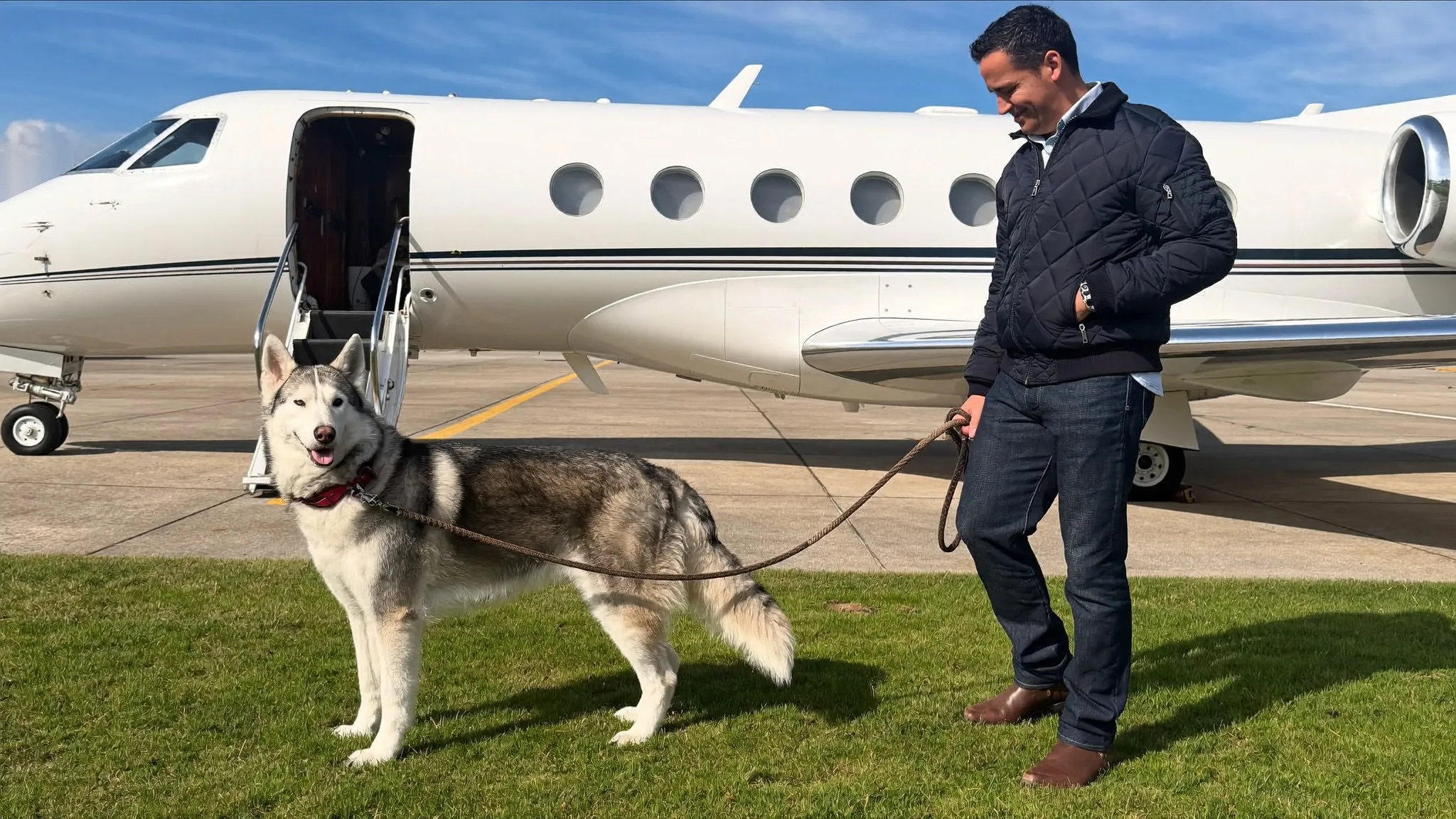
It can, on a private flight, without the weight limits of scheduled airlines. Loulou Air, a brand of AEROAFFAIRES, a private aviation broker since 1991, offers Pay-per-Seat travel on shared private jet flights from Paris-Le Bourget to Teterboro for New York: your dog travels in the cabin, at your feet, never in the hold. The CDC form is still required on every flight, private ones included: every dog entering the United States must have its receipt. Before departure, our brokers go through your dog’s file with you.
See flights to New York or talk to a broker.
Frequently asked questions
Does the CDC form replace my dog’s EU pet passport?
No, the two documents serve different journeys. The EU pet passport is for travel within the European Union, while the CDC Dog Import Form receipt is what the airline and US customs ask for on entry to the United States. Carry both.
Can my four-month-old puppy travel to the United States?
No. The CDC requires a dog to be at least six months old at the time of entry or return, and airlines must confirm before boarding that the dog appears to be that age. Filing the form does not waive this.
Do I need a new form for every trip?
Not always. From a dog rabies-free or low-risk country such as France, the receipt covers multiple entries from that same country for six months. It lapses as soon as the dog visits a high-risk country, or a different dog rabies-free or low-risk country, in the meantime.
Sources
Rules change: check them against these sources before every trip.
- CDC - CDC Dog Import Form and Instructions
- CDC - Entry Requirements for Dogs from Dog-Rabies Free or Low-Risk Countries
- CDC - High-Risk Countries for Dog Rabies
- CDC - Layovers
- CDC - Information for Air Carriers on Dogs Being Imported into the U.S.
- CDC - Frequently Asked Questions on Dog Importations
- CDC - Entry Requirements for Foreign-Vaccinated Dogs from High-Risk Countries