Vancouver with your dog: the rules
Dog licence, 2.5-metre leash rule, the five beaches that allow dogs, regional parks and transit: the official rules for visiting Vancouver.
By the Loulou Air team · · 8 min read

Vancouver is good walking country with a dog, provided you know three rules: the city licence, the 2.5-metre leash that applies across all public space, and the five beaches where dogs are allowed. Fines under the city’s animal control by-law run from 250 to 10,000 Canadian dollars, and the City enforces it in every park and on every beach, year round. Here is what the City of Vancouver, Metro Vancouver, BC Parks and TransLink publish, as of 19 October 2026.
What paperwork does a dog need to enter Canada?
A valid rabies vaccination certificate, written in English or French. For a dog arriving from a country that is not designated as rabies-free, the Canadian Food Inspection Agency requires a certificate issued in English or French by a licensed veterinarian, clearly identifying the dog and showing that its rabies vaccination is current. Below three months of age, no rabies vaccination is required. The agency also accepts, as an alternative, a rabies antibody titre test result of at least 0.5 IU/ml, taken three to four weeks after any previous vaccination, with the laboratory report travelling with the dog.
At the border, declaring the dog matters as much as the certificate. The Canada Border Services Agency says its officers can refuse entry, confiscate or detain an animal that is undeclared, family pets included, or that lacks the necessary certificates, and strongly recommends travelling with the physical original of every required document. The full file is set out in Taking your dog to Canada.
Does your dog need a licence in Vancouver?
Yes, from three months old. The City writes that in Vancouver, all dogs and all service dogs over three months of age must have a dog licence, renewed annually.
The fees are published. A new licence costs 68 Canadian dollars per dog per year, no tax, and a renewal the same; renew after the expiry date and a 10-dollar late penalty applies. Replacing a lost tag costs 8 dollars, and a service dog’s licence is free. A dog whose owner has received an “Aggressive Dog” letter from the City needs an aggressive dog licence, at 222 Canadian dollars a year, worn on the dog’s collar.
The licence follows where the dog is kept. The City provides for cancelling it when the owner moves out of Vancouver, and for transferring one from another municipality for 8 dollars with proof of a valid licence. It is never transferable to a new owner. For a dog kept on the Musqueam Indian Reserve or the University Endowment Lands, the licence is bought by phone or in person rather than online.
Where must your dog be leashed in Vancouver?
Everywhere in public, except inside a designated off-leash area. The City sums up its animal control by-law, Animal Control By-law 9150, in three duties: your dog must hold a valid licence, must be under control at all times, and must not run free in public spaces, outside one of the 39 designated off-leash areas.
Three details matter on the pavement.
Length. The leash must be no longer than 2.5 metres, and the City notes that most retractable leashes are not allowed.
Your hand. You must hold the leash at all times: tying your dog to a pole or a bike rack is not permitted.
The fine. Violations carry fines of 250 to 10,000 Canadian dollars.
Parks follow the same rule: dogs are welcome in all of them and must be on leash unless they are in a designated off-leash area. Animal Services takes reports of dogs off leash outside an off-leash area, and of dogs on a beach.
Which Vancouver beaches allow dogs?
Five, and only inside the off-leash areas marked there. The City publishes the same list on its off-leash areas page and on its beaches page:
- Hadden Park: seasonal and time restrictions apply.
- John Hendry Park.
- New Brighton Park: seasonal and time restrictions apply.
- Spanish Banks Beach Park.
- Sunset Beach Park.
Vancouver has nine beaches in all, so the busiest downtown stretches, English Bay and Kitsilano, are not on that list. Hours and seasons differ from one area to the next, and the City publishes them area by area: that page is the only current reference before you unclip the leash.
What are the rules in regional and provincial parks?
More precise than the city’s, and written into a by-law. The large natural areas around Vancouver belong to Metro Vancouver, which asks that dogs be leashed unless in a designated off-leash area or on a designated leash-optional trail, and kept out of streams, creeks, ponds, wetlands and shorelines.
The 2025 regional parks by-law sets out the rest. Anyone in care and control of an animal must keep it leashed and under control at all times, carry one leash and one collar per animal, leash it immediately near a horse, and pick up its waste. In an area posted “off-leash area” or “leash optional”, a dog may be unleashed provided the person carries a leash and keeps a clear line of sight to the dog.
The by-law defines that control: the animal stays within 10 metres and in sight of its handler, returns immediately when called or signalled, does not annoy, harass or attack any person or animal, and does not run off-trail. A park officer may order a dog leashed or muzzled, even inside an off-leash area, or bar it from the park. Contravening the by-law carries a fine of 50 to 50,000 Canadian dollars and imprisonment of up to six months.
In British Columbia’s provincial parks, BC Parks says pets must be leashed in most places and are not allowed in playgrounds or public buildings.
Dogs on the bus, SkyTrain and SeaBus: what are the rules?
Only inside a closed carrier. TransLink, the region’s transport authority, allows pets on board provided they are kept in an appropriate carrier: small, hand-held, fully enclosed, fitting in your lap, with no part of the animal exposed, and clean, odour-free and free of sharp edges.
The rest plays out on board. The carrier may sit on the floor if it does not impede other passengers, but not near the doors. Only one pet per passenger is allowed, pet strollers are not permitted, and drivers may refuse a pet at their discretion, for instance when space is tight. TransLink recommends travelling outside peak times.
The SeaBus, the passenger ferry linking downtown to North Vancouver, runs its own arrangement. Pet kennels are provided, four in all, two at each terminal, and the animal must be placed in one before entering the waiting room; boarding is through doors 3 or 4, and the pet stays in the kennel until arrival. Only two kennels are allowed per sailing, for operational and space reasons. On HandyDART, the custom transit service, pets are not allowed; assistance animals are.
What about coming back to the EU?
It is simpler than a return from many other countries, because Canada is a listed country. The European Commission requires a dog entering from a non-EU country to have a microchip and a valid rabies vaccination: the dog must have been at least 12 weeks old on the date of vaccination, the vaccination must not precede the microchip, and its validity starts no less than 21 days after the primary vaccination.
The rabies antibody titration test is not required: the Commission writes that the test is not needed for an animal moved from a country or territory listed in Annexes I and II to Implementing Regulation (EU) 2026/636, and Canada does appear in Annex II to that regulation. Tapeworm treatment is not required either: the Commission asks for it only before entering Finland, Ireland, Malta, Northern Ireland and Norway.
Two things still need preparing. A dog habitually resident in the EU travels without an animal health certificate if its pet passport, completed before it left the EU, establishes that it met the rabies vaccination conditions. And because Canada falls under Annex II rather than Annex I, the dog must pass through a designated travellers’ point of entry, where the owner contacts the competent authority for the documentary checks; our travel requirements pages cover them.
What if your dog flew in the cabin, at your feet?
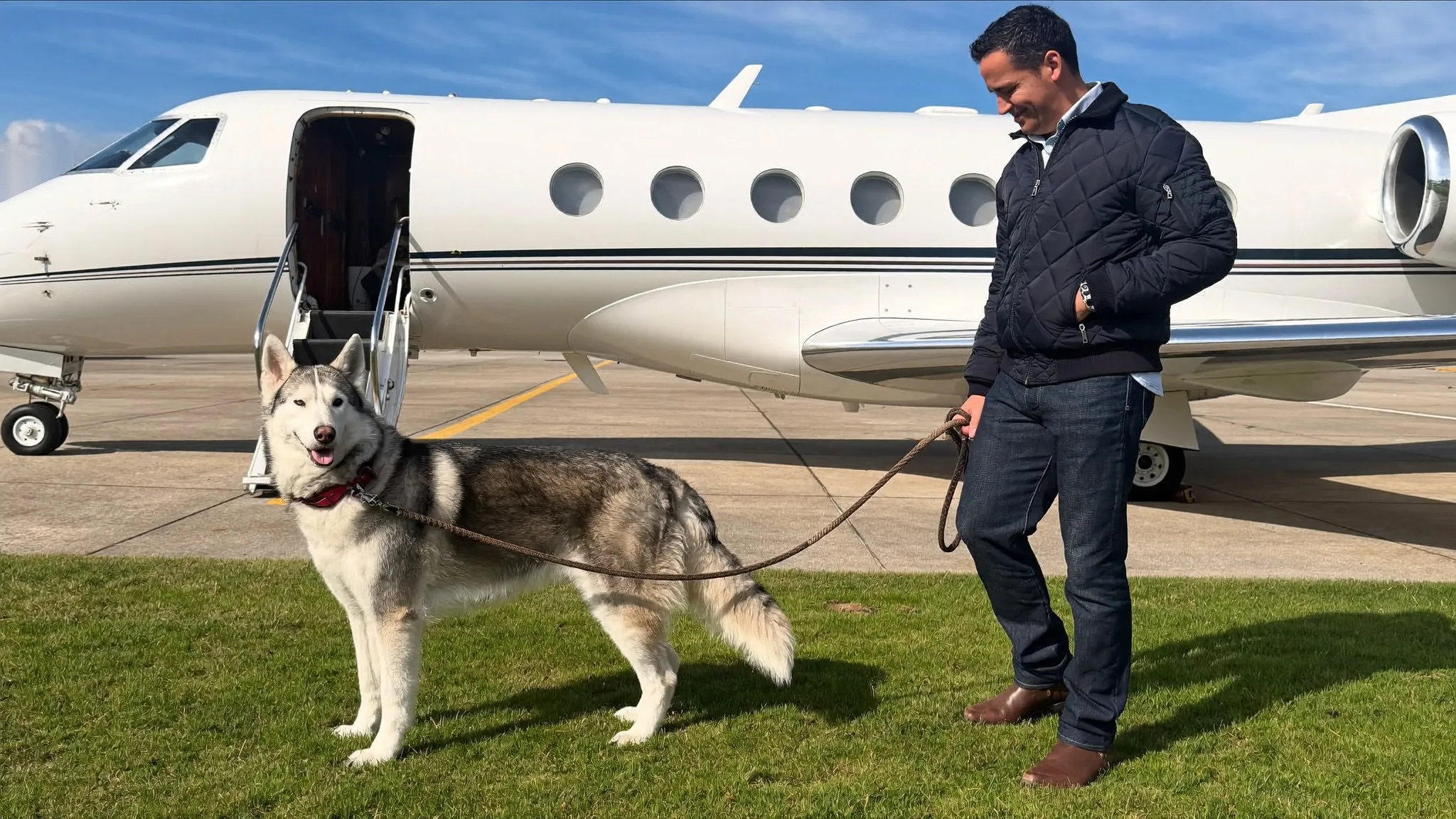
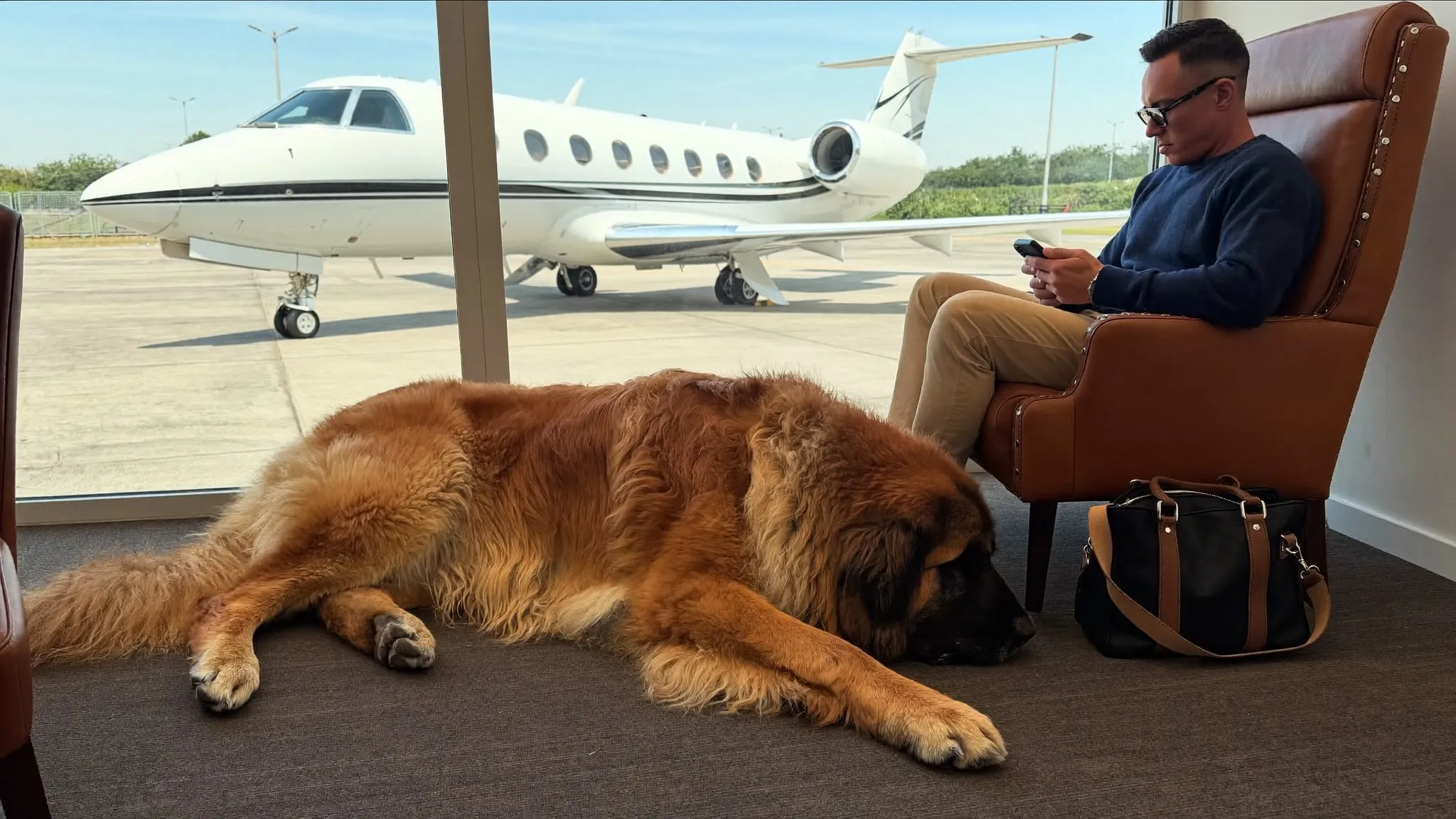
That is what a shared private flight allows: your dog stays in the cabin with you, never in the hold, and spends the flight at your feet. Loulou Air, a brand of AEROAFFAIRES, a private aviation broker since 1991, sells Pay-per-Seat private jets for your dog and you: you pay for your seat, not the jet, and every ticket covers one seat for a human and their dog. None of the weight limit imposed by scheduled airlines applies, because your dog does not travel in the hold; capacity depends on the aircraft and the number of animals on board, and a broker confirms each dog case by case. Boarding is through a private aviation terminal, with no queues and no separation, and the crew is briefed on welcoming animals. The requirements described here remain due on every flight, private ones included, and our brokers check every dog’s file before departure.
Our routes currently serve New York, Dubai and Los Angeles: see the open flights. We open new flights every month, so tell us where you want to go and talk to a broker; for a whole aircraft, our sister company AEROAFFAIRES arranges full charters.
Frequently asked questions
Can my dog run free on a Vancouver beach?
Only at five beaches, and only inside the marked off-leash area: Hadden Park, John Hendry Park, New Brighton Park, Spanish Banks Beach Park and Sunset Beach Park. Hadden Park and New Brighton Park also have seasonal and time restrictions. Everywhere else the dog stays leashed, and the City enforces its by-law year round.
Does a visitor need to buy a dog licence in Vancouver?
The City writes that every dog over three months old must hold a licence in Vancouver, and provides for cancelling it when the owner moves out of the city or transferring one from another municipality: the licence follows where the dog is kept. For a short stay, call Animal Services on 604-873-7000 before you arrive.
Which leash should I pack for Vancouver?
A conventional leash of no more than 2.5 metres, held in your hand: the City notes that most retractable leashes are not allowed, and the regional parks by-law uses the same maximum length. Your dog’s place on the aircraft is the carrier’s call, as Dogs in the cabin: weight, size and airlines explains; our other city guides are in the blog.
Sources
Rules change: check them against these sources before every trip.
- City of Vancouver — Dog licences and tags
- City of Vancouver — Responsible dog ownership
- City of Vancouver — Dog off-leash areas
- City of Vancouver — Beaches
- Metro Vancouver — Dogs in Regional Parks
- MVRD Regional Parks Regulation Bylaw No. 1420, 2025
- BC Parks — Responsible recreation
- TransLink — Etiquette on Transit
- CFIA — Import Reference Document, domestic dogs
- CBSA — Travelling with animals
- European Commission — Bringing a pet into the EU from a non-EU country
- Implementing Regulation (EU) 2026/636, Annexes I and II