Arriving at Van Nuys with your dog
What to expect at Van Nuys with a dog: US customs hours, permission to land, the night curfew, the leash rule and getting into Los Angeles.
By the Loulou Air team · · 8 min read
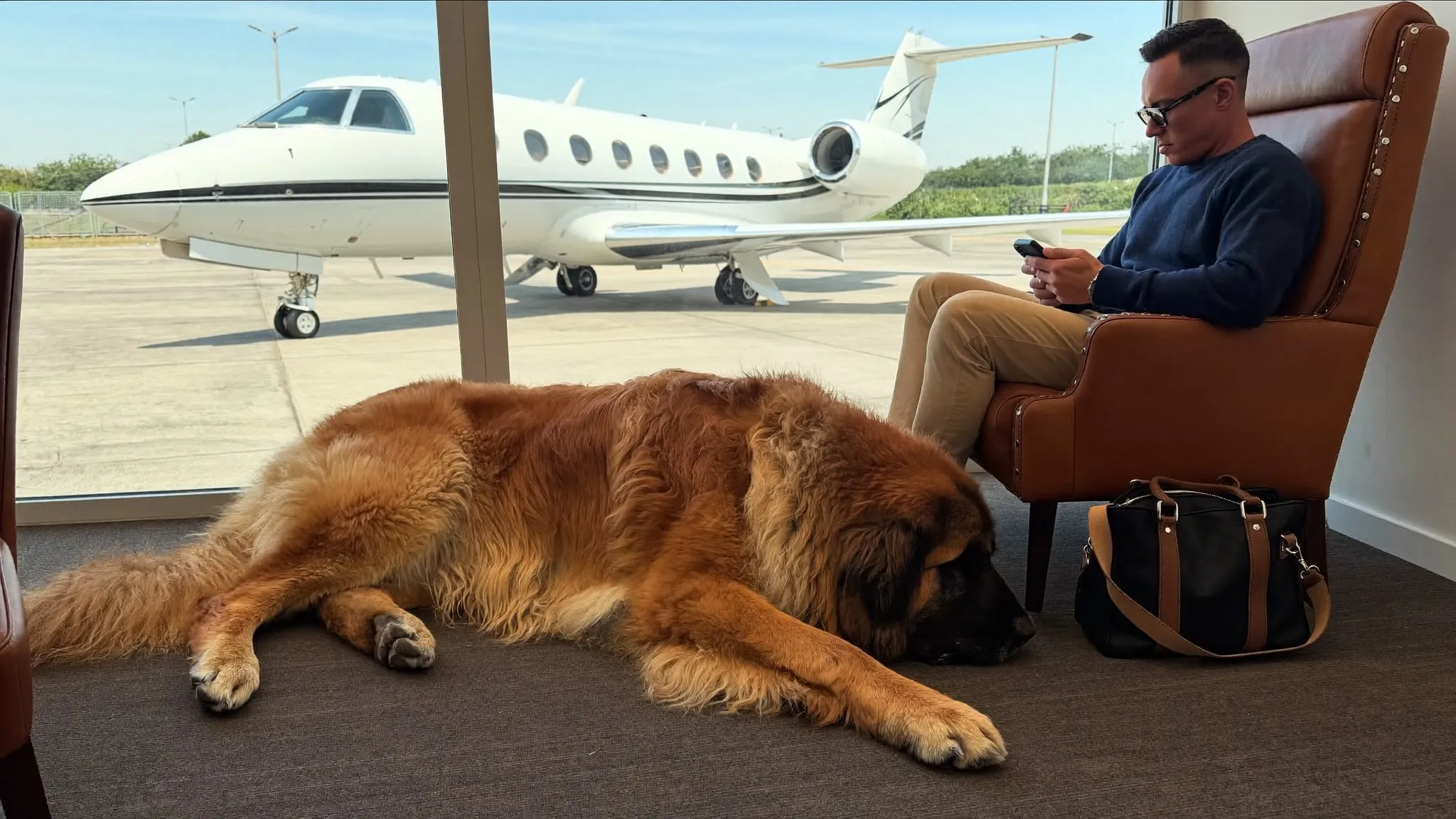
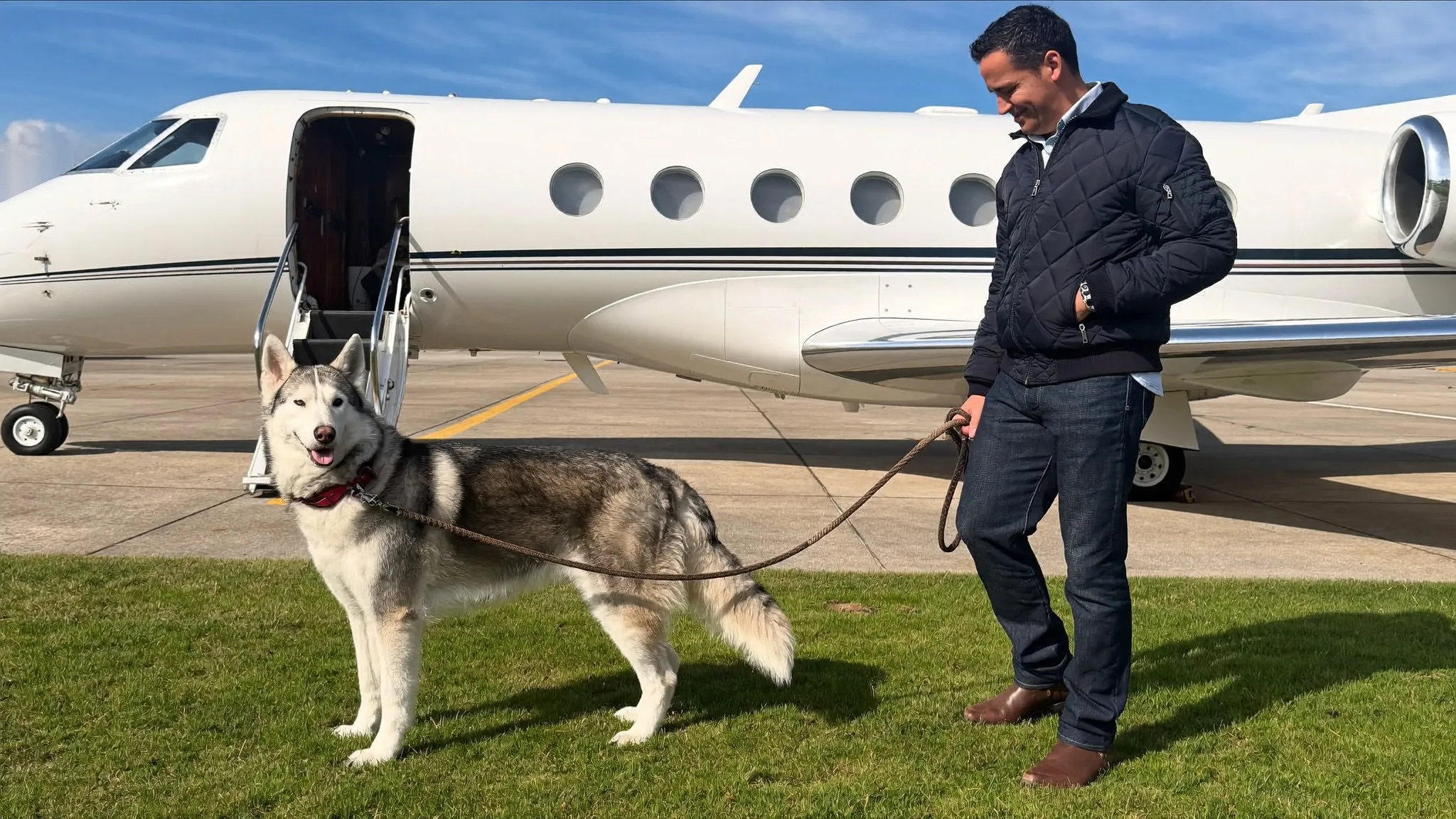
Arriving at Van Nuys with your dog means arriving at a general aviation airport run by the City of Los Angeles, where US customs keeps an office with limited hours and where a curfew governs night departures. Your dog’s paperwork does not change: it is the paperwork for any entry into the United States, and it takes weeks to put together. On our Pay-per-Seat flights to Van Nuys your dog stays in the cabin with you, never in the hold.
Where is Van Nuys Airport?
In Van Nuys, California, and it belongs to the City of Los Angeles. Los Angeles World Airports, which runs it under the code VNY, describes itself as the City of Los Angeles department that owns and operates Los Angeles International and the Van Nuys general aviation airport. The FAA airport record gives the same owner and places the field on the Los Angeles sectional chart.
On the airfield itself, LAWA describes two parallel runways, one with a full instrument landing system, and an FAA tower. The FAA record gives the dimensions: 8,001 feet by 150 for runway 16R/34L and 4,013 feet by 75 for runway 16L/34R, in the data cycle effective 1 to 29 October 2026.
The scale of the place explains what your arrival feels like. LAWA counts more than a hundred businesses on the 730-acre airport, among them four major fixed-base operators: Castle & Cooke Aviation, Clay Lacy Aviation, Jet Aviation and Signature Aviation. The field is given over to general aviation, meaning all flying other than scheduled airline or military service, so there are no check-in lines and no crowded gate rooms, as our article on flying private with your dog explains.
Is Van Nuys a port of entry into the United States?
No, and that changes how an international arrival unfolds. The FAA record is explicit on two lines: Van Nuys is not an airport of entry and not a landing rights airport. Customs and Border Protection gives it a different status in its general aviation fact sheet: Van Nuys is designated a “user fee airport”.
The logic behind that status is simple. CBP describes the programme as a public-private partnership created in 1984 that lets small airports receive its inspection services without meeting the criteria for receiving them free of charge: the requesting body reimburses CBP for all of its costs.
In practice that means permission has to be requested flight by flight. The fact sheet states that the pilot must secure permission to land by emailing CBP before departing the foreign port or place, within twenty-four hours of the requested arrival date. The permission holds to within thirty minutes; beyond that it is void and the crew must request a new one. None of this falls to you: it is the flight operator’s job, as at Teterboro.
When can a flight land at Van Nuys?
During the day, at hours that change with the day of the week. The CBP fact sheet gives its Van Nuys office hours: Monday, Thursday and Sunday from 9 a.m. to 8.30 p.m., Tuesday and Wednesday from 3 p.m. to 8.30 p.m., Friday and Saturday from 9 a.m. to 2.30 p.m., Pacific time. Inspection services for arriving aircraft are, it writes, generally available seven days a week during those hours. An international arrival therefore falls inside a daytime window, a shorter one on Friday and Saturday.
The airport’s noise rules come on top of that, and they govern departures. The operating rules LAWA published in April 2025 restate ordinance 155727: no aircraft may depart Van Nuys between 11 p.m. and 7 a.m. unless its estimated takeoff noise level is 74 dBA or less, or it is exempt, for instance a military flight or a life-saving emergency. Ordinance 171889 adds an hour: between 10 p.m. and 11 p.m. only aircraft certificated Stage 3 may leave.
One further rule covers arrivals as well: since 1 January 2016 no aircraft whose takeoff noise level equals or exceeds 77 dBA may arrive or depart at Van Nuys, with Stage 3 and Stage 4 aircraft exempt. For you it all adds up to an arrival time known well in advance, around which to plan your dog’s last meal and last walk, as our article on preparing your dog for an eight-hour flight sets out.
What happens at the inspection with a dog?
Everyone gets off and goes through the same inspection facility. The CBP fact sheet describes the sequence: the FBO’s ramp staff marshal the aircraft to its space, a CBP officer meets it, then crew and passengers are processed inside the FIS, the federal inspection site. Be ready to show passports, visas and the aircraft’s documents; luggage, passengers and aircraft are all subject to inspection. One detail matters for a dog that has already been travelling for hours: passengers can leave the FIS directly once their inspection is over.
Two lines of the fact sheet concern your animal. The first: the operator must advise CBP when carrying live animals, alongside weapons and hunting trophies. The second is practical: the CBP office sits at 7240 Hayvenhurst Place, inside the Signature West FBO, which charges a customs fee on all arrivals.
What paperwork does the dog need?
The paperwork for any entry into the United States, starting with the CDC form receipt. The agency’s FAQ is blunt: all dogs entering or returning to the US must be accompanied by a CDC Dog Import Form receipt, and one receipt is needed per dog. Someone else may fill the form in on the importer’s behalf, and the CDC strongly recommends doing it ahead of your travel dates.
One rule bears on your arrival airport, though not for every dog. The CDC sorts dogs by the countries they have been in over the previous six months: a dog that has only been in dog rabies-free or low-risk countries can enter at any port of entry, while for a dog that has been in a high-risk country the port of entry must match the one on the receipt. So enter the airport actually planned, and tell your broker if the routing changes. For a dog from a rabies-free or low-risk country the agency requires an animal that appears healthy, carries a microchip readable by a universal scanner and is at least six months old. A dog that is not vaccinated against rabies and has been in a high-risk country in the past six months will not be allowed to enter. US Department of Agriculture rules and those of the destination state apply on top of its own.
The documents and lead times are gathered on our United States travel requirements page; our article on the CDC Dog Import Form, step by step explains how to complete it.
Does the dog have to stay on a leash at the airport?
Yes, from the first metre to the last, and the airport’s own rules say so. The VNY Rules and Regulations published by LAWA devote a section to dogs and other animals: every dog must be restrained with a leash, or in another acceptable manner, and stay under its owner’s control at all times. That rule covers the whole airport, FBO lounges included.
In practice, clip the leash on before the aircraft door opens and keep it on until you reach the car, on a well-fitted harness or collar: the ramp is a noisy place, and a startled dog pulls without warning.
How do you get into Los Angeles with a dog?
By car, in the great majority of cases, because the region’s public transport takes only service animals and animals in carriers. The LA Metro customer code of conduct permits an animal on board only if it is in a carrier or is a service animal as defined by the Americans with Disabilities Act, and requires carriers that are secure and intended for that purpose. On the regional rail side, Metrolink asks that the animal travel in a small pet carrier, under the seat or on your lap, and allows service animals on board.
In other words, a medium or large dog reaches the city by car. Plan for a water bowl, a walk as you leave the airport and a vehicle where the dog is secured. Leash rules in town, dog parks and the beaches that allow dogs are covered in our guide to Los Angeles with your dog.
What if your dog flew to Los Angeles in the cabin?
It can, on a flight where the cabin is open to it from the start. That is what Loulou Air does, as a brand of AEROAFFAIRES, a private aviation broker since 1991: Pay-per-Seat private jets for your dog and you. You pay for your seat, not the jet, and every ticket covers a seat for one human and their dog. None of the weight limit imposed by scheduled airlines applies, since your dog does not travel in the hold: capacity depends on the aircraft and on how many animals are on board, and a broker clears each dog case by case. Boarding is through a private aviation terminal, with no queues and no separation, and the crew is briefed on welcoming animals. Before departure, our brokers go through your dog’s file with you, bearing in mind that the US requirements apply to every flight, private ones included.
See our flights to Los Angeles or talk to a broker. For a whole aircraft, our sister company AEROAFFAIRES handles it.
Frequently asked questions
Does US customs have to be told the dog is on board?
Yes, and the flight operator takes care of it. The CBP fact sheet for Van Nuys asks to be advised when live animals are carried. On your side, you present the CDC form receipt and the dog’s documents during the inspection.
Can you land at Van Nuys in the middle of the night with a dog?
Not on a flight from abroad: customs inspection follows the office hours above, ending at 8.30 p.m. Pacific time and at 2.30 p.m. on Friday and Saturday. The airport curfew also bars departures between 11 p.m. and 7 a.m. for aircraft whose estimated takeoff noise exceeds 74 dBA.
Can you take the metro or the train into Los Angeles with a dog?
Not with a medium or large dog. LA Metro admits only service animals and animals in carriers, and Metrolink requires a small carrier under the seat or on your lap. Plan on a car, as our Los Angeles guide explains.
Sources
Rules change: check them against these sources before every trip.
- Los Angeles World Airports - Van Nuys, General Description
- Los Angeles World Airports - About LAWA
- FAA - Aeronautical Information Services, VNY (KVNY) airport record
- CBP - General Aviation Airport Fact Sheet, Van Nuys Airport (29 January 2026)
- CBP - User Fee Facilities Program
- Los Angeles World Airports - VNY Rules and Regulations (April 2025)
- Los Angeles World Airports - Van Nuys Noise Abatement and Curfew Regulation
- CDC - Frequently Asked Questions on Dog Importations
- CDC - Bringing a Dog into the United States
- LA Metro - Customer Code of Conduct
- Metrolink - What's Allowed Onboard