Arriving at Teterboro with your dog
Landing at Teterboro with your dog: US customs hours, the landing rights rule, how the inspection works and getting into Manhattan.
By the Loulou Air team · · 8 min read
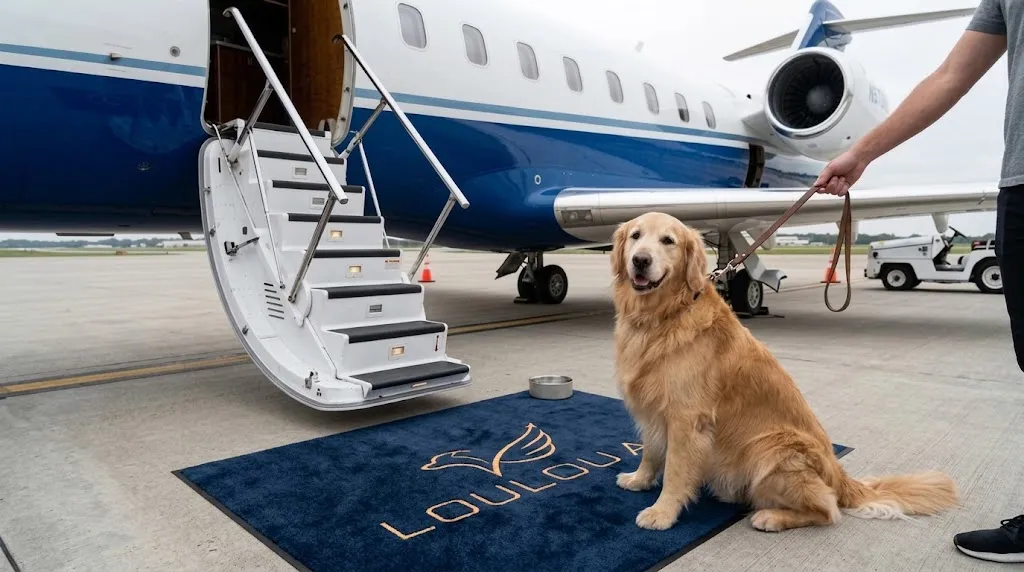
Landing at Teterboro with your dog means landing in New Jersey, at a general aviation airport where US customs processes passengers in its own building, within set hours. Your dog’s paperwork does not change: it is the paperwork of any arrival in the United States, and most of it is done weeks ahead. On our Pay-per-Seat flights into Teterboro, your dog stays in the cabin with you, at your feet for the whole flight, never in the hold.
Where is Teterboro Airport?
In New Jersey, and it belongs to the Port Authority of New York and New Jersey. The airport record published by the FAA, the Federal Aviation Administration, gives the owner as the Port Authority of NY & NJ and the address as 111 Industrial Avenue, Teterboro, New Jersey. The US customs pages for the airport confirm the same address and give its IATA code: TEB.
On the ground, the FAA record lists two runways, one 6,997 ft by 150 ft, the other 6,014 ft by 150 ft. The airport sits on the New York sectional chart and runs on Eastern Time. The data we read is the cycle in force from 1 to 29 October 2026.
One operating rule explains the size of the aircraft you will see there. The certification form published by the Port Authority states that operations of aircraft over 100,000 pounds are not permitted at Teterboro: no aircraft whose actual gross weight exceeds that figure, including passengers, cargo, fuel and equipment, may land, take off or taxi there without the prior permission of the Airport Manager. An operator whose aircraft is certified above the limit must send the completed form and its weight and balance figures to the Airport Manager and to the servicing FBO no less than 72 hours before the operation.
Is Teterboro a US port of entry?
Not in the strict sense, and that is what shapes your arrival. The FAA record lists Teterboro as a landing rights airport and states, on the international operations line, that it is not an airport of entry. The customs page for the airport instead attaches it to an existing port of entry: New York/Newark, New Jersey, number 4601, with entry biometrics available on site.
The consequence is a permission that has to be obtained flight by flight. The general aviation airport fact sheet published by CBP for Teterboro is explicit: the pilot must secure permission to land by contacting CBP at least two hours before departure from the foreign port or place. That permission comes with a tolerance of thirty minutes either side of the stated time. If the estimated arrival falls outside that window, any permission already granted is invalid and the crew has to secure a new one.
None of this is yours to arrange, as it sits with the flight’s operator. It is still worth knowing, because a long delay on departure can move the time of clearance, and with it the time your dog spends on board.
When can your flight land at Teterboro?
During the day or in the evening, not in the middle of the night. Two sets of hours overlap. First, customs: the CBP fact sheet states that inspection services for the entrance and arrival of aircraft at Teterboro are available seven days a week, from 0730 to 2315 Eastern Time, in line with the port’s permission to land procedures. The CBP office keeps wider hours on site, 0700 to 2400, but it is the inspection hours that govern an international arrival.
Second, the airport itself. The flight crew handbook for Teterboro’s Quiet Flying Program, published by the Port Authority, sets out a voluntary restraint on all non-essential aircraft operations during “Quiet Hours”, between 23:00 and 06:00 local time. The same handbook encourages preferential runways and procedures between 22:00 and 07:00, and sets a maximum noise level on runway 24 of 80 dB(A) between 22:00 and 07:00, against 90 dB(A) at other times.
For you, that means a travel day built around a daytime slot. You can plan your dog’s last meal, last walk and breaks around an arrival time you know in advance. Our article on preparing your dog for an eight-hour flight goes through that work the day before and on the day itself.
What happens at the inspection?
Everyone gets off and goes through the same building. The CBP fact sheet for Teterboro states that all crew and passengers are processed inside the FIS, the federal inspection station, and that you should be ready to present passports, visas, pilot’s licence, medical certificate, aircraft registration and user fee decal where it applies.
Two details in that fact sheet bear directly on your dog. First, the operator must advise CBP when carrying live animals, alongside weapons, hunting trophies and commercial imports. Second, the operator chooses which side of the airport will handle the inspection at the time of the landing rights request, the north side at Hangar 1 or the south side at Jet Aviation. That choice changes the end of your journey. At Hangar 1, passengers must reboard the aircraft once the inspection is over, and it then taxis to its FBO. At Jet Aviation, passengers can leave straight from the FIS once the inspection is done.
The fact sheet adds that Teterboro is designated to process passenger flights only, with no cargo: customs clears no freight there, and your dog has no reason to go anywhere near a freight channel.
Which documents does your dog need?
The ones required for any entry into the United States, starting with the CDC form receipt. The frequently asked questions published by the US health agency are clear: all dogs entering or returning to the US must be accompanied by a CDC Dog Import Form receipt, and one receipt is required for each dog. If the person importing the dog cannot complete the form, someone else may fill it in on their behalf, and the CDC strongly recommends doing it well ahead of your travel dates.
One line on that page concerns your arrival airport: the port of entry must match the one listed on the receipt. That is why the airport actually planned should be the one you enter, and why you should tell your broker if the routing changes. For a dog coming from a rabies-free or low-risk country, the CDC also asks for an animal that appears healthy, carries a microchip and is at least six months old; the microchip can be any brand, as long as a universal scanner can read it. The CDC further states that a dog not vaccinated against rabies will not be allowed to enter the United States.
Everything that falls to New Jersey and to New York State is gathered on our travel requirements page, in the section about this arrival: arriving at Teterboro. It covers the health certificate required, the documents to keep on you and what the operator takes care of. Our article on the CDC Dog Import Form, step by step explains how to fill it in, and our travel requirements pages cover the other destinations.
How do you get into Manhattan with a dog?
By road, in almost every case, because neither NJ Transit nor the New York subway and buses will take a dog on a leash. NJ Transit, the New Jersey network, states that only service animals, police dogs and small pets in carry-on travel cages are allowed on board its trains, buses and light rail vehicles. On the New York side, the MTA requires any animal to travel in a bag or other container on the subway and buses, and applies separate policies to service animals.
The run in from the airport, your pick-up options and daily life with a dog once you are there are covered in our guide to New York with your dog. Keep one simple point in mind as you step off the aircraft: you are in New Jersey, not in New York State.
What if your dog flew to New York in the cabin?
It can, on a flight where the cabin is open to it from the start. That is what Loulou Air does, as a brand of AEROAFFAIRES, a private aviation broker since 1991: Pay-per-Seat private jets for your dog and you. You pay for your seat, not the jet, and every ticket covers a seat for one human and their dog. None of the weight limit imposed by scheduled airlines applies, since your dog does not travel in the hold: capacity depends on the aircraft and on how many animals are on board, and a broker clears each dog case by case. Boarding is through a private aviation terminal, with no queues and no separation, and the crew is briefed on welcoming animals. Before departure, our brokers go through your dog’s file with you, bearing in mind that the US requirements apply to every flight, private ones included.
See our flights to New York or talk to a broker. For a whole aircraft, our sister company AEROAFFAIRES handles it.
Frequently asked questions
Does US customs have to be told the dog is on board?
Yes, and the flight’s operator is the one who does it. The CBP fact sheet for Teterboro asks operators to advise customs when carrying live animals, in the same line as weapons, hunting trophies and commercial imports. Your own part is to present the CDC form receipt and your dog’s documents at the inspection.
Can you land at Teterboro in the middle of the night with a dog?
CBP inspection services for arriving aircraft run from 0730 to 2315 Eastern Time, seven days a week, which frames international arrivals. The airport also applies a voluntary restraint on non-essential operations between 23:00 and 06:00 local time, under its noise programme.
Can you take the train into Manhattan with your dog?
Not with a medium or large dog. NJ Transit only accepts service animals, police dogs and small animals in carry-on travel cages, and the MTA requires a bag or container on the subway and buses. Plan on a car, as our New York guide explains.
Sources
Rules change: check them against these sources before every trip.
- FAA - Aeronautical Information Services, airport record for TEB (KTEB)
- CBP - General Aviation Airport Fact Sheet, Teterboro Airport (1 December 2025)
- CBP - Teterboro Airport, biometric location and port of entry
- Port Authority of NY & NJ - 100,000 Pound Aircraft Certification Form (Teterboro)
- Port Authority of NY & NJ - TEB Flight Crew Handbook, Quiet Flying Program
- CDC - Frequently Asked Questions on Dog Importations
- CDC - Bringing a Dog into the United States
- MTA - Traveling with pets
- NJ Transit - Frequently asked questions