New York with your dog: the on-the-ground guide
Leads, parks, taxis, hotels, emergency vets and the journey home: a few days in New York with your dog, with official sources throughout.
By the Loulou Air team · · updated · 11 min read
This guide begins where the paperwork ends: the day your dog sets paw on American soil. It is general information and replaces neither your vet’s advice nor that of the authorities; the rules change without notice, and anything taken from private sources, flagged as such, should be checked on the day you travel.
Entry requirements in brief
The federal health authorities ask for an online form, the CDC Dog Import Form, one per dog and free of charge, a microchip readable with a universal scanner, and a dog at least six months old and healthy in appearance. New York State adds an up-to-date rabies vaccination and a veterinary certificate issued 30 days or less before entry, and it refuses the EU pet passport. New Jersey, where Teterboro Airport is located, also requires a health certificate: aiming for 30 days satisfies both states.
A dog that has been in a high-risk country for dog rabies, such as the United Arab Emirates, in the past six months falls under stricter CDC rules: tell your broker about any stay abroad before you book. The detail and the order of the steps are set out on the US entry requirements page.
How can your dog fly to New York in the cabin?
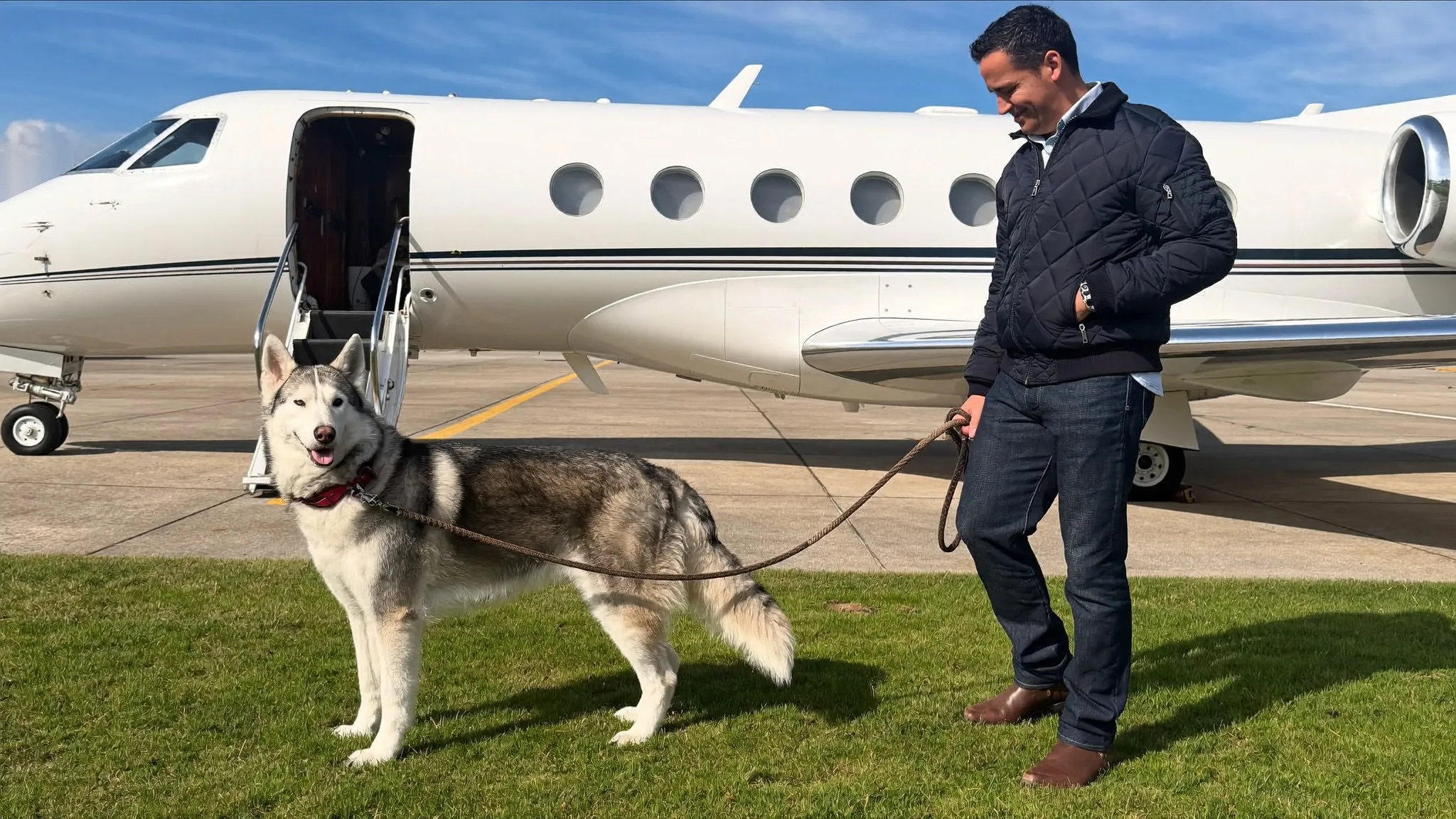
A small dog can travel in the cabin in its carrier on a scheduled flight; for a larger dog that must stay with you, the answer is a private flight, where it travels at your feet instead of in the hold (see Pet in cabin: weight limits, fees and airlines). Loulou Air, a brand of AEROAFFAIRES, a private aviation broker since 1991, offers Pay-per-Seat travel on shared private jet flights from Paris-Le Bourget to Teterboro for New York. You pay for your seat, not the jet, and there is none of the weight limit imposed by scheduled airlines: capacity depends on the aircraft and the number of animals on board. Before departure, our brokers check your dog’s file.
See flights to New York or talk to a broker.
The rules in New York
The rabies jab is not optional
The CDC only strongly recommends rabies vaccination, but New York State requires it for dogs of three months and older arriving from another country. State law requires it for every dog, except an animal transported through the state and remaining there fifteen days or fewer.
According to NYC Health, a dog that has never been vaccinated and has been exposed must be euthanised or isolated for up to six months, while a vaccinated dog is confined and observed for 45 days. If your dog bites someone, it must be watched for 10 days at home, and the official page does not say whether it may leave the city during that period: your flight home may be at risk.
Have your dog vaccinated against rabies in France, before departure, whatever the CDC page says. The State, the City, the parks and the terraces all require it, and it is compulsory for coming back into France.
The lead and off-leash hours
The New York City Health Code, section 161.05(a), requires every dog in a public place to be on a leash no more than six feet long, about 1.83 m, as the city’s 311 service confirms.
In the parks, NYC Parks requires a lead at all times, except in dog runs and in designated off-leash areas, where in practice a dog may be off the lead from 06:00 to 09:00 and from 21:00 to 01:00. The park rules, 56 RCNY 1-04(i)(3), open those windows only to dogs that are licensed, wearing a licence tag and vaccinated against rabies. Dogs are barred from playgrounds, fountains, ball fields and beaches, with seasonal exceptions.
Central Park has no enclosed dog run, but 23 particularly dog-friendly areas. According to a Central Park Conservancy guide, to be treated as an indication, dogs are never allowed on Sheep Meadow and must stay on the lead even during off-leash hours in the Ramble or at Strawberry Fields.
Dog runs
A dog run is a large fenced area where dogs exercise off the lead. In Manhattan, the official list includes Washington Square Park, Tompkins Square Park, Madison Square Park, Union Square, Riverside Park and Hudson River Park. The rules, 56 RCNY 1-05(s)(3), require the dog to wear a licence tag there and be vaccinated against rabies.
Always pick up
New York State law requires dog waste to be picked up in public places, on pain of a fine of up to 250 dollars. In the parks, the NYC Parks schedule sets 100 dollars for failing to remove canine waste, and the same for an unleashed or uncontrolled animal.
The dog licence, a grey area for visitors
The city’s Health Code, section 161.04, provides for a licence for any dog kept in New York City, with the tag on its collar in public places. The Health Department takes two to four weeks to issue it, which makes it unrealistic for a short stay.
311 directs owners whose dog does not live in New York City to the authority where they live, but no official source says explicitly that a visiting foreign owner’s dog is exempt from licensing. The exemption of “less than 30 days for non-residents” that circulates online appears neither in the state law nor in any City source.
Yet the park rules, 56 RCNY 1-04(i)(2), allow entry to a park, even on a lead, only to dogs that are properly licensed. A visitor without a New York tag can therefore be asked to leave a dog run or an off-leash area, or be fined. Until the question is settled in writing, keep your dog on the lead, avoid dog runs and off-leash hours, and carry its French paperwork.
What you should be able to show
NYC Parks and the Health Department FAQ contradict each other on the proof you must carry: take a paper copy or a photograph of the rabies vaccination certificate and of the veterinary certificate issued less than 30 days earlier.
Getting around
Subway and buses: a carrier is compulsory
The MTA requires every pet to travel in a bag or other container, and the rules of conduct of New York City Transit set the fine for an unauthorised animal at 25 dollars. In practice, a medium or large dog can use neither the subway nor the buses: plan for a car or a taxi. The exceptions cover law enforcement dogs and service animals, not emotional support animals and not pet dogs.
Among the commuter railways, Metro-North accepts a dog securely controlled on a leash, while the Long Island Rail Road requires a container that fits on your lap and NJ Transit takes a pet only if it is small and in a carry-on travel cage.
Taxis and ride-hailing
The TLC rules, chapter 80, allow a taxi or for-hire vehicle driver to refuse a passenger accompanied by an animal that is not properly secured in a suitable container, service animals excepted: allow time. Teterboro is not among the destinations a driver may not refuse, so for a trip there from Manhattan a yellow cab driver may refuse, and the fare must be agreed before the trip begins.
Uber Pet takes one pet on a leash, in a harness or in a carrier, for an additional fee whose amount is not published. Lyft Pet is not confirmed for New York City by the operator, and its drivers can opt out of these trips. This commercial information should be checked in the app on the day you travel.
Getting into Manhattan from Teterboro
Teterboro is in New Jersey, 12 miles, roughly 19 km, from Midtown Manhattan, according to the Port Authority, which refers you to the FBO, the business aviation terminal that receives you, for limousines and taxis. NJ Transit is not an option for a medium or large dog. Uber Pet can be booked in advance, up to 90 days ahead for a pick-up at Teterboro.
Book the car before you leave Paris, through the FBO, stating your dog’s size and weight. No official rule says whether a New York yellow cab may pick you up at Teterboro.
Where to stay
These hotels confirm on their official sites that they welcome dogs, but their conditions change often and are sometimes ambiguous: have the maximum weight, the number of animals and the fees confirmed in writing before you pay, especially for a dog of 14 or 15 kg.
- Kimpton Hotel Eventi: no size, weight or number limit, no deposit and no cleaning fee.
- The Plaza: dogs of all sizes, no extra cost, two per room at most, not to be left alone.
- 1 Hotel Central Park: two dogs at no extra fee, but a combined weight of no more than 40 lb per room, 18.1 kg.
- Virgin Hotels New York: no size and no breed restriction, 100 dollars per stay.
- Loews Regency New York: two pets per room at most, 150 dollars per stay.
- The Peninsula New York: one pet per room, up to 65 lb, 29.5 kg, 150 dollars per stay, carried or in a bag in public areas.
- The Ritz-Carlton New York, Central Park: two pets at most, 300 dollars per stay, and a 60 lb limit, 27.2 kg, given sometimes per room and sometimes per pet.
- Sofitel New York: one dog per room, 150 dollars per stay; the hotel announces “30 lbs/15 kgs”, whereas 30 lb is 13.6 kg.
- The Carlyle, A Rosewood Hotel: dogs under 25 lb, 11.34 kg, 50 dollars per night.
- Four Seasons Hotel New York Downtown: dogs under 25 lb, fee not published.
- The Lowell: a 200 dollar cleaning fee, no weight limit given.
- The Mark: the hotel says it welcomes dogs, with neither a fee nor a weight limit shown.
Eating out
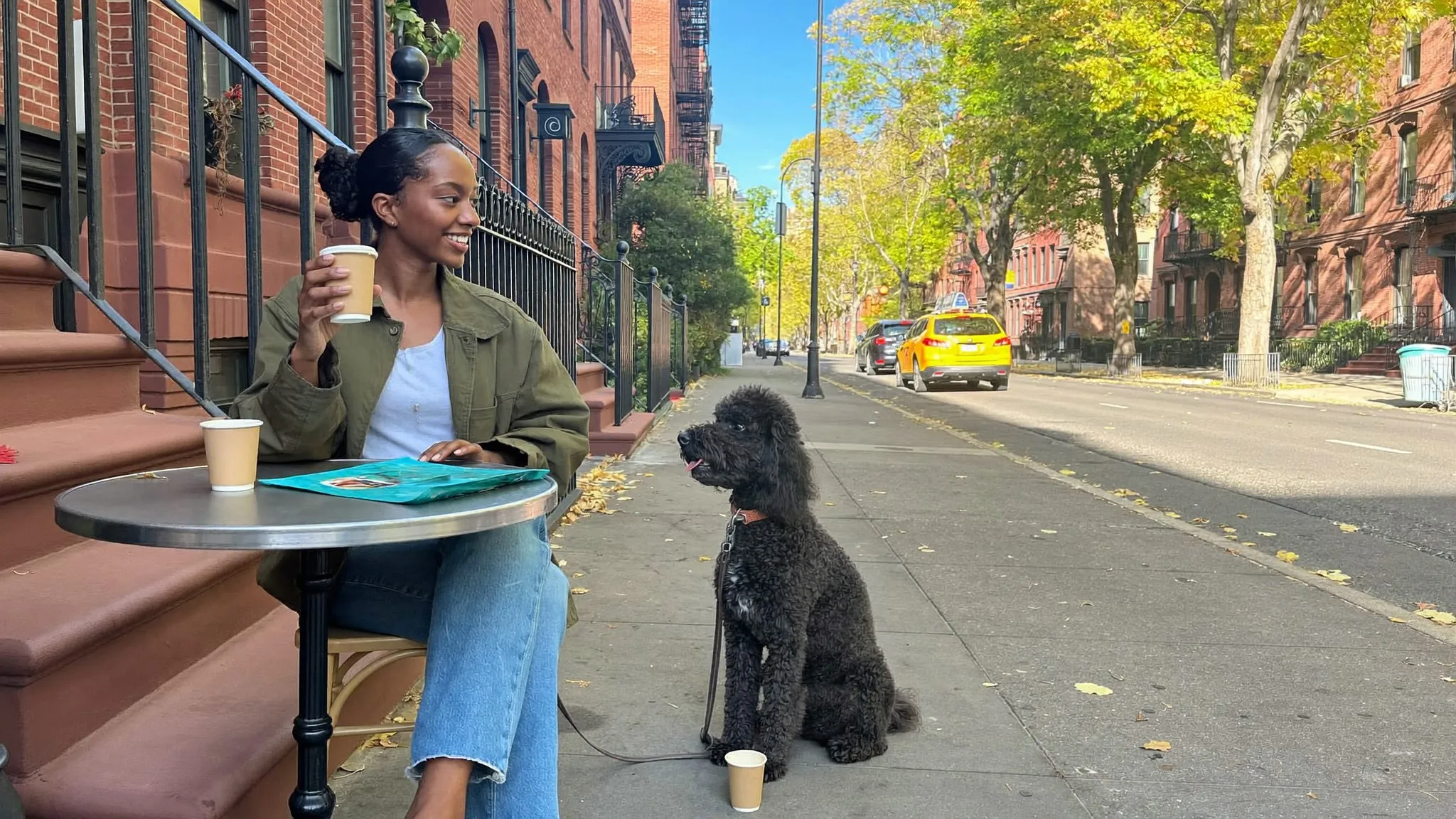
The New York State Department of Health states that restaurants may allow companion dogs in outdoor dining areas, never indoors. None is obliged to, NYC Health points out, and each may limit the number, size and breed of dogs and the tables concerned. There is no official list of them.
State law, section 1352-e, requires the dog to reach the terrace through an outdoor entrance, without going through the restaurant, to stay on a lead or in a carrier under its owner’s control, to keep off chairs and benches, and to be given food and water only in disposable containers. In New York City, the city rules, 24 RCNY chapter 32, add that the dog stays on the floor within arm’s length, and that an enclosed sidewalk café is not an outdoor dining area. The compulsory notice requires a licensed dog, and the rule treats a non-resident owner’s dog as licensed if it holds the licence required where the owner lives.
State and City texts also contradict each other, and no official source consulted says which prevails: ask before you sit down, accept a refusal without argument, and treat an enclosed terrace as an indoor room.
In an emergency
These five Manhattan practices state on their own sites that they run emergency services 24 hours a day. No public authority confirms this independently: call before you set off.
- Schwarzman Animal Medical Center, 510 East 62nd Street. Telephone (212) 838-8100. Emergencies 24 hours a day, seven days a week.
- BluePearl Pet Hospital Midtown, 410 W 55th St. Telephone 212.767.0099. Round-the-clock emergencies.
- BluePearl Pet Hospital Downtown, 1 W 15th St, near Union Square. Telephone 212.924.3311. Round-the-clock emergencies.
- VEG Chelsea, 735 6th Avenue. Telephone (646) 582-8882. Open 24 hours a day, no appointment needed.
- VEG Upper East Side, 1215 2nd Avenue. Telephone (212) 223-3500. Open 24 hours a day.
If your dog swallows something toxic, the ASPCA says to call your vet or its poison control centre on (888) 426-4435, where a consultation fee may apply.
Four other risks are worth knowing about: leptospirosis, which spreads notably through rat urine, ticks, found in all five boroughs, burning pavements in hot weather and road salt in winter. Talk to your vet in France several weeks before departure: a vaccine does not protect on the day it is given. The details are in our article Your dog’s health in New York.
If your dog gets lost
The municipal shelter, Animal Care Centers of NYC, telephone (212) 788-4000, is required to hold a stray animal with no identified owner for three days only, after which the dog may be put up for adoption or transferred. Act within the first hour: call the shelter, go there in person, and tell your hotel and your broker.
We could not verify whether American shelters check the French microchip register, I-CAD, so do not rely on the chip alone. Have a tag engraved with a telephone number reachable in the United States, yours, your hotel’s or your broker’s, and keep photographs of your dog on your phone.
Coming home to France
According to the French Ministry of Agriculture FAQ, rabies vaccination is compulsory to bring a dog into France from a third country, and the protection only becomes valid 21 days after the injection. No blood test is required for a dog returning from the United States, which appear in Annex II to Implementing Regulation (EU) 2026/636.
The EU pet passport is enough only if it was filled in before leaving the Union and the rabies vaccination cover has not changed: a vaccine given or repeated in the United States means an official health certificate, which can delay or even cost you the planned return flight.
The dog must enter through a travellers’ point of entry, such as Paris-Le Bourget, where you present yourself to customs on your own initiative; if the conditions are not met, the animal may be sent back, quarantined or euthanised at the owner’s expense. Finally, French law prohibits the importation, including transit, of category 1 dogs: a category 1 dog that goes to the United States does not come back. The whole return journey is covered in Bringing your dog home to France from the US.
Sources
Rules change: check them against these sources before every trip.
- CDC - Dogs from rabies-free or low-risk countries
- CDC - List of high-risk countries for dog rabies
- New Jersey Department of Health - Importing a dog or cat
- New York State, Agriculture and Markets - Companion animal import
- New York State - Public Health Law 2141, rabies vaccination
- NYC Health - Rabies in New York City
- New York City Health Code - Article 161, dogs
- NYC Parks - Dogs in parks and dog runs
- New York City park rules - 56 RCNY 1-04
- New York City park rules - 56 RCNY 1-07, schedule of fines
- NYC 311 - Leash, off-leash areas and dog runs
- NYC Health - Dog licence
- New York State - Public Health Law 1310, picking up after your dog
- MTA - Travelling with a pet
- New York City Transit - Rules of conduct, January 2025
- TLC - Driver rules, chapter 80
- TLC - Yellow taxi fares
- Port Authority of New York and New Jersey - Teterboro Airport
- New York State - Public Health Law 1352-e, dogs in outdoor dining areas
- New York State Department of Health - Food service questions
- New York City - 24 RCNY chapter 32, dogs in outdoor dining areas
- NYC Health - Outdoor dining with dogs fact sheet
- NYC Health - Leptospirosis
- NYC Health - Ticks
- NYC Health - Veterinary advisory on extreme heat, 11 June 2026
- NYC Emergency Management - Winter weather preparedness
- Animal Care Centers of NYC - Lost and found
- French Ministry of Agriculture - Importing a pet from a third country
- Implementing Regulation (EU) 2026/636
- European Commission - Travellers' points of entry
- Central Park Conservancy - Dog owner guide