Your dog's health in New York
Your dog's health in New York: round-the-clock emergency vets, leptospirosis, ticks, burning pavements and road salt, with the sources for each.
By the Loulou Air team · · updated · 5 min read
In New York, your dog is exposed to leptospirosis, ticks, burning pavements in hot weather and ice-melting chemicals in winter. Ask your vet about the leptospirosis vaccine several weeks before departure, arrange parasite treatment, and adapt your walks to the season. In an emergency, five Manhattan practices say they are open 24 hours a day.
Where can I find an emergency vet in New York?
These five Manhattan practices state on their own sites that they run emergency services 24 hours a day. No public authority confirms this independently: call before you set off.
- Schwarzman Animal Medical Center, 510 East 62nd Street, NY 10065. Telephone (212) 838-8100. Emergencies 24 hours a day, seven days a week, all year, according to the centre.
- BluePearl Pet Hospital Midtown, 410 W 55th St, NY 10019. Telephone 212.767.0099. Round-the-clock emergencies, specialist consultations by appointment.
- BluePearl Pet Hospital Downtown, 1 W 15th St, NY 10011, near Union Square. Telephone 212.924.3311. Round-the-clock emergencies.
- VEG Chelsea, 735 6th Avenue, NY 10010. Telephone (646) 582-8882. Open 24 hours a day, no appointment needed.
- VEG Upper East Side, 1215 2nd Avenue, NY 10065. Telephone (212) 223-3500. Open 24 hours a day.
If your dog swallows something toxic, the ASPCA says to call your vet or its poison control centre on (888) 426-4435. The charity notes that a consultation fee may apply.
Does my dog need a leptospirosis vaccine?
Ask your vet in France several weeks before departure: a vaccine does not protect on the day it is given.
Leptospirosis spreads notably through rat urine. NYC Health writes that cases have been reported in dogs throughout the city, and advises asking your vet whether your dog should be vaccinated.
Are there ticks in New York?
Yes. According to NYC Health, American dog ticks live in all five boroughs of the city, and dogs and cats can get sick from ticks.
Arrange parasite treatment before departure, and check your dog’s coat after every walk in a park or in grass.
How do I protect my dog from the heat in New York?
Walk it early in the morning or late in the evening, keep it off hot surfaces, and never leave it alone in a parked car.
Burning pavements
The surface of asphalt, concrete, sand and metal can be 40 to 60 degrees hotter than the air, writes NYC Health in its veterinary advisory of 11 June 2026. That sentence gives no unit; the document uses Fahrenheit elsewhere. If it is indeed Fahrenheit, the gap works out at roughly 22 to 33 degrees Celsius above air temperature.
The ASPCA gives a worked example: air at 77 degrees Fahrenheit, 25 degrees Celsius, with asphalt at 125 degrees Fahrenheit, about 51.7 degrees Celsius. The same charity advises against letting a dog linger on hot asphalt in high temperatures: its pads can burn, and its body, close to the ground, heats up fast.
When to walk
NYC Health recommends walking pets early in the morning or late in the evening, avoiding hot surfaces as far as possible, and checking the heat index rather than the temperature alone, since humidity hampers an animal’s cooling.
Signs of burned paw pads are limping, reluctance to walk, and blisters or redness on the paws.
Heatstroke
Most at risk of heatstroke are:
- short-nosed breeds;
- large dogs;
- older animals, overweight animals, and those with heart or lung disease;
- dogs with long or thick coats.
If an animal overheats, move it into the shade, douse it with cool rather than cold water, do not cover it with wet towels, and see a vet.
Fifteen municipal cooling centres accept pets, with more during heat emergencies. The list is at finder.nyc.gov/coolingcenters or on 311.
Never alone in a car
An animal is never left alone in a parked car, even with the windows open, and NYC Health asks you to call 911 if a pet is seen alone in a hot car. The CDC notes that the temperature inside a car can rise almost 20 degrees Fahrenheit, about 11 degrees Celsius, within the first 10 minutes, even with a window cracked open.
New York State law, section 353-d, forbids confining an animal in a vehicle in extreme heat or cold without ventilation or other protection where this places it in imminent danger of death or serious injury. The fine runs from 50 to 100 dollars for a first offence and from 100 to 250 dollars thereafter. Police, emergency medical services and firefighters may remove the animal if the driver cannot be found. The text sets no temperature threshold, and the ASPCA adds that a car holds in the cold just as readily.
What should I do about road salt?
Wipe your dog’s paws. If your stay falls in winter, NYC Emergency Management advises it: ice-melting chemicals can make a pet ill.
The detailed advice comes from the ASPCA, a charity rather than a public authority, and no official New York data quantify this toxicity. The ASPCA warns that a walk becomes dangerous if the dog licks these chemicals off bare paws. It recommends:
- washing and drying the paws and stomach after every outing;
- applying petroleum jelly or a vet-approved paw protectant before going out;
- adding booties as extra protection.
This advice does not replace your vet’s. For leads, parks, getting around and hotels, see our guide New York with your dog.
How can your dog fly to New York without the hold?
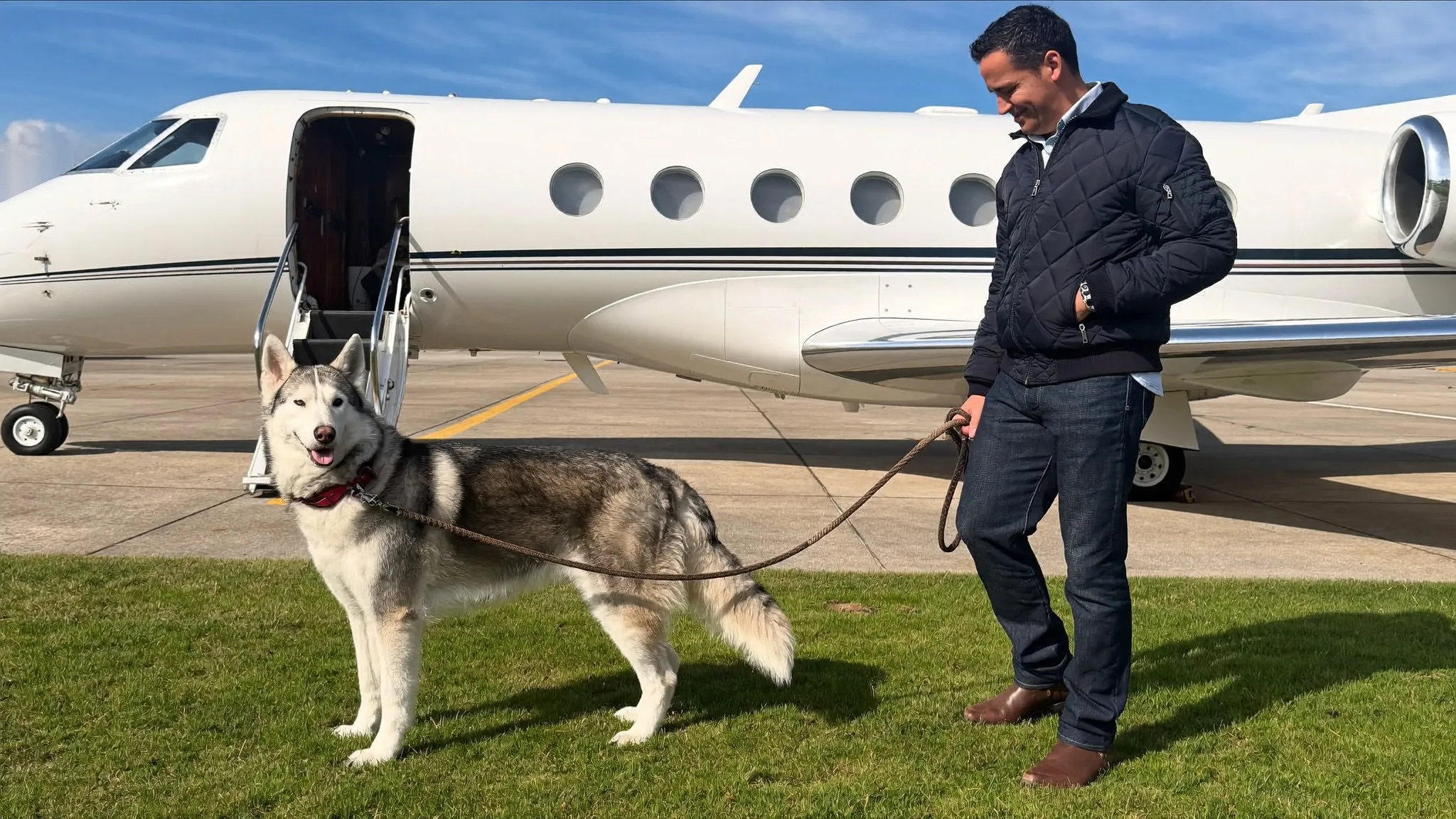
By flying in the cabin, at your feet: that is the principle of Loulou Air, a brand of AEROAFFAIRES, which offers Pay-per-Seat private jets from Paris-Le Bourget to Teterboro for New York. Your dog does not spend hours apart from you in the dark and the noise of the hold. On board, the crew is briefed on welcoming animals, and water, bowls and blankets are provided. Before departure, our brokers check your dog’s file, CDC form included.
See flights to New York or talk to a broker. The risks of the hold are set out in Dogs in the cargo hold: the real risks.
Frequently asked questions
Are New York emergency vets open at night?
Five Manhattan practices, listed above, say on their sites that they run emergency services 24 hours a day. No public authority confirms this independently, so call before you set off.
When should I walk my dog in hot weather?
Early in the morning or late in the evening, keeping off hot surfaces as far as possible, as NYC Health recommends. Check the heat index too, since humidity hampers an animal’s cooling.
Can I leave my dog in the car for a few minutes?
No, not even with the windows open. According to the CDC, the temperature inside a car can rise almost 20 degrees Fahrenheit, about 11 degrees Celsius, within the first 10 minutes, even with a window cracked open.
Sources
Rules change: check them against these sources before every trip.
- NYC Health - Leptospirosis
- NYC Health - Ticks
- NYC Health - Veterinary advisory on extreme heat, 11 June 2026
- NYC Health - Extreme heat and your health
- NYC Emergency Management - Winter weather preparedness
- New York State - Agriculture and Markets Law 353-d, animals confined in vehicles
- ASPCA - Hot weather safety tips
- ASPCA - Cold weather safety tips