Preparing your dog for an eight-hour flight
An eight-hour flight with a dog: the vet visit, crate training, meals, water, sedatives and paperwork, as set out by IATA and the Swiss FSVO.
By the Loulou Air team · · 8 min read
An eight-hour flight with a dog is prepared weeks ahead, and most of the useful work happens before the day of departure: the vet visit, getting your dog used to its travel bag, adjusting its meals, and the paperwork of the country you are landing in. IATA, the international airline association, and the FSVO, Switzerland’s federal food safety and veterinary office, publish precise recommendations on each of those points. On a scheduled flight, those eight hours are spent in a closed bag under a seat; on our Pay-per-Seat flights, your dog spends them in the cabin at your feet, never in the hold.
How long is a Paris to New York flight?
Just under eight hours non-stop: our shared flights between Paris-Le Bourget and Teterboro are scheduled at 7 hours 45 minutes. On top of that come the wait before boarding, taxiing, and the formalities on arrival.
It is that whole span you have to prepare for, not only the time in the air. A dog that spends eight hours at home without difficulty is not going through the same thing shut in a bag, in the noise, surrounded by strangers. IATA puts it plainly in its guidance for passengers: travelling has an unsettling effect on animals, and they must be disturbed as little as possible.
Does your dog need to see a vet before a long flight?
Yes, and that is the first step. IATA states that most airlines require a health certificate for any animal they carry, in the cabin or in the hold: your vet issues it, and it states that the animal is healthy and fit to fly. Its cabin guidance adds that a health certificate is required for international travel, that it may be time sensitive, and that sick, injured or debilitated animals may not be suitable for travel. That call belongs to the vet.
The FSVO suggests using that appointment for two things owners often forget: vaccines and worming treatments, since vets can advise which ones are needed for the destination, and whether any medication or special food is worth considering. After the trip, the same authority advises watching your animal and seeing a vet if it shows unusual tiredness, loss of appetite, fever, digestive trouble or discoloured urine.
How do you get a dog used to its travel bag?
By starting weeks before the flight, not the night before. IATA is specific: let your animal become familiar with its crate or kennel a few weeks or months before your planned departure, buy it in advance, and get your dog used to being confined in it. The association sums up why: taking an animal out of its usual surroundings is by definition stressful, and animals behave perfectly fine when they are accustomed to the container they travel in.
The FSVO points the same way for car journeys, recommending a crate that is familiar to the animal and noting that when a pet gets travel sick, it helps to accustom it to long journeys gradually. An eight-hour flight is the wrong moment for a first encounter with a brand-new bag.
Two steps not to forget. IATA advises reconfirming at least 48 hours before departure, because some airlines restrict the number of animals on a flight. The FSVO adds that you must declare your animal to the airline.
What does a dog eat and drink during eight hours in the air?
Nothing, in practice, if it is travelling in a bag in the cabin: IATA states that dogs must not be removed from their travel containers during the flight and that the container should not be opened in flight. Everything is therefore decided before boarding, and IATA’s advice comes down to three moves:
- The day before, reduce the quantity of food while still giving your dog enough water.
- At least two hours before the flight, a light meal, which helps calm the animal. IATA notes that this light meal before the animal is handed to the carrier is a legal requirement in the United States.
- Just before crating, a short drink and some exercise. IATA also advises walking your dog before leaving for the airport, and again before check-in.
For the flight itself, the container must be able to hold any urine and faeces, and absorbent bedding must be provided, clean and leak-proof: the practical options are covered in our article on toilet breaks, water and food on a flight. The FSVO adds one tip for the other end: take enough of your dog’s usual food, because it is not available everywhere.
Can you give your dog a sedative before an eight-hour flight?
As a general rule, no. The FSVO writes that sedatives are generally not necessary and that they can have side effects such as muscle weakness or a reduced sensation of thirst. On a long flight the second one matters: a dog that drinks less over eight hours is not better prepared.
IATA takes the same line. The association has long discouraged the use of sedatives and tranquilizers in animals being transported, as cargo or as cabin baggage, because of the potential for adverse effects during transport, and notes that this view is endorsed by veterinary organizations such as the American Veterinary Medical Association. Its cabin guidance adds two points: tranquillizers reduce an animal’s ability to respond to the stress of transport, and an airline may refuse to carry a sedated animal.
If treatment is medically justified anyway, IATA requires that it be given under a veterinarian’s direction, that the drug, time and dosage be noted on the health certificate, and that the airline be told.
The FSVO says that for very anxious animals, calming pheromones are an alternative to sedatives, and that anti-nausea medicines should only be used after talking to your vet. No product replaces habituation: our article on keeping your dog calm on a flight covers that preparation.
Which bag or crate for an eight-hour flight?
One your dog can stand up, sit erect, turn around and lie down in, in a natural position: that is IATA’s sizing rule. For the cabin, its guidance adds points to check before buying: the bag must fit under the seat in front of you, have ventilation openings over at least 16% of the area of its four vertical sides, be leak-proof and escape-proof, and carry a “Live Animals” label.
One trap concerns soft-sided bags, the most common in the cabin: IATA notes that they may compress when pushed under the seat, and that squashing the ventilation openings reduces airflow and builds up heat inside.
Two cases call for more care. For snub-nosed breeds, IATA requires a container 10% larger and advises against transport in the hot season, as these dogs struggle to keep a normal body temperature in hot weather: see our article on flying with a snub-nosed dog. For large dogs, the cabin on scheduled flights is closed, IATA noting that only small dogs and cats can travel there: the limits airline by airline are in flying with a dog over 8 kg.
What paperwork do you need to land in New York?
The paperwork of the country you are landing in, started very early. The USDA, the US agriculture department, advises getting to it as soon as you decide to travel, because meeting the requirements takes time, and IATA’s cabin guidance warns that obtaining the documents could take several months.
For the United States, the CDC, the federal health agency, requires a dog at least six months old, microchipped with a chip readable by a universal scanner, appearing healthy on arrival, and accompanied by its import form receipt. The form is completed by the person bringing the dog in, and the receipt is shown to the airline before boarding, then to US Customs and Border Protection on arrival. The CDC recommends filling it in ahead of your travel dates. The step-by-step is in our article on the CDC Dog Import Form and on our page of entry requirements for the United States.
Leaving France, service-public.gouv.fr sets out three basic conditions: the dog must be identified by a microchip, hold an EU pet passport issued by a vet, and be vaccinated against rabies, the vaccination having to come after the identification to count as valid. Our travel requirements by destination cover the rest.
What if your dog spent those eight hours at your feet?
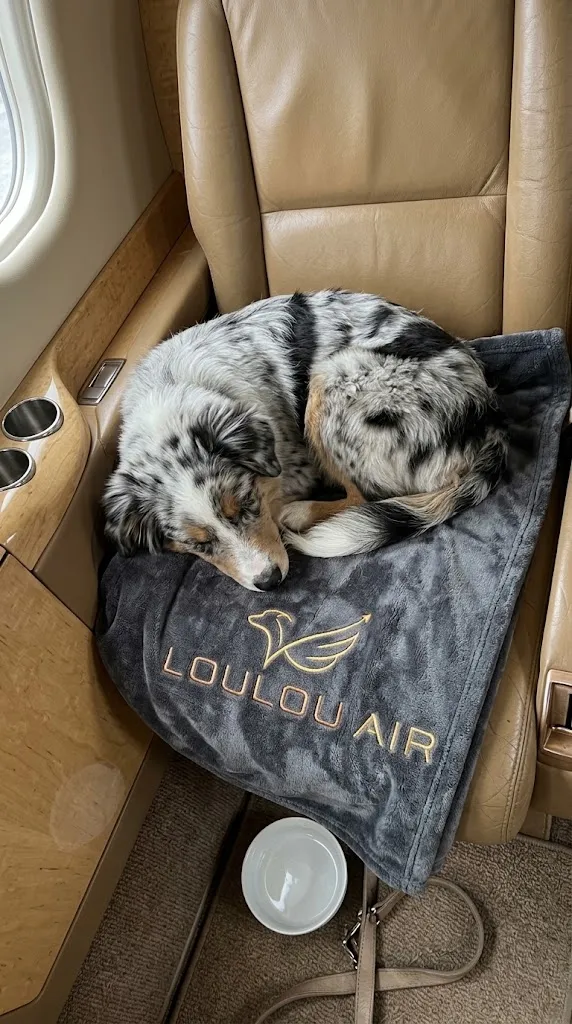
That is what a shared private flight changes: your dog is not shut in a bag under a seat, it stays in the cabin at your feet for the whole flight, never in the hold. Loulou Air is a brand of AEROAFFAIRES, a private aviation broker since 1991, and sells Pay-per-Seat private jets for your dog and you: you pay for your seat, not the jet, and every ticket covers one seat for a human and their dog. There is none of the weight limit imposed by scheduled airlines, and a broker clears each dog case by case, depending on the aircraft and the number of animals on board. Over eight hours the crew is briefed on welcoming animals, with water, bowls and blankets provided, and your dog has its own space in the cabin. Boarding is through a private aviation terminal with no queues and no separation, and entry requirements still apply on every flight, private ones included: our brokers check every file before departure.
See our flights to New York or talk to a broker, who will go through your dog’s preparation schedule with you.
Frequently asked questions
How far ahead should you start preparing your dog?
Several weeks. IATA advises letting your dog get familiar with its bag or crate a few weeks or months before departure. For the paperwork, the USDA says to start as soon as you decide to travel, and IATA warns that obtaining the documents could take several months.
Can you take your dog out of its bag during an eight-hour flight?
No. IATA’s guidance for passengers travelling with a dog in the cabin states that the animal must not be removed from its container during the flight and that the container should not be opened. On a shared private flight the question does not arise in the same way: the dog stays in the cabin, at your feet.
Should your dog fast before a long flight?
No. IATA advises reducing the quantity of food the day before while still letting your dog drink enough, then feeding a light meal at least two hours before the flight. A short drink and some exercise are recommended immediately before crating.
Sources
Rules change: check them against these sources before every trip.
- IATA - Traveler's Pet Corner (Traveling with pets)
- IATA - Guidance for Passengers Traveling with their Dog or Cat in the Cabin (PDF)
- FSVO (Switzerland) - Preparing to travel with your pet
- CDC - Dog importation, frequently asked questions
- CDC - CDC Dog Import Form instructions
- USDA APHIS - Pet travel
- Service-Public (France) - Travelling abroad with a pet