Dog stress on a flight: what vets advise
Noise, pressure changes and confinement: what makes flying stressful for a dog, the signs to watch for, and what veterinary bodies recommend.
By the Loulou Air team · · 8 min read
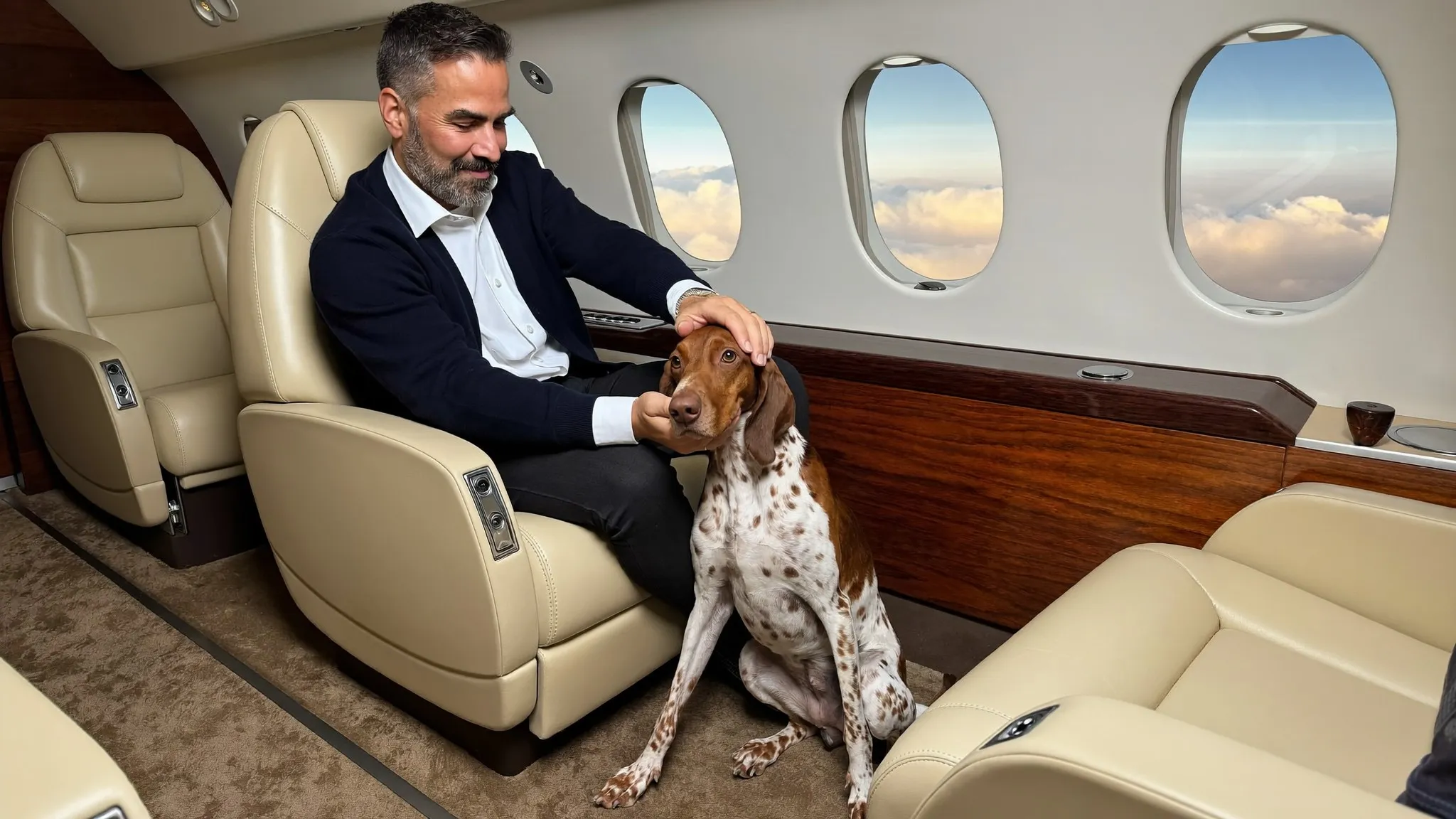
A flight puts a dog through things it meets nowhere else: engine noise, acceleration on take-off, pressure changes and several hours of confinement. Most of the work happens before departure, and veterinary authorities and the air transport industry converge on what helps and on what to avoid. Here is what they actually write, source by source. On Loulou Air’s Pay-per-Seat private jets, your dog travels in the cabin with you and stays at your feet for the whole flight, with no hours of separation in the dark and the noise of the hold.
What makes flying stressful for a dog?
The noise, the movement of the aircraft and the confinement, before the question of the hold even comes up. Cornell University’s Riney Canine Health Center writes that even when flying in the cabin, the sounds of the plane, the acceleration, lift-off, landing and pressure changes can be stressful for a dog.
IATA, the International Air Transport Association, starts from the same point in its 15 July 2026 guidance for passengers travelling with a dog in the cabin: travelling has an unsettling effect on animals and they must be disturbed as little as possible. It adds that domesticated animals prefer dim light, as this helps to calm them and reduces stress.
Scheduled flights add a constraint of their own: the dog must not be removed from its travel container during the flight, and the container must not be opened on board. On a long-haul route, that covers the entire journey.
The hold is another matter. Cornell writes that the cargo area can be quite stressful and poses serious safety risks: a panicking animal may try to escape its crate or injure itself chewing on it, resulting in broken teeth or paw pad injuries. Incidents are rare, the centre notes, but injuries and deaths in cargo have occurred. Short-muzzle breeds and dogs with underlying heart or respiratory disease are the most exposed. Our article on dogs in the cargo hold covers this in detail.
How do you spot the signs of stress in a dog?
Through body language, and by reading the dog as a whole rather than one isolated sign. The PDSA, the British veterinary charity, is firm on this: you need to look at the dog as a whole and the situation they are in, not a single clue.
The signs it lists:
- yawning when not tired, licking the nose or lips;
- a low or tucked tail, ears pinned back, stiff or tense body language;
- panting even though the dog is not warm;
- keeping the eyes on something with the head turned away, so the whites of the eyes show;
- withdrawing or turning away when approached, not eating, low energy.
Cornell’s Riney centre lists much the same for anxiety, adding drooling, excessive barking, shaking and whining.
The PDSA advises contacting your vet for a check-up if a dog’s behaviour changes suddenly. That holds before a trip too: it is far better to spot a problem weeks ahead than at check-in.
Should you sedate your dog before a flight?
No, not without veterinary advice, and both sedatives and tranquillizers are explicitly advised against on board. IATA writes that it does not encourage the use of sedatives and tranquilizers in animals being transported either in cabin or cargo hold due to the potential for adverse effects during transport, and notes that this view is endorsed by veterinary organizations such as the American Veterinary Medical Association. Its July 2026 guidance adds that tranquillizers reduce an animal’s ability to respond to stress during transportation, and that airlines may refuse to carry a sedated animal at their discretion.
Cornell explains the mechanism: dogs should never be tranquilized, as this can suppress breathing and lead to serious health complications during flight, particularly in cargo where nobody is watching. The centre does distinguish this from anti-anxiety medication, which it says may sometimes be prescribed for travel. If your dog is anxious when travelling, it advises talking to your vet, who may refer you to a veterinarian specialised in behaviour. Nothing here is a decision to make alone, and certainly not the night before.
How should you prepare your dog in the weeks beforehand?
Gradually, and by starting early. IATA asks that dogs be introduced to the travel container well before the journey, so that their stress at being confined in it during the trip is minimised.
Cornell sets the pace. Some dogs acclimate to car rides within a week, others take a few months, so the sooner you start the better. Sessions stay short and enjoyable, around five to ten minutes, and you begin by introducing the crate or carrier with positive reinforcement and your dog’s favourite treats. If your dog becomes anxious during training, you are progressing too quickly.
The principle is that of any desensitisation. For separation anxiety, Cornell describes the method: walk out of the room and come straight back, then gradually increase the time you are out of sight, without expecting a quick fix. The centre also spells out what to avoid: trainers who use harsh, punitive methods such as yelling, jerking leashes, pinch collars or shock collars, and anyone promising a quick fix. If you are not making progress, it recommends consulting a veterinary behaviourist or a qualified humane trainer early.
The paperwork runs on the same clock. The French Ministry of Agriculture states that travelling with an animal has to be prepared well in advance, and that a rabies vaccination is only valid in law at least twenty-one days after the date of vaccination if the animal was not already up to date. See our travel requirements by destination and our article on the EU pet passport.
What should you do on the day?
A light meal well before the flight, water until the last moment, and exercise just before. IATA advises a light meal and a small drink roughly two hours before the animal is handed over, then exercise immediately before it goes into its container. It adds that you can, and should, keep offering water right up to the time of travel.
Cornell frames the meal question around motion sickness: many dogs, especially puppies, get nauseous when travelling, and the centre advises avoiding food in the four to six hours before the trip. The two recommendations differ at the margin, not in substance: either way, no full bowl at boarding time.
Three more points on the day:
- Heat. The French Ministry of Agriculture warns never to leave an animal shut in a vehicle or an unventilated, non-temperature-controlled space, even briefly, and to offer fresh water and breaks regularly. An animal can die very quickly of heatstroke.
- Identification. Cornell advises checking that the dog is microchipped and wears an ID tag with up-to-date contact details.
- Familiar things. The centre recommends bringing items of comfort from home and keeping normal feeding and walking times, because dogs run on routine.
What can you do during the flight?
Not much on a scheduled flight, which is exactly why preparation matters. IATA repeats that the container must not be opened nor the dog taken out during the flight, and that the passenger remains responsible for the dog’s behaviour on board.
One technical point matters in the cabin: IATA notes that soft-sided containers may compress once pushed under the seat, and that compressing the ventilation openings reduces airflow and causes heat to build up inside. Check how rigid a bag is before buying it.
Dogs Trust sums up what to do with a frightened dog: stay calm, gently reassure, keep your movements slow and steady, and avoid telling them off or forcing interactions. The charity also recommends giving them a safe space to rest undisturbed, and keeping routines calm and predictable.
How can your dog avoid hours in the hold?
By taking a flight where it stays in the cabin with you. That is the principle behind Loulou Air, a brand of AEROAFFAIRES, a private aviation broker since 1991: Pay-per-Seat private jets for your dog and you. On our shared flights you pay for your seat, not the jet, and your four-legged companion travels in the cabin with you, never in the hold, with none of the weight limit imposed by scheduled airlines. There are therefore no hours of separation in the dark and the noise of the hold: boarding is through a private aviation terminal, with no queues, and your dog boards with you. The crew is briefed on welcoming animals; water, bowls and blankets are provided, and your dog has its own space in the cabin, with its blanket, its bowl and its owner within reach. A broker checks every dog case by case and reviews its file before departure; entry requirements, for their part, still apply on every flight, private ones included.
Our flights serve New York, Dubai and Los Angeles: see our open flights. For anywhere else, we open new routes every month, so tell us where you want to go: speak to a broker, or, for a whole aircraft, our sister company AEROAFFAIRES.
Frequently asked questions
Can you give a dog a tranquillizer before flying?
IATA advises against sedatives and tranquillizers in the cabin and in the hold, because they reduce an animal’s ability to respond to stress during transport, and an airline may refuse a sedated dog. Cornell states that dogs should never be tranquilized, as this can suppress breathing. Any question of medication is one for your vet, who may refer you to a colleague specialised in behaviour.
How long before a flight should you feed a dog?
IATA advises a light meal at least two hours before the flight, with a small drink and exercise just before the dog goes into its container. Cornell prefers avoiding food in the four to six hours before the trip, to reduce the risk of nausea. Either way, water stays available until departure.
My dog has never flown. Where do I start?
With the container, well before departure. IATA asks that the dog be introduced to it long in advance to reduce the stress of being confined, and Cornell advises short five to ten minute sessions using positive reinforcement, slowing down as soon as the dog shows anxiety. The centre notes that some dogs acclimate to car rides within a week while others take a few months, so start early.
Sources
Rules change: check them against these sources before every trip.
- IATA — Traveling with Pets
- IATA — Guidance for Passengers Traveling with their Dog or Cat in the Cabin, edition 1, 15 July 2026
- IATA — press release of 15 July 2026 on the in-cabin pet travel guidance
- Cornell University College of Veterinary Medicine, Riney Canine Health Center — Traveling safely with your dog
- Cornell University College of Veterinary Medicine, Riney Canine Health Center — Anxious behavior
- PDSA — Tips to identify and prevent stress in dogs
- Dogs Trust — Why dogs get scared or frustrated and how to help them
- French Ministry of Agriculture — Comment voyager avec son animal de compagnie ?