Flying with a snub-nosed dog: the rules
Which breeds count, the airlines that bar them from the hold, cabin weight limits and the warning signs to check, from official pages only.
By the Loulou Air team · · 7 min read
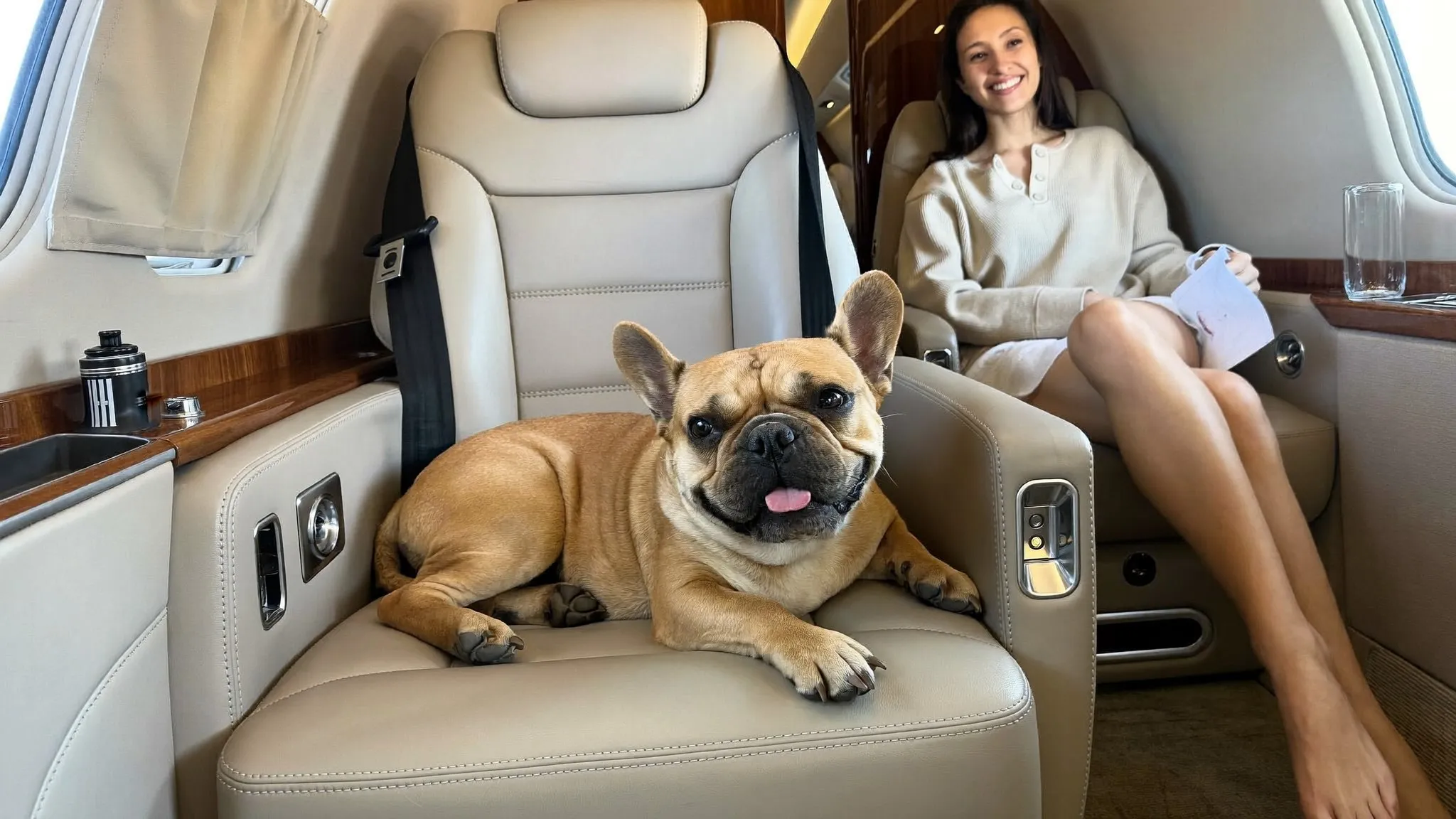
A snub-nosed dog has a harder time flying than other dogs, and airlines say so in plain words: Delta no longer takes one as checked baggage, Air Canada bars it from the baggage compartment, and Corsair refuses it even in the cabin. The reason is anatomical, not administrative: these dogs breathe less easily and cool themselves less easily than other dogs. That leaves the cabin, if your dog stays under the weight cap, or a private flight where the weight question does not arise in the same terms: on Loulou Air flights the dog travels in the cabin with you, never in the hold.
Which breeds count as brachycephalic?
The word describes dogs whose skull bones are compressed, giving them a flattened face. Cornell University’s College of Veterinary Medicine states that brachycephalic obstructive airway syndrome, or BOAS, is seen most frequently in the English bulldog, pug, French bulldog and Boston terrier, and also lists the boxer, Pekingese, shih tzu, Chinese shar-pei, Lhasa apso and bull mastiff.
Airline lists go wider still, because they work from breed names rather than a clinical exam. Delta names twenty-five dog breeds, from the Boston terrier to the Tibetan spaniel, taking in the chow chow, the Lhasa apso and every mastiff. TAP Air Portugal adds breeds most owners would never expect: the Cavalier King Charles spaniel, the chihuahua and the Griffon Bruxellois. Crossbreeds are covered too, and TAP refuses them unless a vet certificate states that the animal does not show the characteristics of its original breeds.
So check your airline’s own list rather than your instinct. A chihuahua is not a bulldog, but it sits on TAP’s list all the same.
Why does a short muzzle matter in the air?
Because the same anatomy gets in the way of both breathing and cooling. The University of Cambridge’s Department of Veterinary Medicine explains that excessive selection for brachycephaly has deformed the upper airway and created obstructions, and that affected dogs must increase their inspiratory effort to overcome that resistance and ventilate properly. Cornell sets out the anatomy behind it: congenitally small nostrils that may collapse as the dog inhales, an elongated soft palate that blocks airflow into the larynx, everted laryngeal saccules, and in some dogs a narrowed windpipe.
The second mechanism is thermal. A dog does not sweat; it lowers its body temperature by panting. Cambridge notes that in an obstructed brachycephalic dog the airway becomes inflamed and swollen during panting, which worsens both the obstruction and the overheating. The Royal Kennel Club adds that the nose is the main site of heat exchange in a dog’s body, and that flat-faced dogs are at high risk of overheating in warm weather. Weight makes it worse: Cambridge notes that excess fat tissue surrounds and narrows the airway.
A flight therefore stacks up exactly what these dogs handle least well: heat, waiting and stress.
Which airlines refuse snub-nosed dogs?
The refusals start with the hold, and sometimes cover the whole aircraft. Delta states that it no longer accepts snub-nosed or pug-nosed dogs and cats as checked baggage. Air Canada writes that these breeds cannot travel in the baggage compartment because they face increased risks of heat stroke and breathing problems when exposed to extreme heat or stressful situations. TAP Air Portugal puts it more bluntly: a brachycephalic animal must not travel in the hold, because that poses a risk of death within the hold’s usual temperature range, which it gives as 10 to 19 °C.
One case is stricter again. Corsair states that brachycephalic dogs and cats are not accepted on its flights at all, neither in the cabin, nor in the hold, nor as cargo. A 5 kg French bulldog that would fit under the seat without trouble still does not board.
Some airlines, on the other hand, carry no animals in the hold at all, flat-faced or not: Vueling writes that under no circumstances will animals be carried in the cargo hold. And with Emirates, animals are not permitted in the cabin apart from falcons on certain routes and guide dogs for the visually impaired; on any itinerary ending in Dubai, the animal travels as cargo. Our articles Dogs in the cargo hold: the real risks and Pet in cabin: weight limits, fees and airlines go through both routes.
Can a snub-nosed dog travel in the cabin?
Yes, on several airlines, if it fits in a bag under the seat and stays under the weight cap. TAP Air Portugal sets a maximum of 8 kg for dog and carrier combined, in a bag of 45 x 30 x 23 cm. Corsair also applies 8 kg including the container, and states that above that limit the animal must travel in the hold, which is exactly where snub-nosed breeds are not allowed. Vueling allows a soft carrier of 45 x 39 x 21 cm, up to 10 kg with the pet inside. Air Canada accepts a small dog in the cabin in a soft-sided carrier placed under the seat in front of you.
The squeeze is therefore double: the breed closes the hold, the weight closes the cabin. For a dog too heavy for the bag, these airlines leave no place on board at all.
On booking, IATA, the International Air Transport Association, published operational guidelines for in-cabin pet transport in July 2026. It restates that, subject to each airline’s policy, cats and dogs may travel in the cabin provided they meet Container Requirement 1 of the Live Animals Regulations, whose new edition has applied since 1 January 2026, and it recommends that airlines require booking at least 48 to 72 hours before departure. Corsair, for its part, asks for the animal to be declared no later than 72 hours before the flight.
How do you know your dog is fit to fly?
By having a vet examine it before you book, not the day before departure. The Royal Kennel Club lists the signs that should prompt a check: a dog that makes a lot of noise breathing even at rest, sounding like snoring, snorting or wheezing; excessive panting or laboured breathing, with the chest and stomach heaving; a dog that cannot exercise normally and has to rest on walks; gums with a blue or grey tinge, a sign of low blood oxygen. If any of these show, it says to seek veterinary advice immediately.
Cornell adds that the severity of signs may increase as the dog ages, and lists what helps in mild cases: a healthy weight, less panting, excessive heat and humidity avoided, controlled activity, minimised stress, and a harness instead of a neck collar. That last point is worth remembering on departure day, when handling comes thick and fast.
On sedatives, the rule is clear and it is not ours. IATA recommends that airlines communicate that sedation is discouraged unless prescribed by a veterinarian, with documentation required. In other words: nothing without a prescription, and the call belongs to your vet. Our article on dog stress on a flight covers the preparation beforehand.
What if your snub-nosed dog stayed in the cabin with you?
That is what a shared private flight allows, because there is no animal hold. Loulou Air, a brand of AEROAFFAIRES, an air charter broker since 1991, sells individual seats on private jets: Pay-per-Seat private jets for your dog and you. You pay for your seat, not the jet, and every ticket covers one seat for a human and their dog, who stays at your feet for the whole flight. None of the weight limit imposed by scheduled airlines applies, since the dog does not travel in the hold: capacity depends on the aircraft and on how many animals are on board, and a broker clears every dog case by case, which matters all the more for a flat-faced breed. Boarding is through a private aviation terminal, with no queues, and your dog walks on board with you, never separated. On board, the crew is briefed on welcoming animals, and water, bowls and blankets are provided. Entry requirements for the destination still apply on every flight, private ones included, and our brokers check every dog’s file before departure.
See our open flights or talk to a broker. We open new routes every month: tell us where you want to go. For a whole aircraft, our sister company AEROAFFAIRES handles it.
Frequently asked questions
Can a French bulldog travel in the hold?
Not with the airlines covered here. Delta no longer accepts one as checked baggage, Air Canada bars it from the baggage compartment, TAP Air Portugal bars it from the hold, and Corsair refuses it on all of its flights. The cabin is the remaining option, within the airline’s weight cap.
Does a vet certificate change anything?
With TAP Air Portugal it does, in one specific case: the listed breeds and their crosses are accepted if a vet certificate states that the animal has had surgery to improve its condition, or that it does not show the characteristics of its breed. The other airlines covered here do not set out that exception on their pages. Ask your airline for the rule in writing before you buy a ticket.
Can heat alone stop the transport?
Yes, and it is published. Delta refuses an animal as checked baggage if the forecast high at any point of the trip is above 29.4 °C or below -12 °C. Air Canada states that it may not always be possible to accommodate a pet when summer temperatures exceed 29.5 °C, since not all of its aircraft have a temperature-controlled, ventilated baggage compartment.
Sources
Rules change: check them against these sources before every trip.
- Cornell University College of Veterinary Medicine — Brachycephalic Obstructive Airway Syndrome (BOAS)
- University of Cambridge, Department of Veterinary Medicine — Pathophysiology of BOAS
- Royal Kennel Club — Breathing problems in brachycephalic dogs
- Delta — Pet requirements and restrictions
- Air Canada — Travelling with pets
- TAP Air Portugal — Pets
- Corsair — Pet transport
- Vueling — Travelling with pets
- Emirates — Rules and charges for travelling with animals
- IATA — Operational Guidelines for In-Cabin Pet Transport (Edition 1, 15 July 2026)
- IATA — Live Animals Regulations