Banned dog breeds in Dubai: the official list
The sixteen dog breeds banned from import into Dubai and the UAE, the law that sets the list, and what it all means for a crossbreed.
By the Loulou Air team · · updated · 8 min read

Sixteen dog breeds cannot enter the United Arab Emirates, Dubai included. The list is published by the UAE Ministry of Climate Change and Environment, known as MOCCAE, and it names breeds only: neither your dog’s weight nor its behaviour comes into it. Here is that list, the law behind it, and the two points on which official UAE sources still contradict each other.
Which dog breeds are banned in Dubai?
MOCCAE bans the import of sixteen breeds, which it groups into four families. The ministry’s pet import service page lists them as follows (MOCCAE):
- Pit bulls: Staffordshire bull terrier, American pit bull terrier, American Staffordshire terrier, American bully.
- Mastiff dogs: Brazilian mastiff (Fila Brasileiro), Argentinian mastiff (Dogo Argentino), Tibetan mastiff, Neapolitan mastiff, French mastiff (dogue de Bordeaux), boerboel, bullmastiff, cane corso, bully kutta, perro de presa canario.
- Tosa: Japanese tosa.
- Presa canario.
The names are the ministry’s own. Its list holds sixteen entries, two of them closely named: “perro de presa canario”, placed among the mastiffs, and “presa canario”, which forms a family of its own.
Is a breed that is legal at home automatically allowed?
No. The two sets of rules are independent, and France makes the comparison plain. French law classifies certain dogs it considers potentially dangerous: category 1, attack dogs, covers dogs without a pedigree whose build resembles the American Staffordshire terrier, the Mastiff or the Tosa; category 2, guard and defence dogs, covers pedigreed American Staffordshire terriers, rottweilers and tosas (service-public.gouv.fr).
The two lists do not match. The dogue de Bordeaux, the cane corso, the bullmastiff and the Staffordshire bull terrier are banned in the UAE, yet none of them is named by either French category. The rottweiler is the reverse case: a category 2 dog in France, and absent from the current UAE list.
So draw no conclusion from the rules where you live. Only the MOCCAE list governs entry into the UAE.
Where is the ban written down?
In an annex to a UAE federal law, amended in 2021. Federal Law No. 22 of 2016 regulates the possession of dangerous animals, and its Annex 2 is titled “List of Dangerous Dogs”. Article 14 prohibits every natural or legal person from possessing, trading or breeding any of the dogs classified as dangerous and specified in that Annex 2 (UAE Ministry of Justice).
The word “trading” is broader than it looks. The law defines trade as “all transactions of sale, supply, marketing, promotion, transport, import, export or re-export, swap or borrowing”. Transport and import are therefore named explicitly: bringing one of these dogs into the UAE falls under the Article 14 prohibition.
That Annex 2 was amended by Ministerial Resolution No. 190 of 2021, signed by the Minister of Climate Change and Environment and issued on 25 August 2021 (Resolution 190/2021). The annex attached to that resolution is the four-family list, the one the ministry’s import page now reproduces.
The penalties. Article 20 of the law punishes a breach of Article 14 with imprisonment of one to six months and a fine of AED 10,000 to 500,000, or either of those two penalties alone.
Does the ban cover a crossbreed?
Nothing rules it out, and two official UAE texts still online say different things. This is the trickiest part of the subject.
Resolution 190 of 2021, the version in force, lists sixteen breeds and mentions neither crossbreeds nor hybrids. But the ministry still publishes, on its own website, the PDF of the 2016 law carrying the original Annex 2, and that version was worded differently (MOCCAE PDF of Law 22/2016): after the four pit bulls came “any mixed breed of above breeds of dog or their hybrid”, the mastiff family ended with “any mastiff or hybrid”, and the tosa was listed “or hybrid”. That original version also named three breeds absent from the current list: the rottweiler, the dobermann and the boxer. The English text published by the Ministry of Justice carries the same original annex.
The 2016 law also defines a hybrid animal as “offspring of two animals of two different breeds or species”, and refers to its annexes for the list.
In short: the most recent version of the annex is silent on crossbreeds, the earlier version covered them, and the ministry still distributes both. No official source explains the gap, and none describes how a dog’s breed is established on arrival, whether by visual inspection or by a required pedigree.
The practical rule: until MOCCAE has answered in writing about your dog, assume a cross of one of these breeds will be refused. The ministry gives an enquiries address on its service page: [email protected]. Ask before you book, not the night before you fly.
Is there an exception for assistance dogs?
Yes, and it is the only one the text provides. Each of the four families in Annex 2 carries the words “except for those used as service animals, emotional support animals, or for medical purposes”.
Resolution 190 of 2021 sets three conditions for importing and using such a dog:
- a certified document from a training centre stating that the dog has been trained for one of those purposes;
- a medical report on the owner’s health condition supporting the purpose of using the dog;
- an undertaking by the owner not to transfer ownership, not to abandon the dog and not to breed it, and to abide by the requirements in the relevant legislation.
The ministry’s page asks for the same documents, certified by the competent authority in the country of origin, and quotes five working days for these files, against one working day for an ordinary pet.
My dog is not on the list: what does the trip require?
An import permit issued before departure, and a complete health file. MOCCAE sets out the following.
The permit. The ministry issues it before import and it is valid for 90 days from the date of issuance. A pet cannot be imported on an expired permit.
The rabies antibody test. Mainland France is not on the ministry’s list of low-risk countries, so a dog leaving France falls under the high-risk regime: a blood sample analysed by an approved laboratory, a result of at least 0.5 IU/ml, taken at least twenty-one days after a first vaccination. The test certificate is valid for 365 days, provided the rabies vaccination stays valid and no booster has been given in the meantime.
Minimum age. The ministry sets a minimum age of twelve weeks from a low-risk country, and not less than fifteen weeks from a high-risk country.
How many pets. An individual may import at most two companion animals per person per year: two dogs, two cats, or one dog and one cat. Resident pets returning to the country are not counted.
The routing. The consignment must be shipped directly from the exporting country, and if the aircraft crosses another country the animal must not be mixed with other pets in transit. The ministry requires dogs to be shipped according to IATA conditions for pet animal transport.
The full procedure, including the gaps we found between official sources, is on our UAE travel requirements page. Our article on flying with a dog over 8 kg covers what scheduled airlines accept to Dubai.
What happens if the file is refused?
Rejection or confiscation. MOCCAE is brief on this point: where import requirements are not met, the pet is rejected at its owner’s expense, or confiscated. For a banned breed, the Article 20 penalties above apply on top.
Two precautions are worth taking early. First, get your dog’s position confirmed in writing by MOCCAE, especially for a crossbreed. Second, check the requirements again shortly before departure: the Canadian Food Inspection Agency warns on its UAE page that the UAE may change these import requirements without notifying the agency, and advises comparing the export certificate against the import permit you hold (CFIA).
Once you are there, the 2016 law requires a leash: Article 15 obliges dogs to be leashed with a suitable collar whenever they are taken outside the boundaries of their shelter, failing which they may be detained. Article 22 punishes that breach with a fine of AED 10,000 to 100,000.
How can you take your dog to Dubai in the cabin?
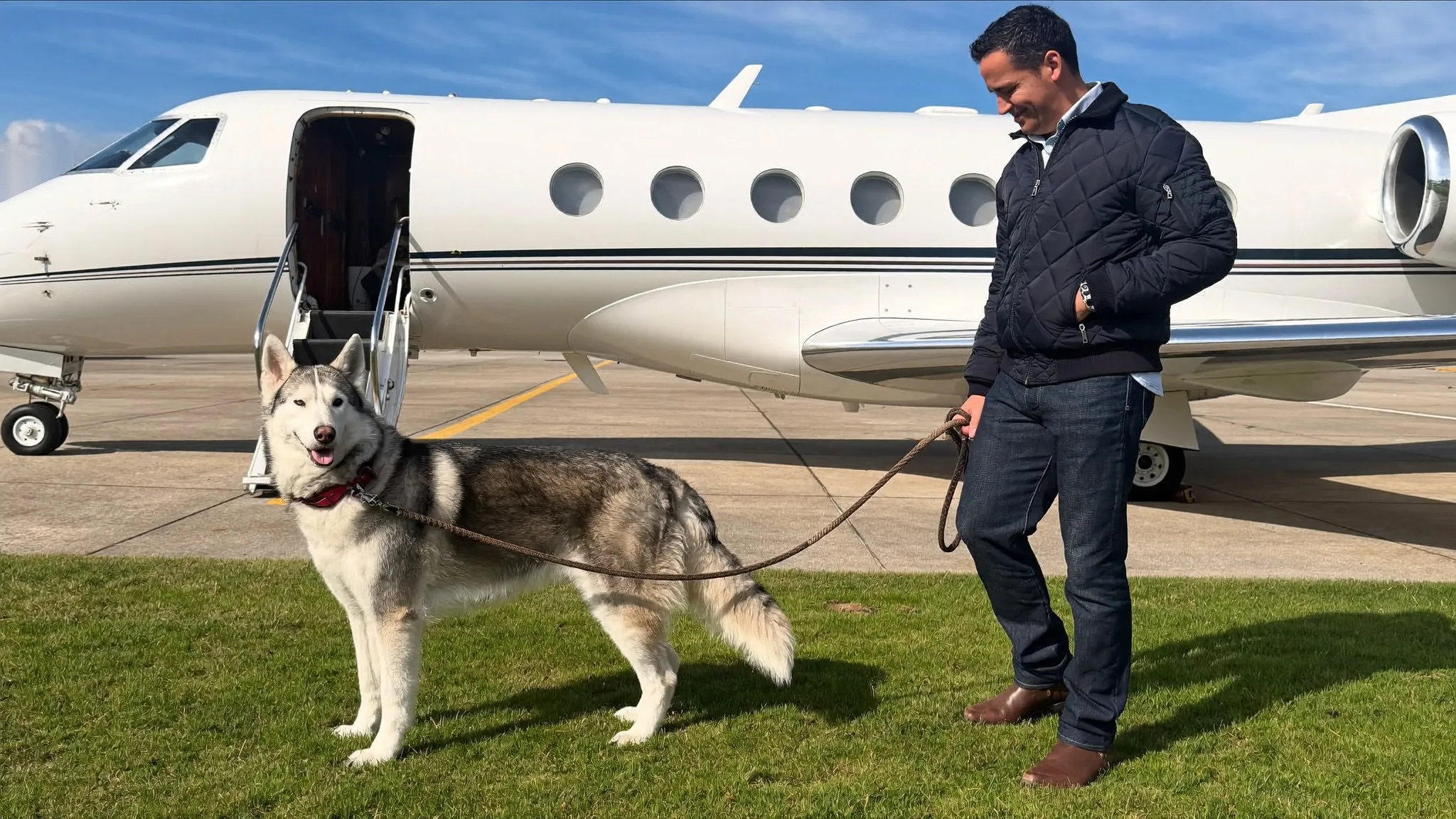
On a private flight: on scheduled flights, the options for a dog flying to Dubai are very limited, as our article Pet in cabin: weight limits, fees and airlines shows. Loulou Air, a brand of AEROAFFAIRES, a private aviation broker since 1991, offers Pay-per-Seat travel on shared private jet flights from Paris-Le Bourget to Dubai Al Maktoum: your dog travels in the cabin, at your feet, never in the hold. The breeds on the list remain banned from import whatever the flight: before any booking, our brokers go through your dog’s file with you.
See flights to Dubai or talk to a broker.
Frequently asked questions
Is the rottweiler banned in Dubai?
It is not on the current MOCCAE list, which comes from Resolution 190 of 2021. It was on the original version of Annex 2, which the ministry still publishes online. Get the case confirmed in writing by MOCCAE before booking.
How can I know whether a crossbreed will be accepted?
No official source says, and the two versions of Annex 2 circulated by the UAE ministry disagree on the point. The only reliable answer is a written reply from MOCCAE, whose service page gives the address [email protected], obtained before you book anything.
Can a banned dog transit through Dubai without leaving the airport?
The ministry provides that air transit at the same airport needs no transit permit, provided the animal stays isolated from all other animals. No official source says whether the Annex 2 breeds benefit from that allowance, so put the question to MOCCAE before buying a ticket with a UAE stopover.
Sources
Rules change: check them against these sources before every trip.
- MOCCAE — Import of pets (cats / dogs)
- MOCCAE — Ministerial Resolution No. 190 of 2021, amending Annex 2
- MOCCAE — Federal Law No. 22 of 2016 and its annexes
- UAE Ministry of Justice — Federal Law No. 22 of 2016, English text
- Canadian Food Inspection Agency — United Arab Emirates
- service-public.gouv.fr — Rules for category dogs in France