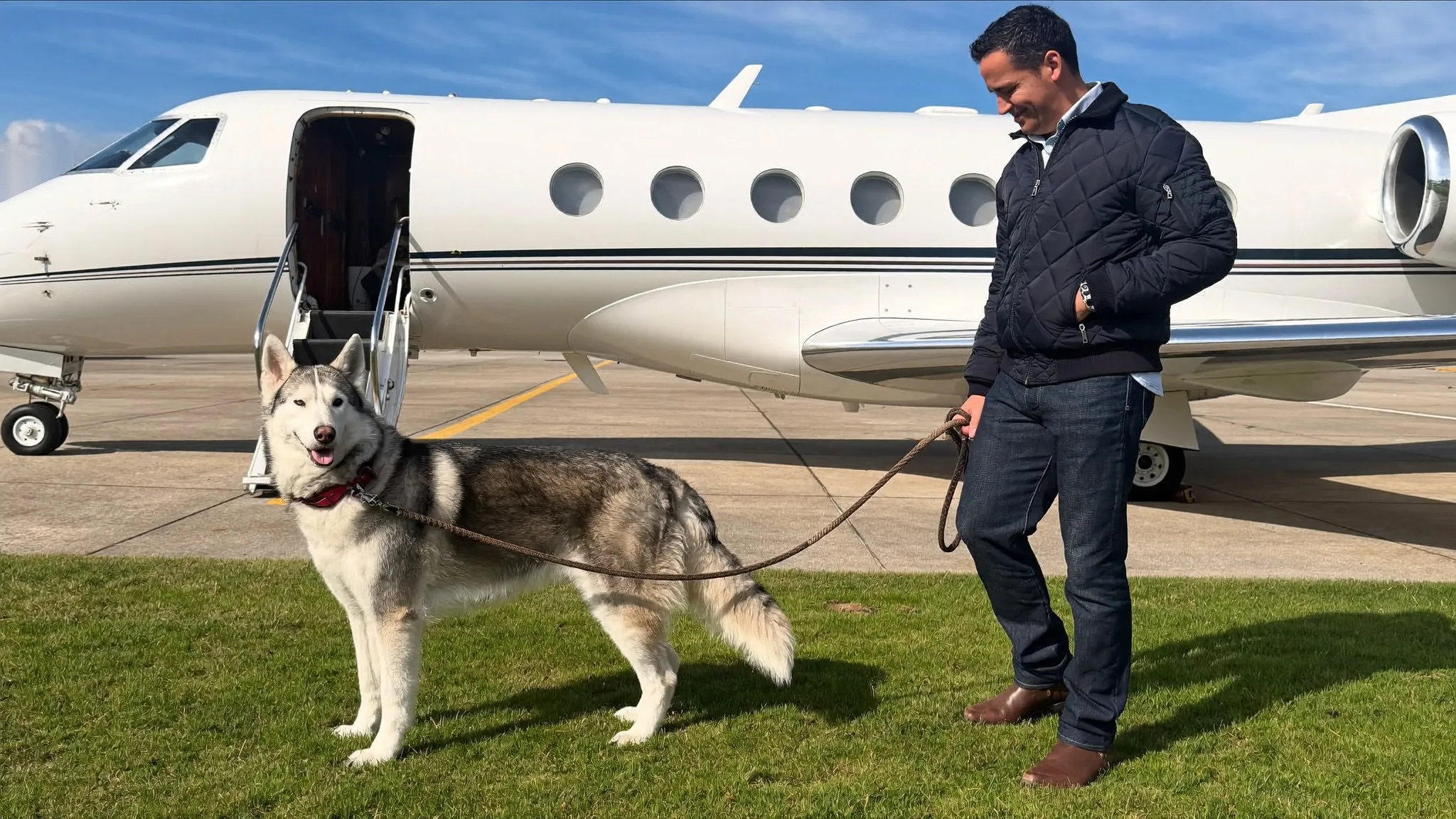
Flying with a dog: what it really costs
Dog flight costs explained: cabin and hold fees published by airlines, when cargo takes over, and what the paperwork adds before departure.
By the Loulou Air team · · updated · 7 min read
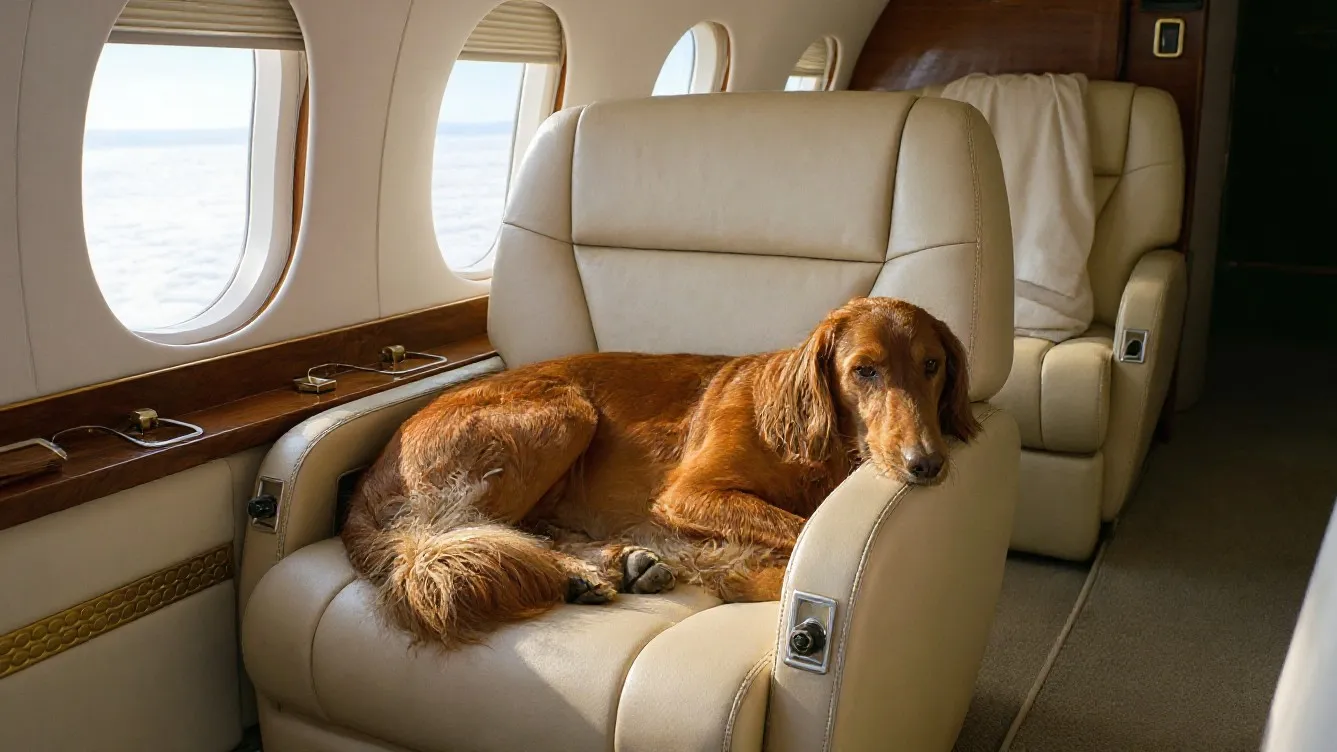
Flying a dog costs between 40 and 200 euros per journey in the cabin on the airlines that publish their fares, and from 78 to 300 euros in the hold. In the cabin the price does not follow your dog’s exact weight, nor the price of your own ticket: it follows the airline, the distance and the number of journeys. Here are the amounts published by the airlines themselves, plus what the paperwork adds. We also compare them with a shared private flight, where you do not buy a pet fee but a seat, and your dog travels in the cabin with you.
How much does a dog in the cabin cost?
Expect 40 to 200 euros per animal, per journey, depending on distance. The airlines that publish their fares online set out clear grids.
TAP Air Portugal charges from 40 euros in low season on its Portuguese domestic routes, 70 euros to Europe, Morocco and Tunisia, and 150 euros on intercontinental flights. In high season those figures become 50, 80 and 170 euros.
Corsair asks 75 euros per journey between Paris and Fort-de-France, Pointe-à-Pitre, Réunion or Mayotte, and 150 euros to Abidjan and Madagascar.
Luxair charges 80 euros per flight per animal in economy, and carries the animal free of charge in business class.
La Compagnie, which flies Paris to New York, prices the journey at 200 euros.
North American carriers publish in their own currencies. Delta charges 150 US or Canadian dollars per animal each way within the United States, Canada, Puerto Rico and the US Virgin Islands for tickets issued on or after 8 April 2025, and 200 dollars on international routes, collected in euros when you leave Europe. Air Canada lists 50 to 60 Canadian or US dollars one way within Canada and between Canada and the United States, and 100 to 120 dollars internationally. Alaska Airlines quotes a range of 100 to 200 dollars depending on the type of travel and the route.
Why doesn’t the price depend on your dog’s weight?
Because cabin space is sold by the slot, not by the kilo: below the weight limit, a chihuahua and a 7 kg dog pay the same. Weight only decides whether your dog is allowed in the cabin at all.
That limit is 8 kg including the carrier at TAP, Corsair, Luxair and La Compagnie. Vueling allows a carrier of 45 x 39 x 21 cm weighing no more than 10 kg with the pet inside. Airline by airline, the thresholds are set out in our article on flying with a dog over 8 kg.
A carrier itself often weighs one to two kilos. Above roughly 6 or 7 kg of dog, the cabin fare stops being the question and the hold fare begins.
How much does a dog in the hold cost?
The hold costs roughly twice the cabin fare on the same routes, and this time the price does follow weight.
TAP publishes two scales. Up to 32 kg including the crate, the hold costs 78 euros on Portuguese domestic routes, 118 euros to Europe and 227 euros intercontinental, in low season and booked through the contact centre. Between 32 and 45 kg, those become 128, 228 and 297 euros.
Corsair charges 150 euros per journey to the French Caribbean, Mayotte and Réunion, and 300 euros to Madagascar, Abidjan and from Mauritius. Luxair charges 140 euros per flight per animal. Air Canada lists 105 to 126 Canadian or US dollars one way domestically and to the United States, and 270 to 324 dollars internationally. Alaska Airlines applies the same 100 to 200 dollar range in the hold as in the cabin.
One caveat: these fares are not directly comparable, because the weight ceilings differ. TAP publishes fares up to 45 kg, Air Canada accepts up to 45 kg including the crate, Corsair and Luxair up to 50 kg.
At what weight does cargo take over?
Above the hold ceiling, your dog no longer travels as baggage but as freight. Corsair says it plainly: beyond 50 kg in total, cargo shipping is mandatory.
Cargo changes the nature of the trip. The dog is handed to a freight service, often on a different flight from yours, and the price appears on none of the fare pages we consulted: you have to ask the airline for a quote. For budgeting, settle this first, because it is the one item you cannot estimate in advance.
Does a return trip cost double?
Yes, in almost every case, because these fares are quoted per journey.
Delta states a fee per animal, each way. Alaska Airlines specifies that its amounts are priced each way, per kennel or carrier. Air Canada lists one-way prices, Luxair a price per flight. La Compagnie does the arithmetic for you: 200 euros per journey, which it puts at 400 euros or 500 dollars for a round trip.
Three other things move the total. Season: TAP separates low and high season, a 20 euro gap in the cabin on intercontinental routes. Booking channel: the TAP cabin fares quoted here are the online ones. Cabin class: Luxair carries the animal free in business. At Delta, even the ticket issue date matters, since tickets issued before 8 April 2025 remain at 95 dollars within the United States and Canada.
What does the paperwork cost?
This is the most variable item, and the one airlines do not bill. Price it with your vet.
Leaving France, the French administration requires the dog to be identified by microchip and to hold a European pet passport issued by a vet. Rabies vaccination is possible from 12 weeks, must come after the microchip, only takes effect 21 days later and needs an annual booster. No fee is published on that page: these are acts performed by a vet.
To come back into the European Union from outside it, the European Commission requires a health certificate issued by an official vet, and often a rabies antibody test with two waiting periods: 30 days after the first vaccination before the blood sample, then three months between that sample and the trip. What these cost most is time, and they force you to plan months ahead.
Into the United States, the CDC requires you to meet its dog importation rules or the dog will not be allowed in. The import form produces a receipt you must show to the airline before boarding, then to US Customs and Border Protection on arrival. In the other direction, for a dog leaving the United States, the USDA charges 101 dollars to endorse a health certificate with no laboratory test, 160 dollars with one or two tests, 206 dollars for three to six, and 275 dollars beyond that. Service dogs belonging to people with disabilities as defined by US law are exempt. The steps are set out on our United States travel requirements page and in our article on bringing your dog home to France.
What about a shared private flight?
On a shared Pay-per-Seat private flight you are not paying a pet surcharge: you pay for your seat, and your dog travels in the cabin with you.
That is how Loulou Air works, a brand of AEROAFFAIRES, a private aviation broker since 1991. On the flights currently on sale, a seat costs 10,000 euros from Paris-Le Bourget to Teterboro for New York, 8,500 euros from Paris to Al Maktoum for Dubai and 6,200 euros from Teterboro to Van Nuys for Los Angeles. The number of dogs on board is capped per aircraft, and a broker confirms each dog before booking.
So the order of magnitude is not that of a scheduled ticket plus a pet fee: it is the price of the journey itself, not of an add-on. What a whole aircraft costs and how it works are set out in Private jet with your dog: costs, how it works, and the entry rules country by country on our travel requirements pages.
For that price, your dog stays at your feet for the whole flight, never in the hold and without the weight limits of scheduled airlines, and you board through a private aviation terminal with no queues. See the flights and their prices, or talk to a broker to check that your dog can travel on the flight you have in mind.
Frequently asked questions
What is the average cost of flying a dog?
There is no average, only the grids each airline publishes. In the cabin, the fares we read run from 40 euros on a Portuguese domestic route to 200 euros on Paris-New York, per animal and per journey. In the hold, they run from 78 euros to around 300 euros depending on distance and weight.
Does a dog need its own seat?
Not on scheduled flights: your dog pays a surcharge per animal and per journey, whatever your own ticket cost. On a shared private flight it is the other way round, since what is sold is the passenger’s seat and the dog travels with them.
Do service dogs pay?
Not with the airlines that address it: Alaska Airlines states that trained service animals travel free. In the United States, the USDA also waives its endorsement fee for service dogs belonging to people with disabilities as defined by US law.
Sources
Rules change: check them against these sources before every trip.
- TAP Air Portugal - Traveling with animals
- Corsair - Travelling with an animal
- Luxair - Travelling with animals
- La Compagnie - Special services
- Vueling - Travelling with pets
- Delta - Pet travel
- Alaska Airlines - Pets
- Air Canada - Travelling with pets
- Service-public.gouv.fr - Travelling with your pet (French government)
- European Commission, Your Europe - Travelling with pets
- CDC - Bringing a dog into the United States
- CDC - Dog Import Form and instructions
- USDA APHIS - Cost to endorse your pet's health certificate