Flying with two dogs: the rules by airline
Flying with two dogs: most airlines allow only one animal per passenger in the cabin, and no more than five pets may travel with their owner.
By the Loulou Air team · · 8 min read
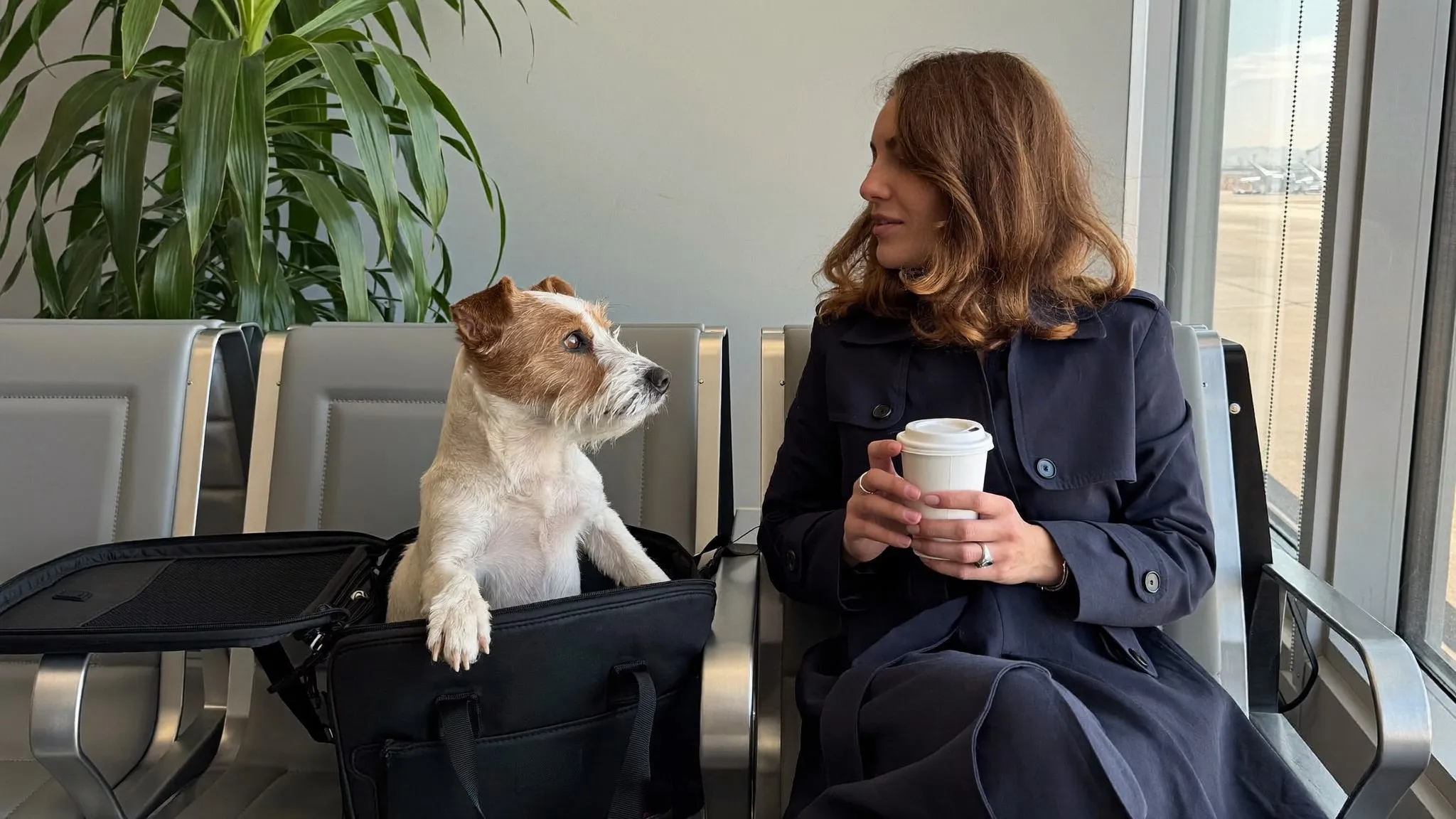
You can travel with two dogs, but almost never with both of them in the cabin beside you: most scheduled airlines accept only one animal per passenger. The rest comes down to how many animals each flight takes, whether two dogs may share one crate in the hold, and one set of travel documents per dog. Here is what the airlines and the authorities actually publish, and what changes on a private flight, where both your dogs stay in the cabin with you.
How many dogs can you travel with?
Five at most. The French administration puts it plainly: the maximum number of animals that may accompany you is five. The European Commission sets the same ceiling for entry into the EU from a non-EU country, specifying that it applies per vehicle and to non-commercial movements, meaning no sale and no transfer of ownership. The Your Europe portal sums it up in five words: you can travel with up to five pets.
Two dogs therefore leave you plenty of room. The ceiling can only be exceeded in one case: a movement for the purpose of taking part in a competition, an exhibition or a sporting event, or in training for one of those events. You then need written evidence that the animals are registered, and dogs older than six months. Without those conditions, a group of more than five animals falls under the animal health rules that apply to import into the EU or to trade within it.
Can two dogs travel in the cabin?
Rarely with a single passenger: most airlines limit the cabin to one animal per traveller. Corsair states it in its general rules, one animal per passenger and approved carrier, and accepts the animal only if the total weight, carrier included, stays under 8 kg. Air Canada is just as clear: only one cat or small dog in the cabin is allowed per passenger. On Paris to New York, La Compagnie writes that each passenger may travel with only one pet, at least six months old and under 8 kg with its carrier.
With two dogs, you will often need two travellers, each responsible for one animal. And they may not sit together: Corsair warns that if you travel with another person carrying an animal, the two animals must be seated separately on board for safety reasons.
One exception exists, and it is made for small dogs. TAP Air Portugal allows only one carrier per passenger, but that carrier “may contain up to two pets of the same species”, within a total of 8 kg including the bag, in a soft carrier of no more than 45 x 30 x 23 cm. The ceiling does not move: both dogs and their carrier have to fit inside those 8 kg, and the airline states that if the total weight exceeds the limit, the pets travel in the hold.
Delta counts by crate rather than by passenger: one pet is permitted per kennel, except for a female travelling with her un-weaned litter aged 8 weeks to 6 months, and for two pets of the same breed and size, aged 8 weeks to 6 months, which may share a kennel if they fit and are compatible.
Can two dogs share one crate in the hold?
Yes, under strict weight and cohabitation conditions. IATA, the international air transport association, sets the benchmark the airlines follow: “a maximum of two adult animals of comparable size up to 14 kg each, that are compatible in size and used to cohabiting, may be shipped in the same container”. Animals over 14 kg must be crated individually.
IATA is more flexible for young dogs: weaned puppies may share a container if they are from the same litter, no older than six months, weigh no more than 14 kg each, and number no more than three per container. It adds that some national regulations require one animal per crate, unless the shipment is a litter over eight weeks travelling with its mother. A shared crate also has to grow: its formulas put the internal width at three times the shoulder width of the largest animal, against twice for a single dog.
Airlines apply that framework with their own nuances.
- Corsair accepts two animals per crate if each weighs no more than 14 kg, 28 kg in total, and they are used to cohabiting; its section on crates adds that they must be from the same litter.
- Air Canada limits crate sharing to fully weaned puppies and kittens from 12 weeks to 6 months, of the same species, and caps the crate at two dogs of no more than 14 kg each, used to cohabitation.
- TAP accepts per crate two adult animals of similar weight, up to 14 kg each, or up to three animals aged six months or less and weighing no more than 14 kg each.
Before choosing the hold, read our article on the real risks of the cargo hold.
Do you pay twice for two dogs?
Almost always, yes. Corsair states that transport fees apply per pet, per journey. Air Canada goes further for a shared crate: two pets travelling in one kennel count as two pets regardless of their combined weight, and the applicable fee is charged twice.
The only documented saving concerns very young dogs: when Delta allows two pets aged 8 weeks to 6 months to share a kennel, they are charged as one pet. Full fares are in our article on the cost of flying with a dog.
How many dogs does one flight take?
Fewer than you might think, and this is often where the plan stalls. La Compagnie accepts only four pets per flight and asks for a booking no later than 48 hours before departure. TAP makes its service conditional on carrying no more than five pets at once, cabin and hold combined, and also on the aircraft type and the space available. Delta runs a first-come, first-served policy with a limit on the total number of animals allowed on each flight.
Two dogs take two of those places: book early, and have both animals confirmed before you buy.
Two dogs, two sets of documents
Each dog needs its own, with no exception. For entry into the EU from a non-EU country, the European Commission requires every animal to be identified by a microchip, vaccinated against rabies from 12 weeks of age, and accompanied by an animal health certificate valid for 10 days until the checks at the point of entry. Our article on the EU pet passport covers the document itself.
For the United States, the CDC, the federal health agency, sets no ceiling on numbers: “there is no limit to the number of dogs you can bring into the U.S., but they must meet CDC entry requirements for dogs”. The receipt, however, is individual: you need one per dog, and the instructions page asks you to complete another form for each additional dog. That receipt covers one dog for multiple entries within six months from a dog rabies-free or low-risk country, and a single entry from a high-risk country. See our article on the CDC Dog Import Form and our pages on travel requirements and entry into the United States.
Do two dogs travel better together?
Not necessarily, and IATA warns against that assumption. Its text states that animals may become stressed and aggressive when travelling by air and should not be placed in the same container unless they are young puppies or kittens, and adds that animals which share the same household may become stressed and aggressive towards each other in flight. Two dogs that get along at home are not necessarily two dogs that will travel well in one crate.
Two further points are worth a detour. If one of the two has a short muzzle, the hold is often closed to it: Corsair refuses brachycephalic breeds in the hold for respiratory reasons, while accepting them in the cabin if the weight and carrier rules are met, and our article on flying with a snub-nosed dog lists the breeds. On sedation, TAP writes that it does not endorse tranquillisers or sedatives, which can cause a drop in blood pressure and be fatal to pets: preparation is a conversation with your vet, and our drug-free approaches are gathered in keeping your dog calm on a flight.
What if both your dogs flew in the cabin with you?
They can, on a shared private flight, subject to availability. Loulou Air is a brand of AEROAFFAIRES, a private aviation broker since 1991: Pay-per-Seat private jets for your dog and you, where you pay for your seat, not the jet, and one ticket covers one person and their dog. Your dogs stay in the cabin with you, at your feet for the whole flight, never in the hold, and there is none of the weight limit imposed by scheduled airlines. Several dogs are accepted subject to availability: each animal takes up space in the cabin, capacity depends on the aircraft and the number of animals on board, and a broker confirms each dog case by case after checking its file before departure, with entry requirements still applying on every flight, private ones included. Boarding is through a private aviation terminal, with no queues, and the crew is briefed on welcoming animals.
See our open flights, or talk to a broker and say that you are travelling with two dogs. We open new routes every month: tell us where you want to go, and for a whole aircraft, our sister company AEROAFFAIRES handles full charter.
Frequently asked questions
Can two dogs travel in the cabin on one ticket?
On most airlines, no: Corsair, Air Canada and La Compagnie allow only one animal per passenger in the cabin. TAP is the exception, accepting up to two animals of the same species in a single carrier, provided the total stays under 8 kg.
Can two dogs share the same crate in the hold?
Yes, if each weighs no more than 14 kg, they are of comparable size and used to cohabiting: that is the IATA rule, followed by Corsair, Air Canada and TAP. Above 14 kg, each dog travels in its own crate.
How many dogs can you take abroad?
Five at most, according to Service-public and the European Commission. Beyond that you need a competition, an exhibition or a sporting event, written proof of registration and animals older than six months, otherwise the commercial transport rules apply.
Sources
Rules change: check them against these sources before every trip.
- Service-public.gouv.fr - Travelling abroad with a pet
- European Commission - Bringing a pet to the EU from a non-EU country
- Your Europe - Travelling with pets and other animals in the EU
- IATA - Traveling with pets
- TAP Air Portugal - Traveling with pets
- Corsair - Transport of animals
- La Compagnie - Special services
- Delta - Pet travel
- Air Canada - Travelling with pets
- CDC - Dog importation, frequently asked questions
- CDC - CDC Dog Import Form instructions