Paris-Le Bourget airport with your dog
Flying out of Paris-Le Bourget with your dog: the paperwork, the rabies blood test, customs on the way back and the airport's night restrictions.
By the Loulou Air team · · 7 min read
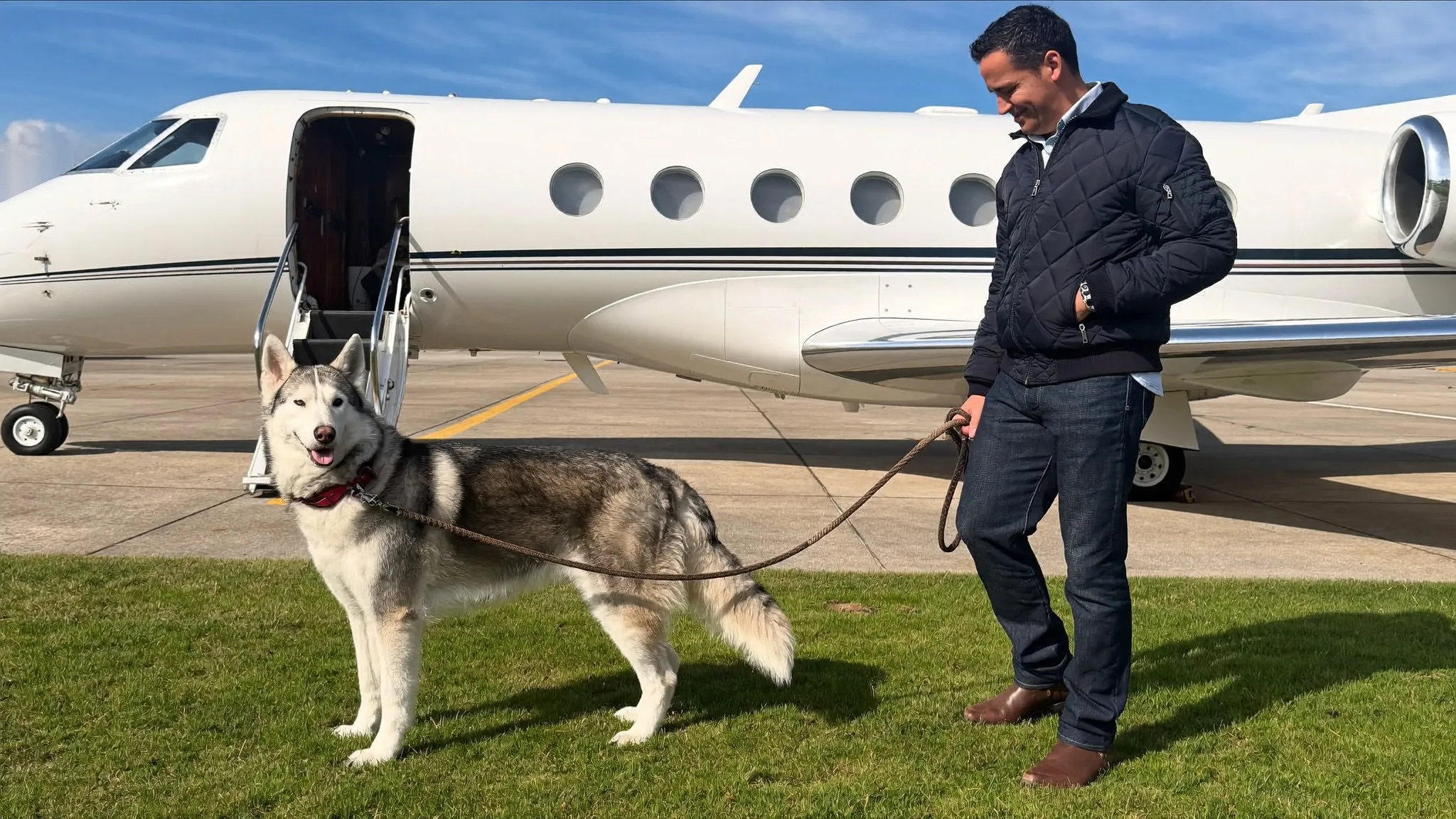
Flying out of Paris-Le Bourget with your dog does not change the paperwork: it is the same as for any departure abroad, and most of it happens at the vet weeks before the flight. What changes is the setting of the departure, and the hours at which an aircraft may leave this airport. On our Pay-per-Seat flights from Le Bourget, your dog stays in the cabin with you, at your feet for the whole flight, never in the hold.
What is Paris-Le Bourget airport?
It is an airport run by Groupe ADP, north-east of Paris. France’s airport noise authority, ACNUSA, states in its fact sheet that Paris-Le Bourget airport is 13 km north-east of Paris, that it has three runways, and that the site is run by Groupe ADP.
On the operational side, the airport’s codes are LBG and LFPB, and its opening hours are 24 hours a day, according to the fact sheet of COHOR, the French slot coordinator. The same sheet classes Le Bourget as a Level 1 airport under the IATA scale and notes that night restrictions apply.
For you, that means one practical thing: your departure address is neither Roissy nor Orly, and the drive to the airport is part of the trip, including the time on the road and a walk before you arrive.
When can an aircraft take off from Le Bourget?
Not at night, if it is a jet. The official night restrictions table published by ACNUSA is specific for Le Bourget: jet aircraft may not take off between 10.15 pm and 6 am, and may not land between 11.30 pm and 6.15 am. The legal basis given is the order of 15 February 2011 restricting the operation of the airport.
So the airport stays open around the clock, but a jet departure necessarily falls in the daytime or the evening. This restriction is not about animals: it is about aircraft noise. It still has a practical consequence when you travel with a dog: there is no point hoping for a middle-of-the-night departure to avoid heat or crowds. Your day, meals and walks included, is built around a daytime flight.
What paperwork does your dog need before take-off?
The same three items as for any departure outside the European Union: identification, a valid rabies vaccination and, depending on the destination, a rabies antibody test. The information note from the DGAL, France’s food safety directorate, updated on 22 April 2026, is explicit about the order of operations: the dog must be identified with a microchip, and the vaccination must always be given after identification to be recognised as valid. A tattoo is accepted only with proof that it was done before 3 July 2011.
The rabies antibody test, or titration, is a laboratory test on a blood sample. The same note states that the sample must be taken at least 30 days after the vaccination, that the result must be equal to or above 0.5 IU/ml, and that the analysis must be run by a laboratory approved by the European Union. Our article on the rabies antibody test for dogs goes through those timings, and the one on the EU pet passport explains which document carries these entries.
The most useful advice in that note is aimed precisely at people leaving France. The DGAL recommends leaving the European Union only with an animal that is identified, validly vaccinated against rabies and has a favourable antibody result, and starting the process with your own vet at least three months before departure. The note gives the reason: in the event of a sudden return, the test can be hard to obtain, or hard to obtain in time.
Do you have to declare your dog to customs?
Yes, when you come back from a country outside the European Union. French Customs writes that on arrival in the European Union from a non-EU country you must declare and present your pets to customs officers, who then carry out a document and identity check. The declaration is made by the animal’s owner, or by any authorised person who takes responsibility for it.
One point deserves attention before you book, in either direction. The same page warns that not every border control post is authorised to check pets, and asks travellers to find out, before boarding, whether the post at their point of entry is competent. If the animal arrives through an entry point whose post is not designated for its species, the veterinary services can order it to be sent back. The list of authorised posts is held by the administration, not by the airports, so this is the kind of check to get in writing for your exact itinerary, outbound and inbound.
Numbers matter too. The DGAL note caps a non-commercial movement at five animals per owner or authorised person, all species combined. Above that, the movement counts as commercial and must be declared to the border control post of SIVEP, the French border veterinary and plant health inspection service, with specific health conditions. And when an authorised person, rather than the owner, travels with the animal, the movement may only take place within the five days before or after the owner’s own journey.
What does the arrival country require?
Its own rules, which come on top of the French formalities and do not depend on the departure airport. For the United States, the CDC writes that all dogs entering or returning to the U.S. must be accompanied by a CDC Dog Import Form receipt, one receipt per dog, and advises completing the form well ahead of your travel dates. For a dog coming from a rabies-free or low-risk country, the agency also asks for an animal at least six months old, healthy in appearance and fitted with a microchip that a universal scanner can read.
These conditions are gathered on our travel requirements pages, with the detail for the United States and for the United Arab Emirates. They apply to every flight, private ones included.
On the way back, is the pet passport enough?
Often yes, on one condition set out by the DGAL: the passport replaces the health certificate only if it was filled in before the animal left the European Union. That is one more reason to see your vet before you go, not after.
The note flags two cases where the passport alone is no longer enough: if a rabies booster was given in the non-EU country during the stay, or if the antibody test was carried out there. You then need a health certificate signed by that country’s official authorities, who alone can confirm the validity of a local practising vet’s signature. That certificate is valid for at most ten days from the date it is issued. Our article on bringing your dog home to France from Dubai shows how these rules play out on a real route.
Could your dog fly in the cabin from Le Bourget?
Yes, on a flight where the cabin is open to it. That is the idea behind Loulou Air, a brand of AEROAFFAIRES, a private aviation broker since 1991: Pay-per-Seat private jets for your dog and you. You pay for your seat, not the jet, and each ticket covers a seat for one human and their dog. None of the weight limit imposed by scheduled airlines applies, because your dog does not travel in the hold: capacity depends on the aircraft and on how many animals are on board, and a broker approves every dog case by case. Boarding is through a private aviation terminal, with no queues and no separation, and the crew is briefed on welcoming animals. Before departure, our brokers check your dog’s file with you, bearing in mind that the arrival country’s formalities are due on every flight, private ones included.
See our open flights or talk to a broker. We open new flights every month, so tell us where you want to go, and for a whole aircraft, our sister company AEROAFFAIRES handles it.
Frequently asked questions
Is there a veterinary check when you leave Le Bourget?
The checks described by French Customs apply to arrivals in the European Union from a non-EU country: declaration, document check and identity check. On departure, it is the destination country’s requirements that govern, and your vet prepares the matching documents. Do find out, before boarding, whether the border control post at your point of entry on the way back is competent for dogs.
Can you take off from Le Bourget in the middle of the night with your dog?
No, not on a jet. The ACNUSA night restrictions table bans jet aircraft from taking off between 10.15 pm and 6 am, on the basis of the order of 15 February 2011. Landing is banned between 11.30 pm and 6.15 am.
How many dogs can you take with you?
The DGAL caps a non-commercial movement at five pets per owner or authorised person, all species combined. Above that, the movement becomes commercial and goes through the SIVEP border control post. On our flights, several dogs are possible subject to available space, and a broker confirms it case by case.
Sources
Rules change: check them against these sources before every trip.
- ACNUSA - Paris-Le Bourget airport
- ACNUSA - Night restrictions at French airports
- ACNUSA - Night restrictions table (xlsx)
- COHOR - Paris Le Bourget airport (LBG/LFPB)
- French Customs - Coming to France with my pet
- DGAL/SIVEP - Non-commercial import of pets from non-EU countries (22 April 2026)
- CDC - Frequently Asked Questions on Dog Importations