Bringing your dog home to France from Dubai
No rabies antibody test is needed to bring a dog from Dubai to France, but it needs a valid rabies shot and the right paperwork.
By the Loulou Air team · · 8 min read
Bringing your dog back to France after a stay in Dubai involves no blood test: the United Arab Emirates is on the EU’s list of countries exempt from the rabies antibody titration test. What your dog does need is a microchip, a valid rabies vaccination, and either its EU pet passport or a health certificate issued locally by an official veterinarian. Here is what the rules require, and what happens when you land. For the journey itself, Loulou Air sells seats on shared private flights where your dog stays in the cabin with you, without the weight limit imposed by scheduled airlines.
Is a rabies antibody test required to return from Dubai?
No. The United Arab Emirates appears in Annex II to Implementing Regulation (EU) 2026/636, and the European Commission states that dogs, cats and ferrets moved from a listed country or territory do not require a rabies antibody titration test. The information note from the French directorate general for food, updated on 22 April 2026, says the same: animals coming from the countries in those annexes are exempt from the serological test, and the United Arab Emirates is named there.
That makes the preparation lighter. Where the test is required, the blood sample must be taken by a laboratory approved by the European Union, at least 30 days after vaccination and at least 90 days before entry, and the result must be equal to or greater than 0.5 IU/ml. The 90-day wait exists because the analysis cannot tell antibodies produced by the vaccine from those produced by a possible infection in the non-EU country. Our article on the rabies antibody test for dogs covers the procedure for countries that do require it.
One point worth knowing if your flight has a stopover: when transiting through a country that is not exempt from the test, the owner must supply a declaration confirming that the dog had no contact with species susceptible to rabies during the transit and remained confined in the means of transport or inside the international airport.
What paperwork does your dog need?
Two basic conditions apply to any return from a non-EU country: identification and vaccination. Your dog must be identified by a microchip implanted under the skin; a tattoo counts only if it comes with proof that it was done before 3 July 2011.
The microchip must comply with ISO standards 11784 and 11785 and be assessed in line with ISO 24631-1; if it does not, you have to provide the means of reading it. Our article on the EU pet passport looks at these documents in more detail.
The order matters: the vaccination must always have been carried out after the identification to count as valid. A rabies shot given before the microchip was implanted does not count.
The rabies vaccination must be valid at the time of the return journey. The dog must have been at least 12 weeks old on the day of the injection, and validity starts no less than 21 days after the primary vaccination course is completed. There is no waiver of the vaccination requirement for an animal under 12 weeks old, and French customs states that an animal of less than 16 weeks may not be imported.
Is an EU pet passport enough on the way back from Dubai?
Yes, on one condition: that it was filled in before you left the European Union. For a re-entry, the health certificate may be replaced by the animal’s passport, provided that document was completed before the animal left EU territory.
Two situations take that away. If a rabies booster was given in the Emirates during the stay, or if a titration test was carried out there, the passport alone is no longer enough. You then need a health certificate signed by the official authorities of the non-EU country, which alone are competent to confirm that the signature of a local practising veterinarian is valid.
In other words, a booster given at a local vet a few weeks before the return moves the file from the passport to the official certificate. For the journey in the other direction, see our article on moving to Dubai with your dog.
The health certificate: who issues it, and how long does it last?
The health certificate is the original, drawn up or endorsed by an official veterinarian of the non-EU country of origin, meaning a veterinarian designated by the competent central authority. It comes with the rabies vaccination records and a written declaration from the owner confirming that the movement is non-commercial.
Its life is short: it is valid for no more than 10 days from the date it was issued by the official veterinarian. For sea crossings, that period is extended by the length of the sea journey. It lapses once the documentary and identity checks have been carried out at the designated travellers’ point of entry into the European Union.
If you then travel on to another member state, even after a short stay in France, the certificate stays valid for a total of six months from the date of those documentary and identity checks, or until the rabies vaccination expires. In that case, have the certificate stamped by customs officers when you arrive in France.
One date to keep in mind: the certificate model set out in Annex IV to Regulation (EU) 577/2013 is treated as compliant until 31 March 2027 if it was issued before 1 October 2026.
Where do you enter, and what happens on arrival in France?
Your dog must pass through a travellers’ point of entry designated by the country of arrival, where the competent authorities carry out documentary and identity checks. This requirement does not apply to animals coming from the territories in Annex I, such as Switzerland or Monaco; as the United Arab Emirates falls under Annex II, it does apply.
On arrival in France, travellers are required to present their pets to customs of their own accord. There is no appointment to book beforehand: you pass in front of the customs desk before leaving the international zone. Dogs and cats coming from countries that are not exempt from the titration test must, for their part, be presented systematically for documentary and identity checks.
How many dogs can you bring, and must you travel with yours?
Up to five animals per owner or authorised person, all species combined. Above five, the movement counts as commercial: it must be declared at the border control post of the veterinary and plant health border inspection service at the point of arrival, and specific health conditions apply.
There is one waiver to that ceiling. It may be exceeded where the movement takes place so the animals can take part in competitions, exhibitions or sporting events, or in training for such events, provided written proof of registration is produced and the animals are more than six months old.
As a rule, the owner must travel with the animal. A dog travelling with an authorised person is nonetheless accepted if the movement takes place within five days before or after the owner’s own journey, with supporting evidence such as a boarding pass or an air ticket.
Which dogs cannot return to France?
Category 1 dogs. Dogs resembling the Staffordshire terrier, American Staffordshire terrier, Mastiff or Tosa types that are not entered in a pedigree register are classed as attack dogs in category 1, and importing them into France is prohibited. A dog of that kind that leaves the country does not come back.
Only category 2 dogs, as defined by the French order of 27 April 1999, may be imported: Staffordshire terriers, American Staffordshire terriers and Tosas entered in a pedigree register, along with dogs whose physical characteristics resemble the Rottweiler breed. Importing them requires the documents proving pedigree registration, and the French rules on keeping and walking category 2 dogs then apply. All Rottweilers, and dogs that look like Rottweilers, with or without a pedigree, fall under category 2.
One further rule concerns very young dogs: under Article L. 236-1 of the French rural and maritime fishing code, a dog imported from a non-EU country may only enter national territory if it has at least one adult tooth. The breeds banned in Dubai are covered separately in our article on banned dog breeds in Dubai.
What if your dog flew home from Dubai in the cabin?
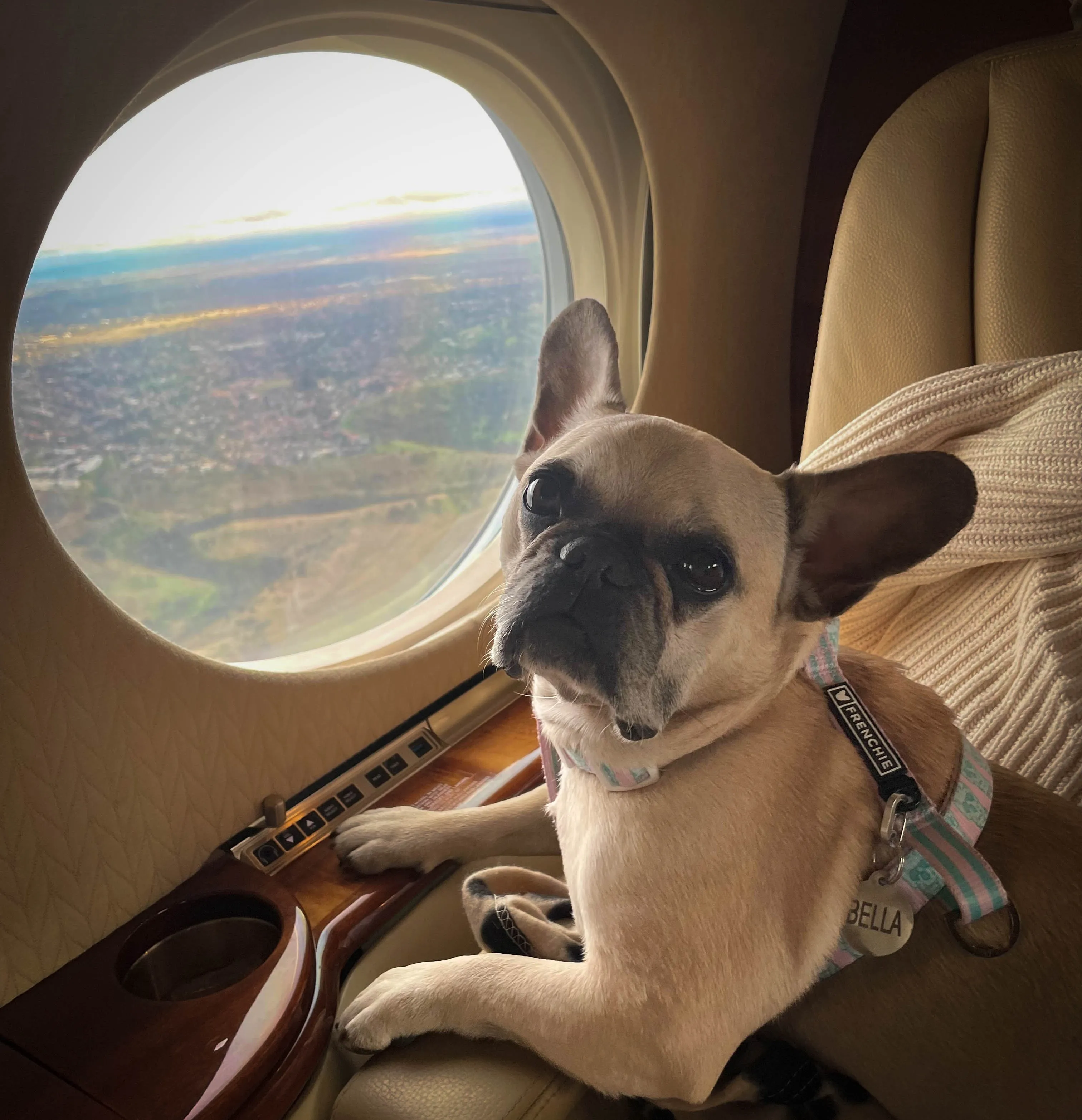
It can, on a private flight, staying at your feet for the whole journey. Loulou Air, a brand of AEROAFFAIRES, a private aviation broker since 1991, offers Pay-per-Seat private jets for your dog and you: you pay for your seat, not the jet, and one ticket covers one person and their dog. There is none of the weight limit imposed by scheduled airlines, because your dog does not travel in the hold; capacity depends on the aircraft and the number of animals on board, and a broker confirms each dog case by case. The paperwork described above is still due on every flight, private ones included: before departure, our brokers go through your dog’s file with you. Boarding is through a private aviation terminal, with no queues, and the crew is briefed on welcoming animals.
See flights to Dubai or talk to a broker. Entry conditions for the Emirates are set out on our United Arab Emirates travel requirements page, and other destinations on our travel requirements pages.
Frequently asked questions
Does my dog need a blood test to come back from Dubai to France?
No. The United Arab Emirates appears in Annex II to Implementing Regulation (EU) 2026/636, and animals coming from the countries on those lists are exempt from the rabies antibody titration test. What remains is identification, a valid rabies vaccination and the right health document.
What happens if my dog’s rabies shot was renewed in Dubai?
The EU pet passport is no longer enough. If a rabies booster was given in the non-EU country during the stay, you need a health certificate signed by the official authorities of that country, which alone are competent to confirm the signature of a local practising veterinarian.
How long does the health certificate stay valid?
No more than 10 days from the date the official veterinarian issued it, and it lapses after the checks at the designated travellers’ point of entry. For onward travel to other member states, it remains valid for a total of six months from those checks, or until the rabies vaccination expires.
Sources
Rules change: check them against these sources before every trip.
- DGAL - Information note: non-commercial imports of pet animals from non-EU countries (22 April 2026)
- European Commission - Listing of territories and non-EU countries (Annexes I and II)
- European Commission - Bringing your pet to the EU from a non-EU country
- French Customs - You are travelling with a dog, a cat or a ferret