Moving to Dubai with your dog: the steps
Moving to Dubai with your dog: the import permit valid for 90 days, the rabies titre test, the two-animal yearly cap and registration once you arrive.
By the Loulou Air team · · 8 min read
Moving to Dubai with your dog takes months of preparation: the United Arab Emirates require an import permit, a complete health file and, for a dog leaving most European countries, a rabies titre test. Once you land, Dubai Municipality takes over, with registration of the animal. Here are the steps in order, as the Emirati ministry and the municipality publish them. For the flight itself, Pay-per-Seat private aviation keeps your dog in the cabin, at your feet.
What has to be done before you leave France?
Three obligations apply to any destination outside the European Union. If you are leaving France, the administration’s own page states that your dog must be identified by microchip, hold an EU pet passport issued by a vet and be vaccinated against rabies. The rabies vaccine can be given from 12 weeks of age, takes effect at least 21 days later, needs an annual booster, and must follow the microchipping to count as valid.
The same page adds two useful reflexes for a permanent move: ask the destination country’s consulate about health measures other than rabies, and ask your departmental animal health office about the conditions for coming back. If your dog belongs to a restricted category, it advises checking in advance whether it can travel and enter the destination country at all.
An EU pet passport does not replace the Emirati file. It serves as the vaccination document, provided it carries the microchip number, the description of the animal and the detail of each vaccine, as our article The EU pet passport for dogs explains.
Who issues the import permit, and how long is it valid?
The permit is issued by the Emirati Ministry of Climate Change and Environment, and it is valid for 90 days from the date of issuance. It is applied for online on the ministry’s website before the import takes place, and the ministry states that pets cannot be imported on an expired permit.
The ministry prices the service at AED 200 per head, paid by card. It quotes one working day to obtain the permit for pet animals, and five working days for a service, emotional support or medical dog, which also requires a document from a certified training centre and a medical report on the owner’s health.
One detail often comes as a surprise: at the permit stage, no document is required for an ordinary pet dog or cat. The health file is checked later, on arrival.
Is a rabies titre test compulsory?
Yes, for a dog leaving France, Germany or Italy. The ministry publishes a list of low-risk countries, and those three are absent from it, while Belgium, Spain (excluding Melilla and Ceuta), Portugal, the Netherlands and Greece appear. A dog leaving a country that is not on the list counts as coming from a high-risk country, with the following consequences.
The file must include a rabies titration certificate from a laboratory accredited by the competent authorities of the exporting country, stating the sampling date and the date and method of the test. The result must not be below 0.5 IU/ml, and the certificate is valid for 365 days as long as the rabies vaccination stays valid and continuous. The result may also be recorded in the health certificate instead.
Two waiting periods matter. For a first vaccination, or after a lapse, at least 21 days must pass between the injection and the blood sample. Where the dog holds a valid booster, that 21-day interval does not apply and the sample can be taken straight away. The minimum age at import is 15 weeks from a high-risk country, against 12 from a low-risk one, and the vaccine cannot be given before 12 weeks. Our article Rabies antibody test for dogs covers how the test is run and how long it takes.
How many dogs can one person bring in each year?
Two at most, per person. The ministry caps personal imports at two cats, two dogs, or one dog and one cat annually, each animal identified by a permanent microchip and meeting the health requirements for import. One exception is written in: resident animals that leave the country and come back are not counted.
Breed can close the door before the permit stage. The ministry bans the import of sixteen dog breeds, except for animals used as service, emotional support or medical animals under the relevant rules. Dubai Municipality states for its part that only domestic companion animals may be kept at home, other than the types and breeds named in Federal Law No. 22 of 2016 on the possession of dangerous animals. The list, and the question of crossbreeds, is in our article Banned dog breeds in Dubai.
What happens when your dog arrives?
A release request, then an inspection. The ministry handles entry in two stages: the import permit first, then the release of the animal at the entry port, with an electronic form, an online payment and a visual inspection. Release costs AED 500 for a dog.
For that stage the ministry asks for a customs declaration or bill of lading, a vaccination document or passport, a certified health certificate issued by the competent veterinary authorities, and the titration certificate where the animal comes from a high-risk country. The vaccination document must carry the microchip number, the full description of the animal, and for each vaccine its name, manufacturer, batch number and date.
The vaccines required for a dog are rabies, canine distemper, canine parvovirus, infectious canine hepatitis and leptospirosis, the last of which can be replaced by a laboratory test where the exporting country does not vaccinate for it. The ministry also asks for preventive treatment against internal and external parasites in the 14 days before shipment.
The penalty is spelled out: where import requirements are not met, the pet is rejected at the owner’s expense, or confiscated. That is why the file is built months ahead of the move. The full set of conditions is gathered on our travel requirements for the United Arab Emirates page.
Does a dog have to be registered with Dubai Municipality?
Yes, and that is an obligation on the keeper, not an entry formality. Local Order No. (11) of 2003 requires the keeper of a dog or cat to register it with the competent department and place an identification collar around its neck, for AED 10 per head under the schedule annexed to the order.
The same order adds an obligation newcomers often discover once they are settled: immunising the animal against animal diseases and zoonoses, and obtaining an immunisation card approved by the competent department. It also calls for clean shelter, regular examinations, and for animals to be restrained in residential areas or in areas where they are not permitted.
Dubai Municipality runs these steps through its own services. It describes services that let owners register, microchip and update the records of cats and dogs, and reports 4,100 pets registered and 6,585 vaccinations given to cats and dogs in the first half of 2026. The vaccines it gives dogs are rabies and the DHPPi vaccine, which protects against canine parvovirus, canine distemper, canine adenovirus and parainfluenza. Its pet clinics are at Al Khawaneej, Al Lisaili and Hatta, and appointments are requested through the municipality’s website.
Daily life then follows the emirate’s rules: collar and leash in public places, and no dogs on beaches or in public parks. Our guide Dubai with your dog covers where to walk a dog and how to get around with one.
And the day you leave Dubai again?
Prepare the exit before you go, because it decides what the return looks like. For a resident dog to be treated as an animal coming back, the ministry requires that it obtained a veterinary health certificate from the ministry before leaving the country, that it is microchipped, that it travels with an authorised veterinary certificate from the exporting country, and that it was vaccinated against rabies before departure, with that vaccination still valid on its return. If it is no longer valid, the animal is treated as a first import, and the whole file has to be rebuilt.
Dubai Municipality gives the same instruction before any trip: the animal should be microchipped and registered in the approved system, have received all mandatory vaccinations and hold an approved veterinary health certificate.
Could your dog fly to Dubai in the cabin?
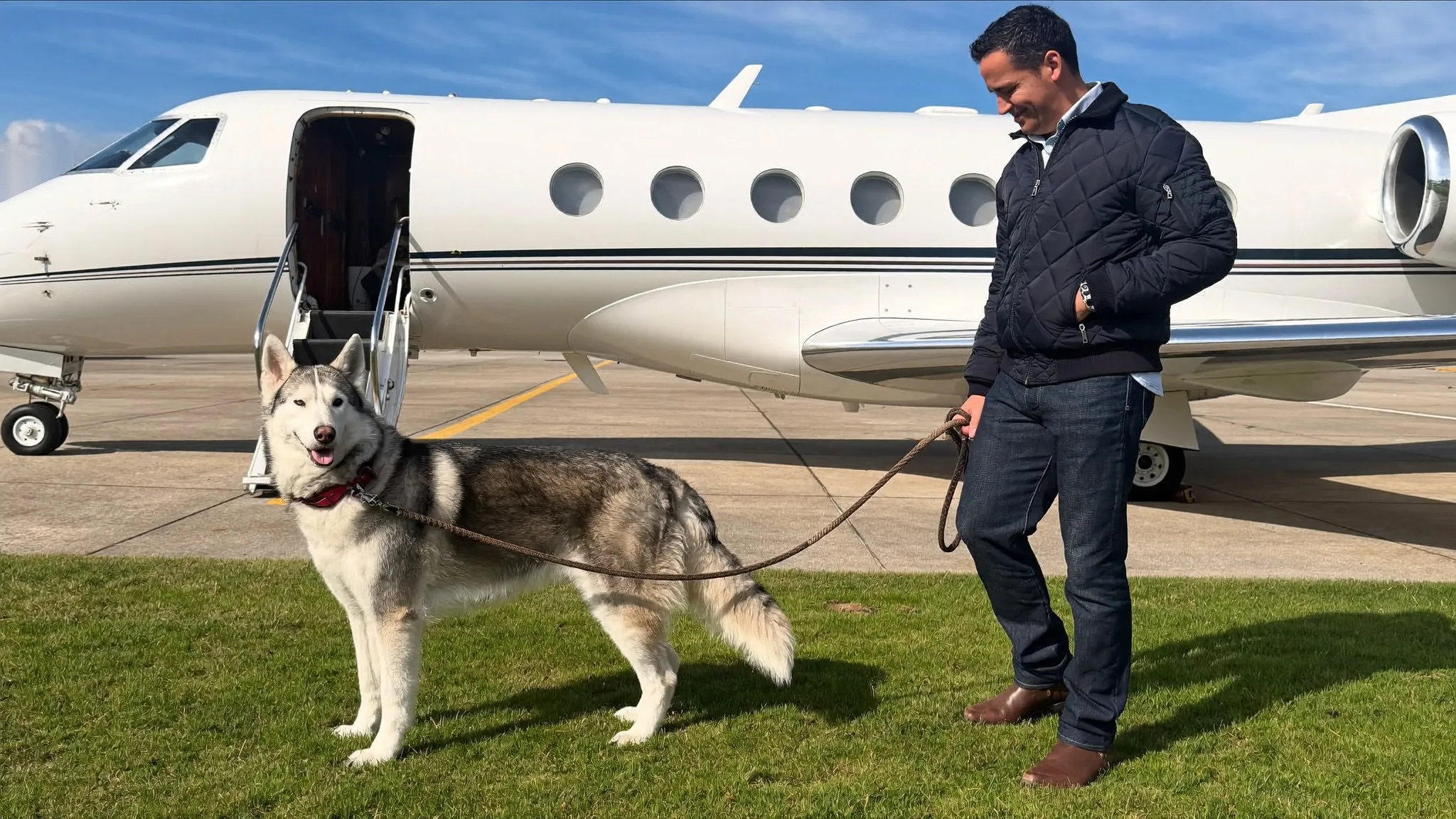
It can, on a private flight, where it stays at your feet for the whole journey. Loulou Air, a brand of AEROAFFAIRES, a private aviation broker since 1991, sells Pay-per-Seat places on shared private jet flights from Paris to Dubai: you pay for your seat, not the jet, and every ticket covers one human and their dog. None of the weight limit imposed by scheduled airlines applies, because your dog does not travel in the hold; capacity depends on the aircraft and on how many animals are aboard, and a broker approves each dog case by case. Boarding is through a private aviation terminal, with no queues, and the crew is briefed on welcoming animals, with water, bowls and blankets on board. Emirati entry requirements are due on every flight, private ones included, and our brokers check every dog’s file before departure.
See flights to Dubai or talk to a broker, who will go through the permit and titre timetable with you. For a whole aircraft, our sister company AEROAFFAIRES arranges full charters.
Frequently asked questions
How far ahead of the move should I start?
The import permit is the last link, not the first: it lasts 90 days and the ministry quotes one working day to issue it. The health timings set the calendar instead, with rabies vaccination from 12 weeks of age and a 21-day wait before the blood sample where it is a first vaccination.
Can I bring two dogs to Dubai?
Yes, within the ministry’s cap: two dogs, two cats, or one dog and one cat per person per year, each animal microchipped and compliant with the health requirements. Resident animals coming back are not counted in that cap.
Does my dog need registering if we stay for a year?
Yes. Local Order No. (11) of 2003 addresses whoever keeps a dog or a cat, with no minimum stay: registration with the competent department, an identification collar, vaccinations and an immunisation card approved by that department, charged at AED 10 per head under the schedule annexed to the order.
Sources
Rules change: check them against these sources before every trip.
- Ministry of Climate Change and Environment (MOCCAE) — Import of pets (cats / dogs)
- Dubai Legislation portal — Local Order No. (11) of 2003 Concerning Public Health
- Dubai Municipality — Nearly 183,700 veterinary services delivered in H1 2026
- Dubai Municipality — Veterinary Services Section
- Dubai Municipality — Frequently asked questions
- service-public.gouv.fr — Travelling abroad with a pet (France)