Dublin with your dog: rules and daily life
Tapeworm treatment 24 to 120 hours before arrival, EU pet passport, leads in Dublin parks, Luas and trains: the official rules, source by source.
By the Loulou Air team · · 9 min read
Bringing a dog to Ireland takes one document most EU countries do not ask for: a tapeworm treatment, given by a vet within a narrow window before arrival. The rest is standard EU paperwork, namely a microchip, a rabies vaccination and a pet passport. Once you land, the lead shapes every walk, in a city whose bye-laws set off-lead hours month by month. Here is what the official pages said when they were read on 11 October 2026.
What paperwork does your dog need for Dublin?
Three documents, plus a treatment specific to Ireland. The Department of Agriculture, Food and the Marine (DAFM) asks, for a dog arriving from an EU country, for a microchip, a valid rabies vaccination, an EU pet passport and a tapeworm treatment.
The order of those steps matters. DAFM states that the microchip must be inserted before the rabies vaccination is administered and must be readable by a device compatible with ISO standard 11785; if it cannot be read on entry, your pet may be quarantined or refused. The dog must be at least 12 weeks old when vaccinated, by a vet authorised by your country’s authorities, and you must then wait at least 21 days, or longer if the vaccine datasheet puts immunity at day 30.
The passport is mandatory for travel between EU countries, and DAFM warns it must be properly and fully completed: simply holding one does not grant automatic entry. How to get one is covered in The EU pet passport for dogs. Two limits apply on top: five pets at most, unless they are entered in a show, competition or sporting event, and the European Commission lists Ireland among the countries that do not admit a young animal that is unvaccinated against rabies, or vaccinated but not yet fully immunised.
Is tapeworm treatment compulsory for Ireland?
Yes, for every dog except those arriving from four territories, and before every trip. This is the rule that sets Ireland apart from most of its neighbours.
For a dog entering from any country other than Finland, Malta, Norway or Northern Ireland, DAFM requires that a vet treat it for tapeworm, specifically Echinococcus multilocularis, and record the treatment in the pet passport or EU health certificate. The product must contain praziquantel and be given no less than 24 hours (1 day) and no more than 120 hours (5 days) before the dog’s scheduled arrival time in Ireland.
So the vet appointment is set by your arrival time, not your departure time, and it has to be repeated before each entry. A dog that has not been treated correctly may be refused entry or placed in quarantine under official control, with all seizure and quarantine costs falling on whoever has possession or control of the animal. No tapeworm treatment is needed to leave Ireland, but a dog returning there must be treated by a vet abroad.
Arriving from an EU country, you do not need to book a compliance check in advance, but DAFM warns that you may face spot checks: keep your documents on you, as originals rather than copies. The dog must arrive with its owner, or with a person authorised in writing if the owner travels within five days.
Do dogs have to be on a lead in Dublin?
Yes, in council parks and open spaces, except during set time windows. The Bye-Laws for the Control of Dogs 1998, which Dublin City Council describes as currently in force, require a sufficiently strong chain or lead, no longer than two metres if fixed, or ten metres if retractable, in any park, garden, open space, field, stadium, seashore or other outdoor recreational or sporting place under the council’s control.
The exception is a timetable, and it shifts through the year. A dog may be let off the lead in those places, while staying under the effectual control of the person in charge, during these windows:
| Months | Morning | Evening |
|---|---|---|
| January and December | 8am to 11am | 4pm to 5pm |
| February and November | 8am to 11am | 4.30pm to 5.30pm |
| March and October | 8am to 11am | 5.30pm to 6.30pm in wintertime, 6.30pm to 7.30pm in summertime |
| April and September | 8am to 11am | 7.30pm to 8.30pm |
| May to August | 8am to 11am | 8.30pm to 9.30pm |
These windows do not apply to North Bull Island, to any site covered by a Special Amenity Area Order, or to restricted breeds, which stay on the lead at all times. The same bye-laws close council offices, art galleries, libraries, swimming pools, playgrounds and sports halls to dogs without an official’s permission; dogs guiding blind or severely sight-impaired people are exempt. Dublin City Council advertises an on-the-spot fine of 100 euros for breaching the bye-laws, and 300 euros for a dog not kept under control. If you are moving in, the council also requires a licence for any dog over four months old, at 20 euros a year or 140 euros for life, and a collar bearing the owner’s name and address, with fines of 150 euros and 200 euros respectively.
Which breeds are restricted in Ireland?
An official list requires certain dogs to be muzzled and kept on a short lead in any public place. Dublin City Council sets out three extra duties for them: a muzzle in public, a strong chain or lead of no more than two metres at all times, and a handler over 16 years of age capable of controlling the dog. Failing any of them brings a 300 euro on-the-spot fine.
The list covers the American Pit Bull Terrier, Bull Mastiff, Doberman Pinscher, English Bull Terrier, German Shepherd (Alsatian), Japanese Akita, Japanese Tosa, Rhodesian Ridgeback, Rottweiler, Staffordshire Bull Terrier and Ban Dog types, along with every strain, cross breed or type of those dogs.
One case is stricter still. Regulations that came into force on 1 October 2024 prohibit the importing, breeding, selling and rehoming of XL Bully type dogs, and owning one without a Certificate of Exemption has been illegal since 1 February 2025. Those certificates are now granted only in exceptional circumstances, to someone who was once ordinarily resident in the State, is returning to live there and can prove they owned the dog before 1 October 2024.
Where can you walk a dog in Dublin?
In the city’s and the State’s large parks, as long as you read the signs. The Phoenix Park, managed by the Office of Public Works, welcomes dogs but states that some areas are closed to them and others require a lead, and requires anyone entering the park with a dog to keep it under control.
The OPW code of conduct goes site by site. Across its historic parks and gardens, dogs are not permitted in children’s playgrounds, cafés and restaurants, toilets or walled gardens, and must be on a lead near roadways, near water and at all events. The Phoenix Park adds the Ashtown Walled Garden, where dogs are not permitted, and lead-only zones in the People’s Gardens, around the visitor centre complex, on cycle lanes, close to horse trekking and wherever deer are in close proximity. At St Stephen’s Green the playground, lake and fountains are closed to dogs; at the National Botanic Gardens, the whole site is.
Three rules apply to any walk. Deer can become particularly intolerant of intrusion at rutting or fawning time, and the OPW points visitors to the signs on site. As a rule of thumb, no one should be in charge of more than three dogs at once. And allowing a dog to chase, injure or kill wildlife is an offence.
Waste must be bagged and binned everywhere, on pain of prosecution: Dublin City Council puts the on-the-spot fine at 150 euros, rising to as much as 4,000 euros in the District Court if it goes unpaid.
Dogs on the Luas, buses and trains in Dublin
It depends on the operator, and the differences are sharp. Transport for Ireland, which publishes the operators’ rules, allows guide dogs and assistance dogs on all its services if they wear the official coat, medallion and lead that mark them out as working dogs. For every other dog, each network sets its own rule.
- Luas, the Dublin tram: animals only in an appropriate enclosed pet carrier case or box.
- Dublin Bus: no animal may be brought on board if, in the view of the driver or inspector, it is likely to cause annoyance or damage to a customer or to property.
- Go-Ahead Ireland: smaller animals may sit on a customer’s lap, not on the seat, with carriage at the operator’s discretion.
- Bus Éireann, which runs the regional coaches: no dogs, cats or other animals on board.
Trains have their own conditions. Iarnród Éireann carries small dogs free of charge on the owner’s lap, on a lead at all times unless in a basket or an appropriate container, and requires dogs on the restricted breeds list to be muzzled on board. Animals are not allowed in restaurant cars, with guide and assistance dogs the only exception.
A dog too big for your lap travels only in the guard’s van, on the Intercity services that have one, which means the Dublin to Cork and Dublin to Belfast trains, and charges apply. Where there is no guard’s van, the dog cannot travel at all, unless it is a guide dog, an assistance dog or a small lap dog. Staff may also refuse an animal that is too large or disturbing other passengers.
What if your dog flew in the cabin, at your feet?
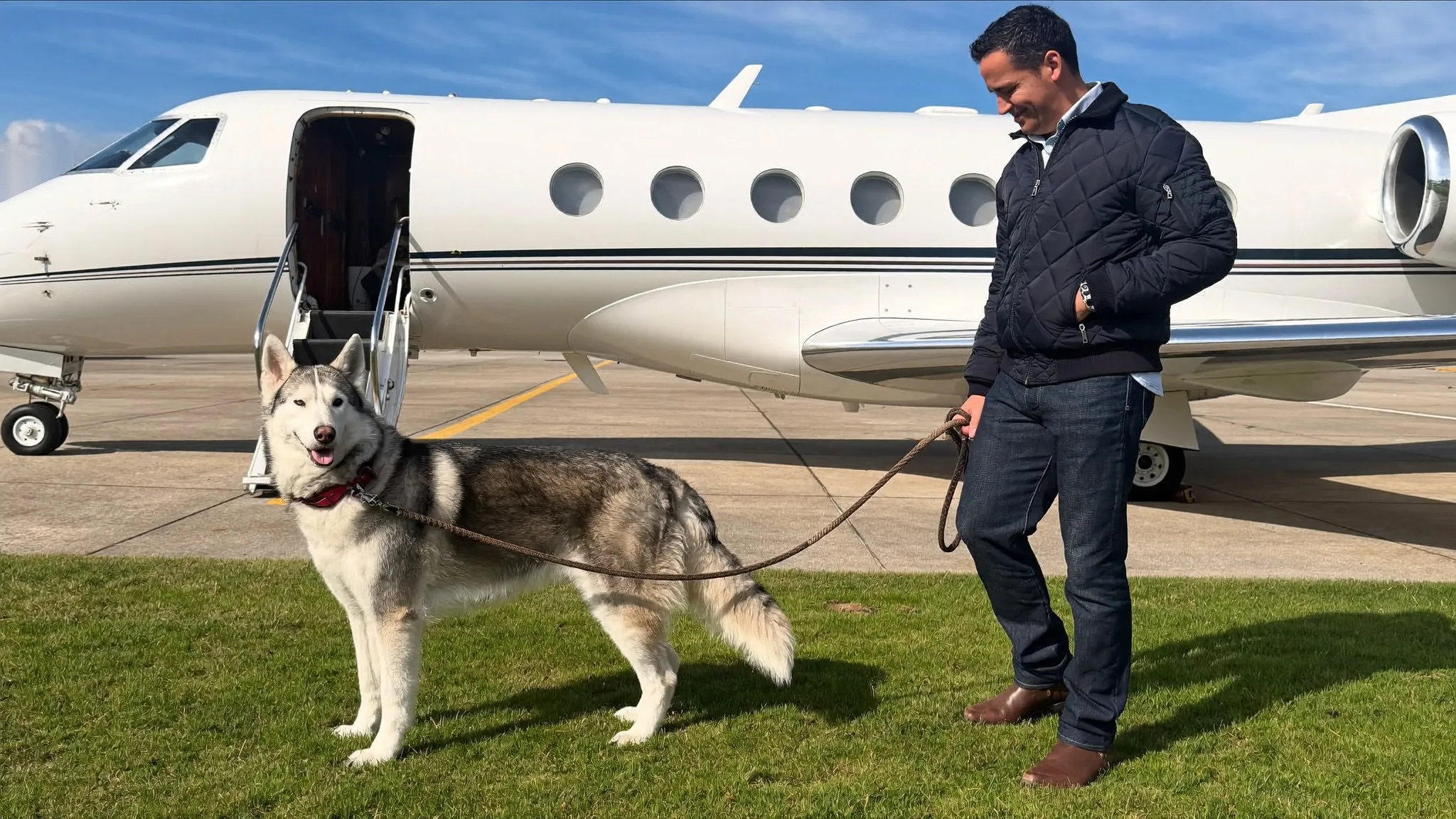
That is how our flights work: the dog stays in the cabin with its owner, never in the hold, and spends the flight at your feet. Loulou Air, an AEROAFFAIRES brand and a private aviation broker since 1991, sells Pay-per-Seat private jets for your dog and you: you pay for your seat, not the jet, and one ticket covers one person and their dog. There is none of the weight limit imposed by scheduled airlines, because your dog does not travel in the hold: capacity depends on the aircraft and the number of animals on board, and a broker approves each dog case by case. Boarding is through a private aviation terminal, with no queues and no separation, and the crew is briefed on welcoming animals. The requirements described here remain due on every flight, private ones included, and our brokers check every file before departure.
Our routes currently serve New York, Dubai and Los Angeles: see the open flights. We open new flights every month, so tell us where you want to go by going to talk to a broker; and for a whole aircraft, our sister company AEROAFFAIRES offers full charter.
Frequently asked questions
When should the tapeworm treatment be given for Ireland?
Between 24 and 120 hours before your dog’s scheduled arrival time, so one to five days ahead. The product must contain praziquantel, be administered by a vet and be recorded in the pet passport or EU health certificate, before every entry into Ireland.
Can a puppy enter Ireland?
Not before it is immunised against rabies. The vaccine cannot be given before 12 weeks of age, and you must then wait at least 21 days, or longer if the datasheet says so. Minimum ages by destination are covered in Flying with a puppy: minimum age.
Who decides where my dog travels on the plane?
Your carrier. DAFM has no objection to an animal travelling in the cabin or as excess baggage, but says the decision on where in the plane an animal travels is up to the airline; cabin weight and carrier limits are compared in Pet in cabin: weight limits, fees and airlines. Our other city guides are in the blog, including Amsterdam and Lisbon, and requirements by country are on our travel requirements pages.
Sources
Rules change: check them against these sources before every trip.
- Department of Agriculture, Food and the Marine — Bringing your pet dog, cat or ferret into Ireland from another EU country
- Department of Agriculture, Food and the Marine — Pet Travel
- European Commission — Travelling with pets and other animals in the EU
- Dublin City Council — A Guide to Responsible Dog Ownership
- Dublin City Council — Bye-Laws for the Control of Dogs 1998
- Department of Agriculture, Food and the Marine — Ban on XL Bully dogs
- Phoenix Park (Office of Public Works) — Park Regulations
- Office of Public Works — Code of Conduct for Dog Owners at National Historic Properties in the Dublin Region
- Iarnród Éireann — Pets On-board Trains
- Transport for Ireland — Animals on TFI Services