Lisbon with your dog: rules and transport
Pet passport, microchip, rabies vaccination, leash and muzzle law, metro and buses: the official rules for taking your dog to Lisbon.
By the Loulou Air team · · 8 min read
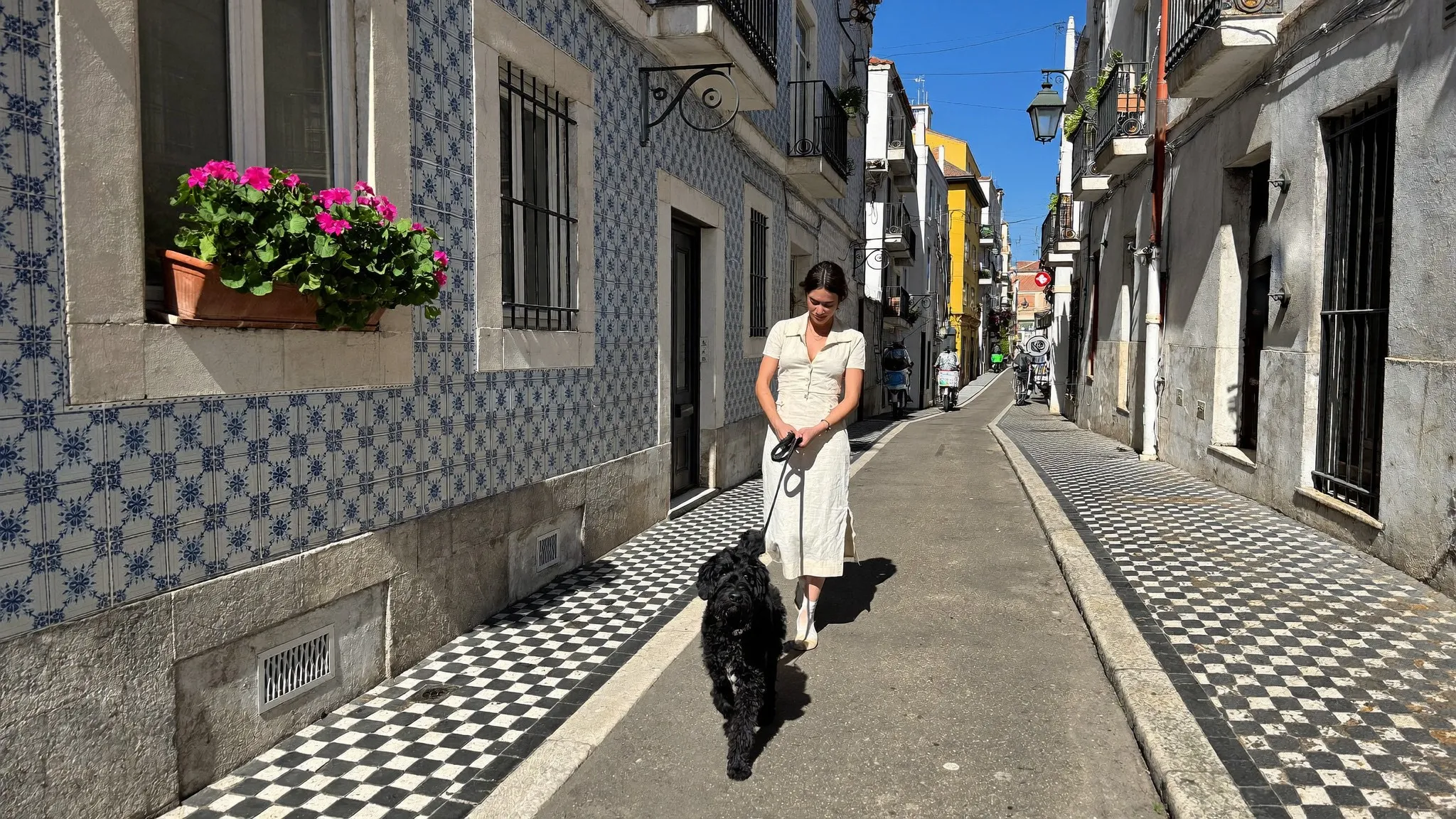
Taking your dog to Lisbon needs very little paperwork: Portugal is in the European Union, and the three usual items are enough. What does need planning is daily life there, because Portuguese law is precise about leashes and muzzles, and each operator adds conditions of its own. Here is what the official pages say, read on 3 October 2026.
What documents does your dog need for Lisbon?
A microchip, a pet passport and a valid rabies vaccination. The Direção-Geral de Alimentação e Veterinária, Portugal’s veterinary authority, writes that non-commercial movement between two European countries, and entry into Portugal, is governed by Regulation (EU) No 2016/429 and Delegated Regulations (EU) 2026/131 and 2026/133, for a maximum of five animals.
The three conditions, as the DGAV lists them: a microchip, a tattoo being accepted only if it is clearly legible and was applied before July 2011; a pet passport, issued in the European country where the owner habitually resides, in the name of the person the dog travels with; and a valid rabies vaccination.
Sequence matters as much as substance. The DGAV specifies that the vaccination must have been given when the animal was at least 12 weeks old, on or after the date the microchip was implanted, and that 21 days must have passed since the injection in the case of a first vaccination. For a booster given within the timeframe set by the vet, that waiting period does not apply. The European Commission says the same and adds that the microchip must be implanted before the vaccination. How to obtain the passport is covered in The EU pet passport for dogs.
One detail if someone else takes the dog for you: the DGAV treats as commercial any movement of the animal that is more than five days apart from the owner’s own journey.
Do you have to notify the Portuguese authorities before arriving?
No, not on a flight from a European Union country. The DGAV is explicit: for movements inside the Union, no arrival notice has to be sent, the passport simply having to remain available for checking if requested. Keep it on you rather than in your suitcase.
Two points deserve attention. Tapeworm treatment against Echinococcus multilocularis is required, according to the same page, only for Ireland, Northern Ireland, Malta and Finland: it does not apply to Portugal, unlike the United Kingdom. And beyond 120 days of stay, the DGAV points out that national obligations fall due, including registration in the SIAC database.
Leash or muzzle: what does Portuguese law say?
Both, depending on the case, and it is a national law that says so. Article 7 of Decree-Law no. 314/2003, published in the Diário da República of 17 December 2003 and still listed among the texts in force by the DGAV, sets out two obligations.
The first is the collar or harness, compulsory for every dog and cat moving on a public road or in a public place: it must carry the keeper’s name and address or telephone number. An engraved tag will do, as long as it is legible.
The second is the muzzle. The same article prohibits the presence, on a public road or in a public place, of a dog that is not accompanied by its keeper and has no functional muzzle, except when it is led on a leash, during trials and training, or when it is a hunting dog during a hunt. On a leash, then, no muzzle is required for an ordinary dog; off the leash, it becomes one.
The text adds that municipalities may create areas set aside for dogs, laying down the conditions under which this may happen without a leash or muzzle. Trust the signs at the entrance to the garden you are walking into rather than a list found online.
Which dog breeds face special rules in Portugal?
Seven breeds and their crossbreeds, set out in an official annex. Portaria no. 422/2004, published in the Diário da República of 24 April 2004, lists the breeds and crosses deemed potentially dangerous: cão de fila brasileiro, dogo argentino, pit bull terrier, rottweiler, American Staffordshire terrier, Staffordshire bull terrier and tosa inu. The DGAV presents that text as the one that determines these breeds, within the framework of Decree-Law no. 315/2009, as amended by Law no. 46/2013.
Entry from another member state is not closed off, though: the DGAV writes that it is permitted for these breeds, and distinguishes two cases according to the length of the stay.
For a stay of less than four months, the only requirement is that the animal wear, when moving in public places, a muzzle and a short leash of no more than one metre. That is also what article 13 of Decree-Law no. 315/2009, republished by Law no. 46/2013, provides: a functional muzzle that allows neither eating nor biting, and a leash of up to one metre, attached to the collar or harness. The same article bars these dogs from moving unaccompanied on public roads, in public places and in the common parts of buildings, and tasks municipalities with regulating their movement in streets, parks and gardens: a Lisbon rule may therefore sit on top of the national one.
For a stay of four months or more, the regime changes completely. Besides SIAC registration, a licence to keep a potentially dangerous dog is needed, issued by the junta de freguesia of the place of residence. The DGAV lists the documents: a sterilisation declaration for animals not entered in an officially recognised studbook, the keeper’s criminal record certificate, civil liability insurance, and proof that the keeper has passed training for keepers of dangerous and potentially dangerous dogs.
Can you take your dog on the Lisbon metro and buses?
Yes, but the conditions differ from one operator to another. A national law sets the floor, then each operator publishes its own conditions, as that law requires.
The floor is Portaria no. 968/2009, published in the Diário da República of 26 August 2009, which governs the movement of dogs on public road, rail and river transport. It requires the animal to be in an adequate state of health and hygiene, to travel in a clean, sturdy, ventilated, washable and watertight container, inside the passenger compartment, and never to take a seat. Two limits matter: at the busiest times operators may refuse the animal, and dangerous and potentially dangerous animals may not be carried at all. Assistance dogs fall outside this text: they are covered by Decree-Law no. 74/2007.
The metro is the more accommodating of the two big Lisbon networks. Metropolitano de Lisboa publishes three conditions: that the dog not be of a breed considered dangerous or potentially dangerous, and it cites the list of seven; that it be accompanied by its owner or carer, with an up-to-date vaccination booklet and a municipal licence; and that it be muzzled and held on a short leash so that it cannot bite or cause harm to other customers. A container is not required, but the booklet and the licence are.
Buses and trams are stricter. The Carris general conditions of carriage, in their May 2025 version, allow pets that pose no danger to be carried free of charge, provided they are properly enclosed in a suitable container that can be carried as hand luggage, one container per passenger. The animal may not occupy a seat or block other passengers’ access to the remaining places. Where those conditions are not met, inspectors may require the passenger and the animal to leave the vehicle, with no right to a refund.
A large dog can therefore take the metro muzzled and on a short leash, but not the bus, where the container is the rule.
Who sets the rules for the flight itself?
Your airline, and nobody else. The DGAV is clear about the division of roles: information on transporting the animal, on carriers, on arrival at the airport, on transport crates and on where the animal travels must be obtained from the chosen carrier. The veterinary authority sets the documents, not the dog’s place on board. That is where airlines diverge: maximum cabin weight, bag size, a hold requirement above a certain size, all covered in Pet in cabin: weight limits, fees and airlines and Dogs in the cargo hold. Country requirements are gathered on our travel requirements pages, and the other country guides in our blog, including Geneva with your dog.
What if your dog flew in the cabin, at your feet?
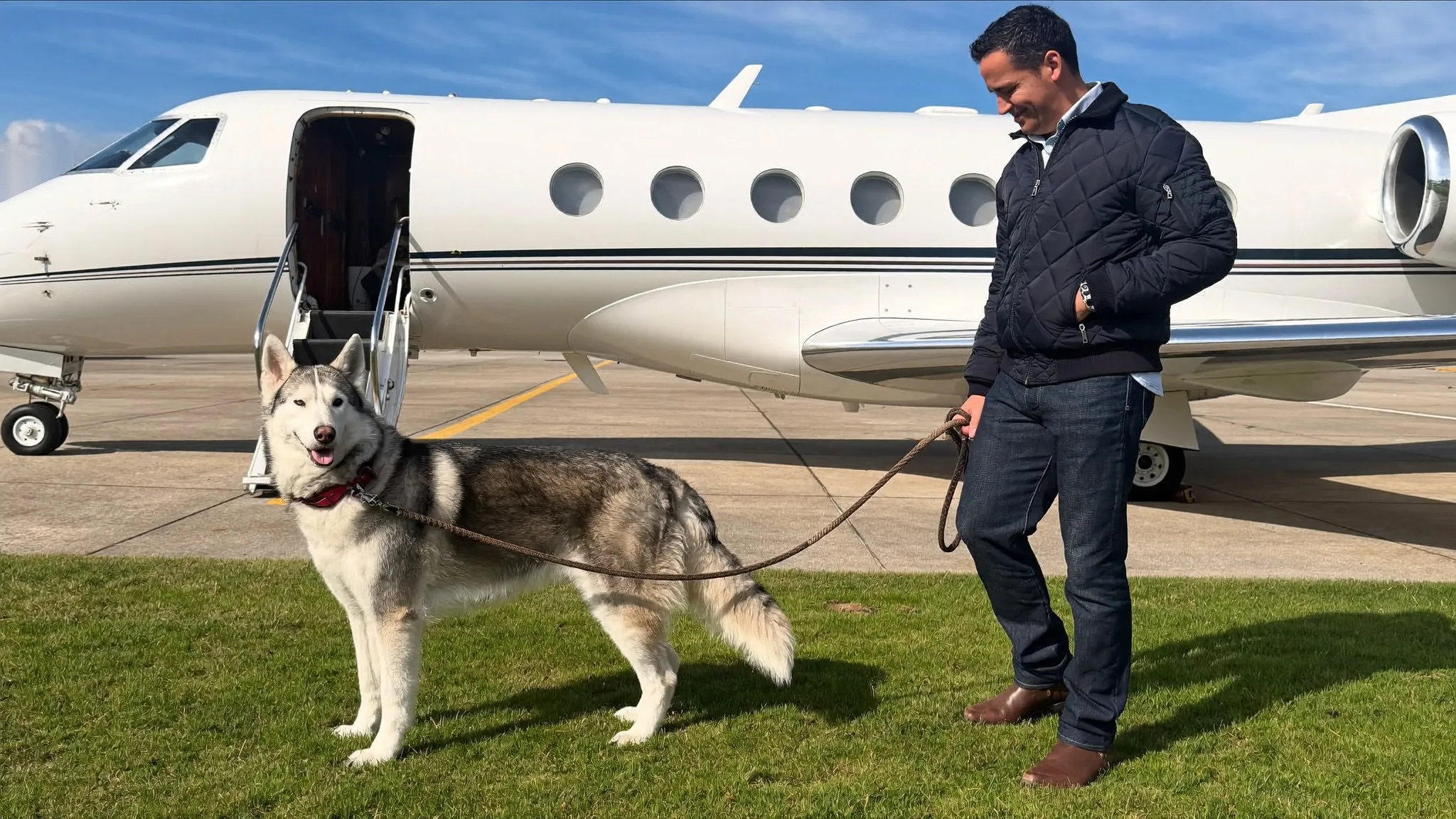
That is how our flights work: the dog stays in the cabin with its owner, never in the hold, and spends the flight at your feet. Loulou Air, an AEROAFFAIRES brand and a private aviation broker since 1991, sells Pay-per-Seat private jets for your dog and you: you pay for your seat, not the jet, and one ticket covers one person and their dog. There is none of the weight limit imposed by scheduled airlines, because your dog does not travel in the hold: capacity depends on the aircraft and the number of animals on board, and a broker confirms each dog case by case. Boarding is through a private aviation terminal, with no queues and no separation. The requirements described here remain due on every flight, private ones included, and our brokers check every file before departure.
Our routes currently serve New York, Dubai and Los Angeles: see the open flights. We open new flights every month, so tell us where you want to go by going to talk to a broker; and for a whole aircraft, our sister company AEROAFFAIRES offers full charter.
Frequently asked questions
Is an EU pet passport enough to take a dog to Portugal?
Yes, together with the microchip and the vaccination. The DGAV requires a microchip, a pet passport issued in the European country where the owner habitually resides, and a valid rabies vaccination. Check that the microchip was implanted before the vaccination: the other way round, the vaccine does not count for the journey.
Does my dog have to wear a muzzle in the streets of Lisbon?
Not if it is on a leash. Article 7 of Decree-Law no. 314/2003 prohibits a dog from being on a public road or in a public place without its keeper and without a functional muzzle, except when it is led on a leash. For the seven potentially dangerous breeds, a muzzle and a short leash of no more than one metre are required in public places.
Can my dog board a Lisbon bus without a carrier?
Not with Carris. Its general conditions allow free carriage only if the animal is enclosed in a suitable container that can be carried as hand luggage, one per passenger. The metro, by contrast, accepts a dog muzzled and held on a short leash, with an up-to-date vaccination booklet and a municipal licence.
Sources
Rules change: check them against these sources before every trip.
- DGAV — Pets: travelling in Europe (Portuguese version)
- DGAV — Dangerous and potentially dangerous animals: general information (Portuguese version)
- DGAV — Pets: legislation (Portuguese version)
- European Commission — Travelling with pets in the EU
- Diário da República — Decree-Law no. 314/2003 of 17 December
- Diário da República — Law no. 46/2013 (republication of Decree-Law no. 315/2009)
- Diário da República — Portaria no. 422/2004 of 24 April
- Diário da República — Portaria no. 968/2009 of 26 August
- Metropolitano de Lisboa — Frequently asked questions (Portuguese version)
- Carris — General conditions of carriage, May 2025 (Portuguese version)