Madrid with your dog: the rules on the ground
Pet passport, microchip, leash and muzzle law, metro, buses, parks and dog areas: the official rules for taking your dog to Madrid.
By the Loulou Air team · · 8 min read
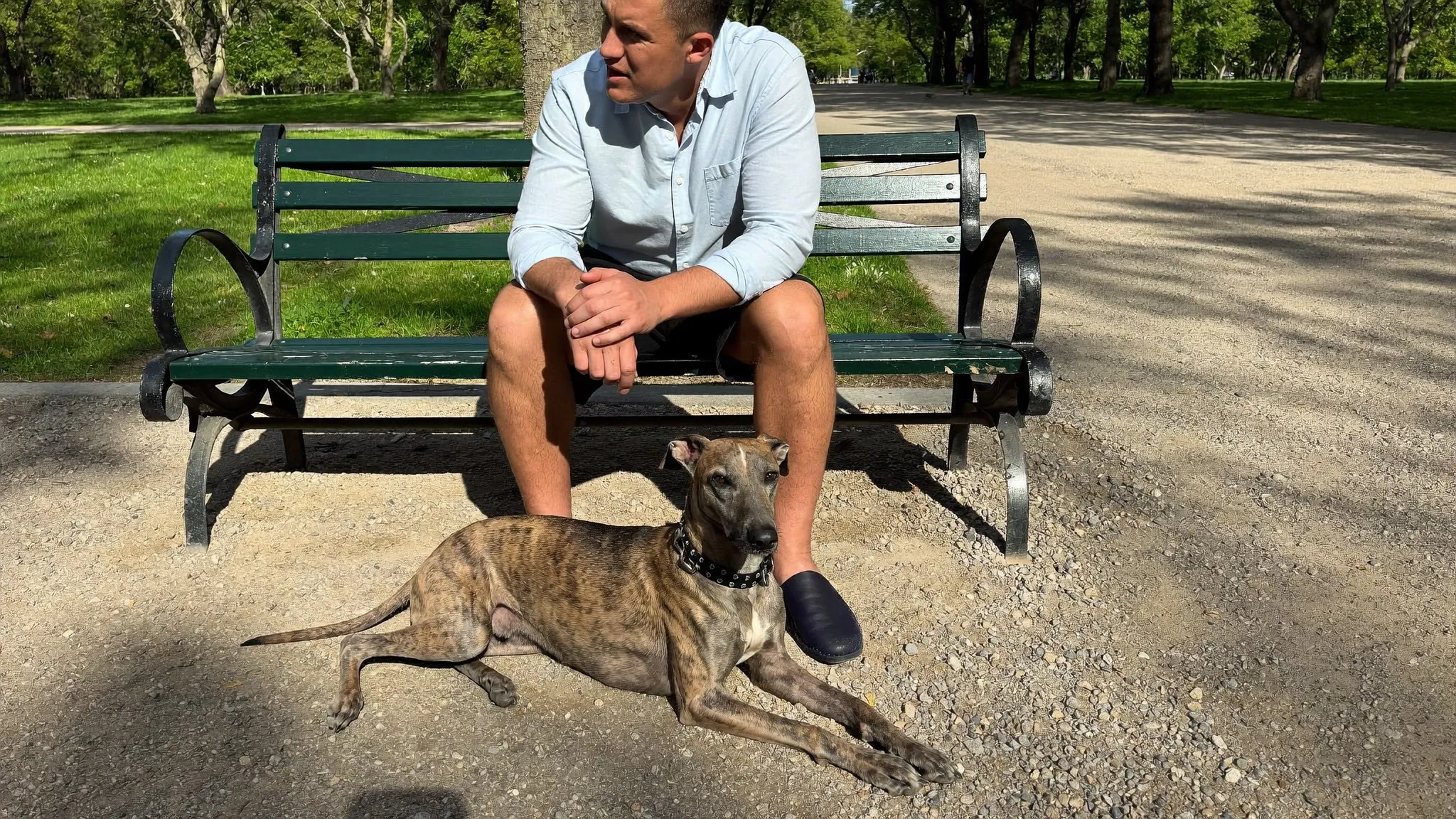
Taking your dog to Madrid needs very little paperwork: Spain is in the European Union, and the usual three items are enough. What takes preparation is daily life once you arrive, because the city is specific about leads, about park hours and about each mode of transport. Here is what the official pages say, read on 5 October 2026.
What documents does your dog need for Madrid?
A microchip, an EU pet passport and a valid rabies vaccination. Spain’s Ministry of Agriculture lists those three conditions for entry from another EU country: identification by microchip, a tattoo being accepted only if it was done before 3 July 2011 and is still legible; a rabies vaccine valid at the time of travel and recorded in the passport; and a European passport for the movement of pet animals.
The European Commission says the same and adds the order of events, which matters as much as the events themselves. The microchip must be implanted before the vaccination for that vaccination to count. The animal must be at least 12 weeks old before its first injection, and you must then wait at least 21 days before travelling. The pet passport is mandatory for movements between EU countries. How to obtain one is covered in The EU pet passport for dogs.
Two limits frame this regime, which the MAPA and the Commission state in the same terms: five animals at most, and a movement with no commercial purpose and no transfer of ownership. Treatment against the Echinococcus multilocularis tapeworm, which the Commission requires for a few destinations between 24 and 120 hours before travel, is not among the entry conditions the MAPA lists for Spain.
Can a puppy enter Spain?
Not before fifteen weeks, and that is a Spanish rule stricter than the European one. The MAPA is categorical: no exception is granted, and the entry into Spain of dogs, cats and ferrets under 15 weeks old is not authorised.
The gap with the European timetable is worth understanding. The Commission’s 12 weeks are the minimum age for vaccinating, to which 21 days of waiting are added: Spain settles on the 15-week threshold and closes it to any waiver. The wider subject is covered in Flying with a puppy: minimum age.
Lead or muzzle: what does Madrid require?
A lead always, a muzzle depending on the dog. Madrid’s municipal ordinance on keeping and protecting animals requires that, in public spaces and in private spaces of common use, pets move about accompanied and led by a chain or sturdy cord that allows the owner to control them. The Ayuntamiento repeats that obligation word for word on its rules page for animal keepers.
The muzzle is not general. The same text provides for it when the animal’s history, temperament, characteristics or the situation make it advisable, under the owner’s responsibility, and the municipal authority can impose it when circumstances require. For an ordinary dog on a lead, it is therefore not required by default.
Waste is the other duty people forget. The ordinance requires owners to stop their dog fouling pavements, promenades, gardens and, more generally, anywhere meant for pedestrians, and to clean up immediately wherever it happens. The municipal page adds that biodegradable products should be used. The same text forbids bathing an animal in ornamental fountains and ponds, and letting it drink straight from public drinking fountains, so bring a folding bowl.
Can you let your dog off the lead in Madrid’s parks?
Yes, in the fenced dog areas at any time, and elsewhere only during set hours. The Ayuntamiento states that it has dog areas in all 21 districts of the city.
Outside those enclosures, the rule is a timetable. The city writes that dogs may be off the lead between 7 pm and 10 am on winter time, and between 8 pm and 10 am on summer time. The rest of the day a lead is required: the general rule is that dogs may move through the parks and must wear a lead there.
Three green spaces are closed to animals: the historic garden of El Capricho in the Alameda de Osuna, the Quinta de Torre Arias and the Jardines de Sabatini. The city does not allow pets inside them. Everywhere else, children’s play areas and areas for the elderly stay off limits to every dog. Trust the signs at the park entrance, which are the only thing that is up to date.
Can you take the metro and the bus with your dog in Madrid?
Yes on the metro, under strict conditions; on the bus, only inside a container. It is this difference between the two networks that surprises visitors most.
The metro accepts dogs at no extra charge. The regional government, which runs the network, notes that their entry carries no additional cost for the passenger, and lists the conditions: the dog must be identified by microchip and entered on the municipal register; one dog per passenger; the journey is made exclusively in the last carriage of each train; and every dog must wear a muzzle and be held on a lead no longer than 50 centimetres.
The hours are the real constraint. Monday to Friday, access is closed during peak periods, that is from 7.30 to 9.30 am, from 2 to 4 pm and from 6 to 8 pm. In July and August, every weekend of the year and on public holidays, access is unrestricted.
The bus is stricter. The EMT passenger regulations, from the city’s transport operator, forbid in article 11 travelling with animals, except guide dogs for blind passengers and small pets, provided they are carried by their owners in suitable containers and cause no nuisance through smell or noise, nor to the comfort of other passengers. A large dog can therefore take the metro muzzled on a short lead, but not the bus.
For hotels and restaurants, the decision rests with the business: the ordinance allows the owners of hotels, guest houses, bars, restaurants and cafés to refuse animals at their discretion, provided they display their choice visibly at the entrance, with guide dogs outside that regime.
Which dog breeds have special rules in Spain?
Eight breeds and their crosses, set by a national decree. Real Decreto 287/2002, published in the Boletín Oficial del Estado, lists in its annex the pit bull terrier, the Staffordshire bull terrier, the American Staffordshire terrier, the rottweiler, the dogo argentino, the fila brasileiro, the tosa inu and the akita inu.
The duties that follow are heavy. In public places and spaces, these dogs must wear a suitable muzzle and be led on a chain or non-extendable lead shorter than 2 metres, and no one person may walk more than one of them. Keeping one requires an administrative licence, which among other things demands third-party liability insurance covering at least 120,000 euros and lasts five years. In Madrid the licence is issued by the Junta Municipal of the owner’s place of residence, and the holder then has 15 working days from acquiring the animal to enter it on the municipal register of potentially dangerous animals.
For a visit, remember that the Ayuntamiento describes these dogs as always leashed and muzzled: the park hours that let a dog off the lead do not apply to them.
Who sets the rules for the flight itself?
Your carrier, and no one else. Veterinary authorities set the dog’s paperwork, not its place on the aircraft: maximum cabin weight, carrier dimensions and any requirement to travel in the hold are each airline’s own conditions, and the differences are set out in Pet in cabin: weight limits, fees and airlines and Dogs in the cargo hold. Requirements by country are gathered on our travel requirements pages, and our other city guides are in the blog, including Lisbon and Geneva.
What if your dog flew in the cabin, at your feet?
That is how our flights work: the dog stays in the cabin with its owner, never in the hold, and spends the flight at your feet. Loulou Air, an AEROAFFAIRES brand and a private aviation broker since 1991, sells Pay-per-Seat private jets for your dog and you: you pay for your seat, not the jet, and one ticket covers one person and their dog. There is none of the weight limit imposed by scheduled airlines, because your dog does not travel in the hold: capacity depends on the aircraft and the number of animals on board, and a broker confirms each dog case by case. Boarding is through a private aviation terminal, with no queues and no separation. The requirements described here remain due on every flight, private ones included, and our brokers check every file before departure.
Our routes currently serve New York, Dubai and Los Angeles: see the open flights. We open new flights every month, so tell us where you want to go by going to talk to a broker; and for a whole aircraft, our sister company AEROAFFAIRES offers full charter.
Frequently asked questions
Is an EU pet passport enough to take a dog to Spain?
Yes, with the microchip and the vaccination. Spain’s Ministry of Agriculture asks for a microchip, a rabies vaccine valid at the time of travel and recorded in the passport, and a European pet passport. Check that the microchip was implanted before the vaccination: in the other order, the vaccination does not count for the journey.
Can my dog travel on the Madrid metro at rush hour?
No, not Monday to Friday. The regional government closes access from 7.30 to 9.30 am, from 2 to 4 pm and from 6 to 8 pm. In July and August, every weekend of the year and on public holidays, access is unrestricted, with the dog still muzzled, held on a lead of no more than 50 centimetres and travelling in the last carriage.
Can you let a dog off the lead in the Retiro park?
Only during the set hours, and outside the restricted zones. The Ayuntamiento allows dogs off the lead between 7 pm and 10 am on winter time and between 8 pm and 10 am on summer time, with a lead required the rest of the day. Children’s play areas and areas for the elderly are off limits to every dog, and three of the city’s gardens are closed to animals.
Sources
Rules change: check them against these sources before every trip.
- European Commission — Travelling with pets in the EU
- MAPA — Viajar con la mascota. Perros, gatos, hurones (Spanish version)
- Ayuntamiento de Madrid — Rules for animal keepers (Spanish version)
- Ayuntamiento de Madrid — Ordenanza Reguladora de la Tenencia y Protección de los Animales
- Ayuntamiento de Madrid — Dogs in the parks of Madrid (Spanish version)
- Comunidad de Madrid — Dog access to the Metro de Madrid network (Spanish version)
- EMT Madrid — Reglamento de Viajeros (Decreto 206/2000)
- BOE — Real Decreto 287/2002, of 22 March