Flying with an older dog: what to plan
No airline sets an upper age limit, but a vet certificate, the cabin weight cap and unchanged entry rules decide whether your senior dog flies.
By the Loulou Air team · · 8 min read
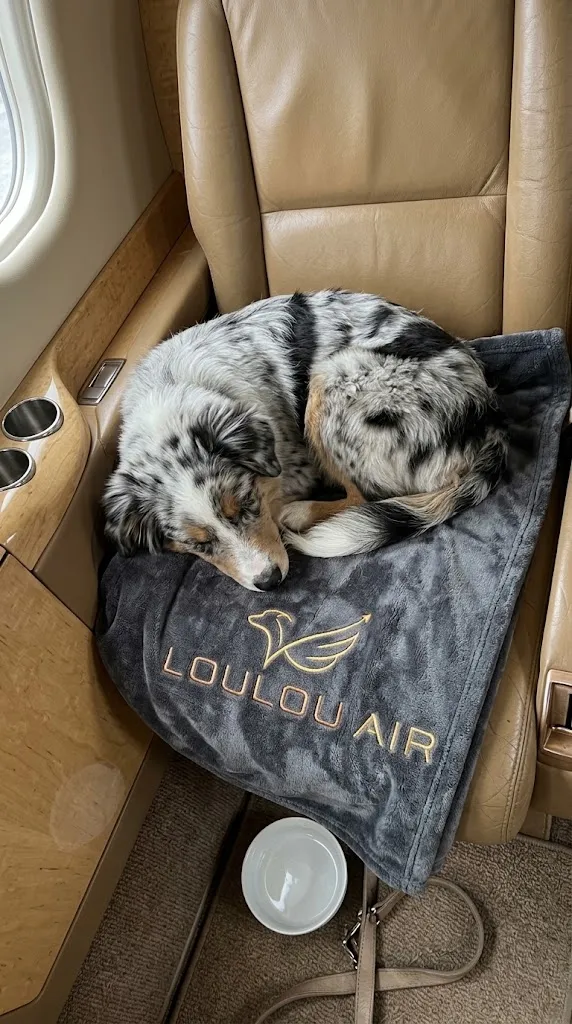
Your dog is getting on in years and you are wondering whether it can still fly. Its age alone settles nothing: the airline policies we read set a minimum age and never a maximum one, and what really decides is its state of health, the weight allowed in the cabin, and the entry rules of the country you are flying to. For an older dog, one thing matters more than the rest: staying in the cabin at your feet instead of spending hours in the hold, which is what Loulou Air sells seat by seat.
Is there a maximum age for a dog to fly?
No. None of the airline policies we read sets one: they all impose a minimum age, then say nothing about the other end of the scale.
- Corsair requires the animal to be at least 2 months old.
- TAP Air Portugal accepts a pet from 10 weeks in the cabin and from 12 weeks in the hold.
- Air Canada requires, in most cases, a dog of at least 10 weeks, fully weaned.
- Delta asks for 8 weeks on a US domestic flight.
Health authorities set a floor and no ceiling either. The CDC states that dogs must be at least 6 months old at the time of entry or return to the United States, and the European Commission ties movement inside the EU to a rabies vaccination given when the animal was at least 12 weeks old. So it is not your dog’s date of birth that will stop the trip, but what the vet and the airline see on the day of departure.
Does an older dog need a veterinary certificate?
Almost certainly, and it is the document that matters most for a senior dog. IATA, the international airline association, notes that most airlines require a health certificate for any animal they transport, in the cabin or as a shipment.
The deadlines are short. Corsair asks at check-in for a health certificate issued within 5 days of travel, plus a rabies certificate dated more than one month and less than one year before the flight. TAP Air Portugal requires, on some flights, a certificate stating that the animal showed no sign of disease on the day of the clinical examination and was fit to travel.
For international travel the vet may need to be accredited: APHIS, the animal health service of the US Department of Agriculture, advises contacting a USDA-accredited veterinarian as soon as you decide to travel. On the French side, service-public.gouv.fr points to two things to check before buying a ticket: the airline’s own conditions for carrying animals, and the entry rules of the destination country.
What does the vet look at before departure?
The dog’s actual condition, not its age. The National Veterinary School of Toulouse runs a senior consultation presented to owners of dogs over 8 years old, and the content of that work-up is a good list of what gets checked at that age: an enhanced clinical examination, a blood pressure reading, blood work in haematology and biochemistry, an endurance assessment, early detection of age-related disease, and tailored feeding advice.
The follow-up rhythm changes too: for a senior dog, Cornell’s Riney Canine Health Center recommends physical exams and checkups at least every six months at the veterinary clinic.
Whether to travel at all comes first. The AVMA brochure opens with a warning: you should consider whether travel is right for your pet, since some are uncomfortable with it because of illness, injury, temperament or other concerns. If the trip is necessary, it says to talk it through with your veterinarian.
Cabin or hold for a senior dog?
On a scheduled airline, the cabin is for small dogs only. Corsair caps the dog and its bag at 8 kg; Vueling allows a 45 × 39 × 21 cm bag of no more than 10 kg including the animal, and never carries animals in the hold. Delta sets no weight but requires the dog to fit comfortably in a kennel stowed entirely under the seat in front, able to move around without touching the sides or sticking out. A 12-year-old labrador fits through none of those doors.
That leaves the hold, whose constraints land badly for an older dog. The crate must let it stand without touching the top, sit up, turn around and lie down: IATA, the AVMA and Air Canada all put it in the same terms. The AVMA adds that defective crates are the most common cause of animals escaping or being injured during air travel.
The booking windows also close fast: Air Canada refuses the hold above 29.5 °C on some routes and in some periods, and accepts no animal as checked baggage or cargo between 18 December and 4 January. Our articles Dogs in the cargo hold: the real risks and Pet in cabin: weight limits, fees and airlines go through these rules airline by airline.
Arthritis, routine, house-training: what travel tests
An older dog’s travel troubles are its daily ones, concentrated. The Riney Canine Health Center lists among the signs of osteoarthritis stiffness, lameness, a decrease in activity, reluctance to walk, and difficulty getting up after lying down. An airport transfer, a long wait on its feet and hours in a closed container press on exactly those points.
Ageing also shifts a dog’s bearings. Cornell notes that most senior dogs prefer a set routine for the important things, such as meals, and advises not moving their bed or their bowls. The centre also describes, in dogs with cognitive dysfunction, night-time pacing and house-soiling in dogs that had been perfectly clean until then, and Vueling forbids taking the animal out of its carrier before disembarking. The AVMA also recommends discussing with your vet whether and when to feed the animal before, during and after the flight. Our articles Toilet breaks, water and food on a flight and Keeping your dog calm on a flight cover the preparation in detail.
Can you give an older dog a sedative before a flight?
Not without your veterinarian’s advice, and not on your own initiative. The AVMA brochure is explicit: consult your veterinarian before giving any tranquilliser or sedative, because these products can increase the risk of heart or respiratory problems and are generally not allowed by airlines.
For a dog whose heart, kidneys or liver already have some years of service, the senior work-up is what allows that call to be made, blood tests and blood pressure included.
Do the entry rules change with age?
No, they stay exactly the same, and that is often where an older dog’s file falls short. Inside the European Union, the European Commission requires a microchip, a rabies vaccination given by an official or authorised veterinarian, and a passport issued by an authorised veterinarian. The validity of the vaccination starts no earlier than 21 days after the primary course, and each booster must have been given while the previous one was still valid: a missed booster puts an 11-year-old dog back where a puppy starts, with a fresh 21-day wait. Service-public.gouv.fr adds a detail that costs dearly when the chip was implanted late: the vaccination must have been given after the identification to count as valid. Our article The EU pet passport and our travel requirements pages set out these rules.
For the United States, the CDC requires the dog to appear healthy on arrival, to be at least 6 months old and to carry a microchip readable by a universal scanner; for a dog that has only been in rabies-free or low-risk countries, the only document required is the CDC Dog Import Form. That “appear healthy” condition is the one that can turn against an older dog worn out by the journey. See our United States travel requirements and our article The CDC Dog Import Form.
What if your older dog stayed in the cabin, at your feet?
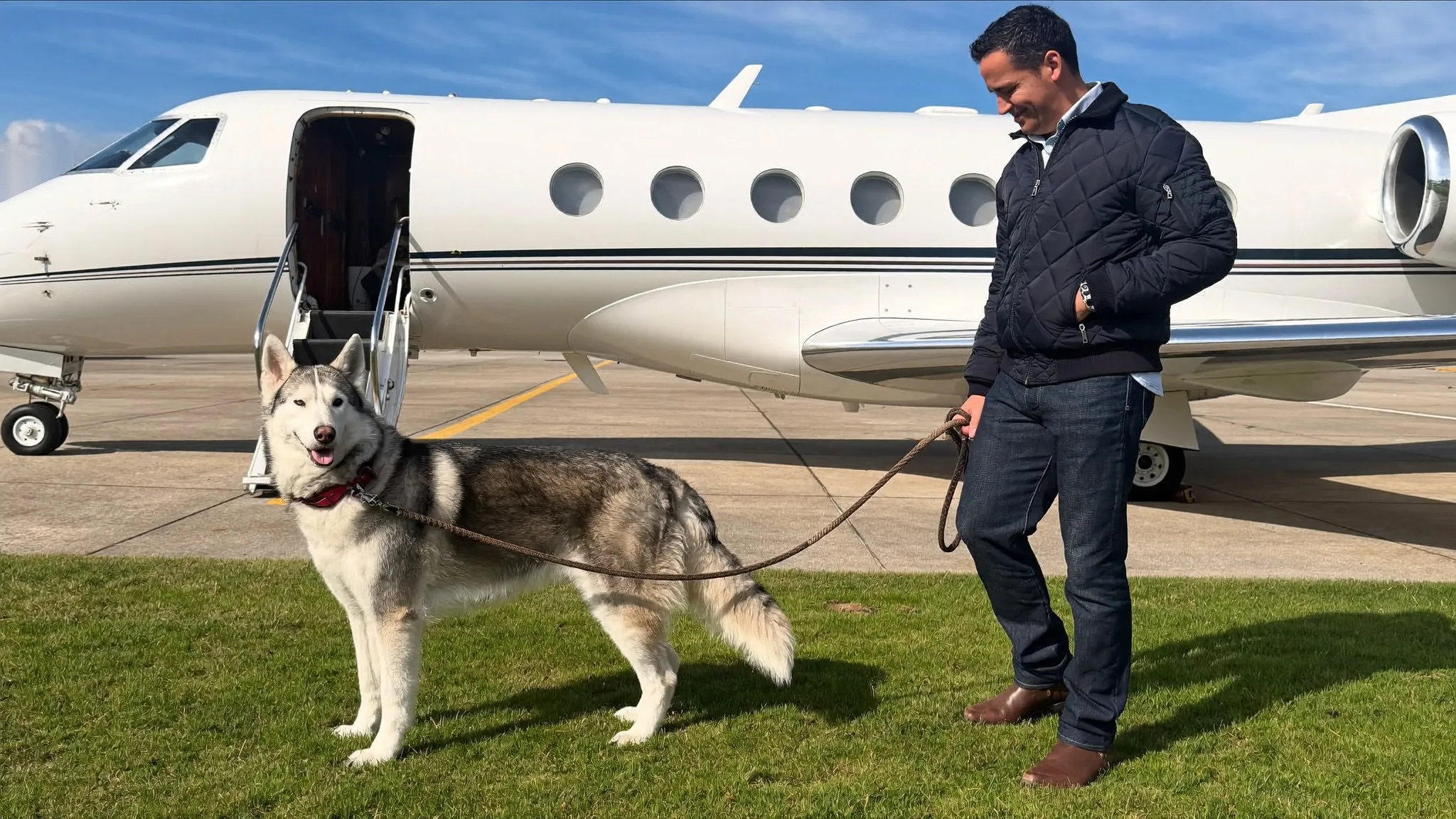
It can, on a shared private flight, whatever it weighs. On a private jet there is no bag to slide under a seat and no 8 kg threshold: your dog travels in the cabin with you, at your feet for the whole flight, never in the hold. That is the Loulou Air principle: a brand of AEROAFFAIRES, a private aviation broker since 1991, selling Pay-per-Seat private jets for your dog and you, where you pay for your seat, not the jet, and every ticket covers one seat for a human and their dog.
For an older dog that changes three concrete things: none of the weight limit imposed by scheduled airlines applies, boarding is through a private aviation terminal with no queues and no separation, and there are no hours spent alone in the dark and noise of the hold. On board, the crew is briefed on welcoming animals, water, bowls and blankets are provided, and our brokers check every dog’s file before departure, with travel requirements still due on every flight, private ones included.
Our flights serve New York, Dubai and Los Angeles: see our open flights. For anywhere else, we open new routes every month, so talk to a broker about the trip you are planning, or go through our sister company AEROAFFAIRES for a whole aircraft.
Frequently asked questions
Can my 12-year-old dog still fly?
Nothing in the policies we read forbids it: Corsair, TAP Air Portugal, Air Canada and Delta set a minimum age, none of them a maximum. What decides is the veterinary certificate, the weight allowed in the cabin and the entry rules of the country you land in. Start with a recent veterinary work-up.
What certificate does an older dog need?
A veterinary health certificate, with a deadline that depends on the airline: Corsair wants it issued within 5 days of travel, and IATA notes that most airlines require one. For international travel, APHIS advises going through a USDA-accredited veterinarian.
Can a senior dog travel in the hold?
That is the question to put to your vet before booking. The AVMA says to consider first whether travel is right for the animal, in particular in case of illness or injury, and the crate must let the dog stand, turn around and lie down. Air Canada also closes the hold depending on temperature and time of year.
Sources
Rules change: check them against these sources before every trip.
- AVMA - Traveling with your pet (2023 brochure)
- IATA - Traveling with pets
- National Veterinary School of Toulouse (ENVT) - Senior consultation
- Cornell University, Riney Canine Health Center - Senior dog dementia
- Cornell University, Riney Canine Health Center - Osteoarthritis
- Cornell University, Riney Canine Health Center - Choosing food for your senior dog
- CDC - Dogs arriving from rabies-free or low-risk countries
- European Commission - Travelling with a pet within the EU
- Service-Public (France) - Travelling abroad with a pet
- USDA APHIS - Pet travel
- Corsair - Transport of animals
- TAP Air Portugal - Pets
- Delta - Pet travel
- Air Canada - Travelling with pets
- Vueling - Travelling with pets