Moving to the United States with your dog
The CDC import form, the health certificate New York State demands, the city dog licence and the customs declaration, step by step.
By the Loulou Air team · · 8 min read

Moving to the United States with your dog means preparing two files, not one: the federal entry file, and the file for the state you are settling in. The first is short for a dog leaving France. The second calls for a veterinary health certificate that the EU pet passport does not replace. Then there is the flight itself: on a Pay-per-Seat private jet, your dog travels in the cabin with you, with none of the weight limit imposed by scheduled airlines.
What paperwork does a dog need to enter the United States?
One federal document: the receipt for the CDC Dog Import Form. For a dog that has only been in dog rabies-free or low-risk countries in the six months before arrival, the CDC states that this form is the only required documentation. France does not appear on the CDC’s list of high-risk countries for dog rabies, so a dog flying out of France falls under those lighter rules.
Three conditions come with the form, and none of them is negotiable:
- Age. The dog must be at least six months old at the time of entry.
- Microchip. The dog must have a microchip that can be detected with a universal scanner.
- Apparent health. The dog must appear healthy on arrival.
The CDC also states that dogs from these countries do not require any other documents from the agency. No rabies vaccination certificate is asked for under federal rules. How to fill in the form is covered in The CDC Dog Import Form and on our United States travel requirements page.
Does a permanent move change anything about the CDC form?
No: the form is the same for a move and for a two-week holiday. Two details matter when you are leaving for good, though.
One form per dog. The CDC requires a separate form for each dog you bring in. There is no limit on how many dogs you may bring, as long as each one meets the entry requirements. The receipt arrives by email within fifteen minutes of submission, once you have confirmed your email address, and you can print it or show it on your phone.
The receipt lasts six months. For a dog from a low-risk country, the receipt allows multiple entries from the same country for six months from the date it was issued. That helps when a move happens in two stages, a house-hunting trip and then the move itself. If you do not yet know the exact arrival date, the CDC asks you to enter the earliest approximate date.
These dogs may also enter at any airport, seaport or land border crossing: no designated port of entry is imposed.
Does New York State require a health certificate?
Yes, and it is separate from the CDC requirement. For a dog arriving from abroad, the New York State Department of Agriculture and Markets requires a Certificate of Veterinary Inspection or health certificate issued by your veterinarian no more than 30 days before entry.
The certificate must:
- be written in English;
- show the full New York destination address, with no PO boxes;
- state that the examination revealed no clinical evidence of infectious or communicable disease, including external parasites and fungi, and no recent exposure to such disease;
- record a current rabies vaccination for animals three months of age and older, with the product name and the date of vaccination. Both the one-year and the three-year vaccine are accepted.
If your country has no certificate form, the state will accept the required information on the veterinarian’s letterhead. One point matters above all for a departure from France: New York State does not accept the EU pet passport in place of this certificate. The CDC requirements still apply on top.
Does every state have its own rules?
Yes. USDA APHIS states that entry requirements for live animals are written and maintained by each receiving state or territory, and points you to that state’s department of agriculture and to the state veterinarian for questions. What New York asks for therefore says nothing about California, Florida or Texas: check the state you are moving to, and not merely the state you land in if the two differ.
On the federal side, APHIS Veterinary Services adds requirements only for a dog coming from a country affected by foot-and-mouth disease or screwworm. APHIS does regulate dogs imported for commercial purposes: it states that the Animal Welfare Act does not apply to privately owned dogs not intended for resale, and that pet dogs travelling with or being delivered to their owners fall outside those rules. Resale there covers retail or wholesale channels and fee-based adoption.
Do you have to register your dog once you live in New York?
Yes: every dog in New York City must hold a city licence, and that licence must be attached to its collar while the dog is in public. Owners may be fined for failing to meet these requirements.
A licence runs for one year, or for up to five years. It costs $8.50 a year for a spayed or neutered dog of any age. For a dog that is not spayed or neutered, it costs $8.50 under four months of age and $34 above that. Renewing late adds $2 for each year the licence was not renewed.
The licence matters day to day as well: with proof of a current dog licence and rabies vaccination, your dog can run off-leash in the city’s park dog runs. New York State also notes that animals destined for New York City may additionally fall under the rules of the city’s Department of Health and Mental Hygiene. For life on the ground, New York with your dog and Dog-friendly hotels in New York take over from here.
What do US customs check on arrival?
They check the dog’s file, how the dog looks, and what you are carrying. Every agricultural product must be declared to US customs officers. APHIS is explicit: as long as you declare all of your agricultural products, you will face no penalties, even if an inspector decides a given item cannot enter. Customs officers are the ones who determine whether a product may come in. APHIS recommends keeping receipts and original packaging as proof of a product’s country of origin.
For a move, that mainly means kibble, treats and supplements. Declare them, and plan on being able to buy locally if a batch is turned away.
If the dog’s file is incomplete, the dog can be refused entry, and the cost falls on you. US customs state that an animal excluded from entry is returned to the country of embarkation at the owner’s expense, and that while a decision is pending it may be detained at the port of arrival, also at the owner’s expense. A dog or cat that appears sick on arrival may need further examination by a licensed veterinarian, again at the owner’s expense.
Customs add one piece of free advice: contact the anticipated port of arrival before bringing an animal in. They also point out that pets may be subject at once to state or municipal veterinary health rules, federal quarantine, and agriculture and customs requirements.
What has to be done in France before departure?
Your dog must be identified and vaccinated before leaving. For travel outside the European Union, service-public.gouv.fr states that the dog must be identified by microchip, or by tattoo if that tattoo was done before 3 July 2011 and is still legible, must hold a European identification passport issued by a veterinarian, and must be vaccinated against rabies.
The same page refers you to the embassy or consulate of the destination country for any additional health measures, and to the carrier for transport conditions. The EU pet passport explains how to obtain that document. Keep in mind that the passport will serve for the French paperwork and for any return to Europe, but not for New York State, which asks for its own certificate.
Could your dog fly to New York in the cabin?
It can, if you book a seat on a shared private flight, where it stays at your feet for the whole crossing. On scheduled airlines, a dog too big for the cabin travels in the hold or as cargo, as Dogs in the cargo hold explains: for a move, that means a long flight and several hours of separation.
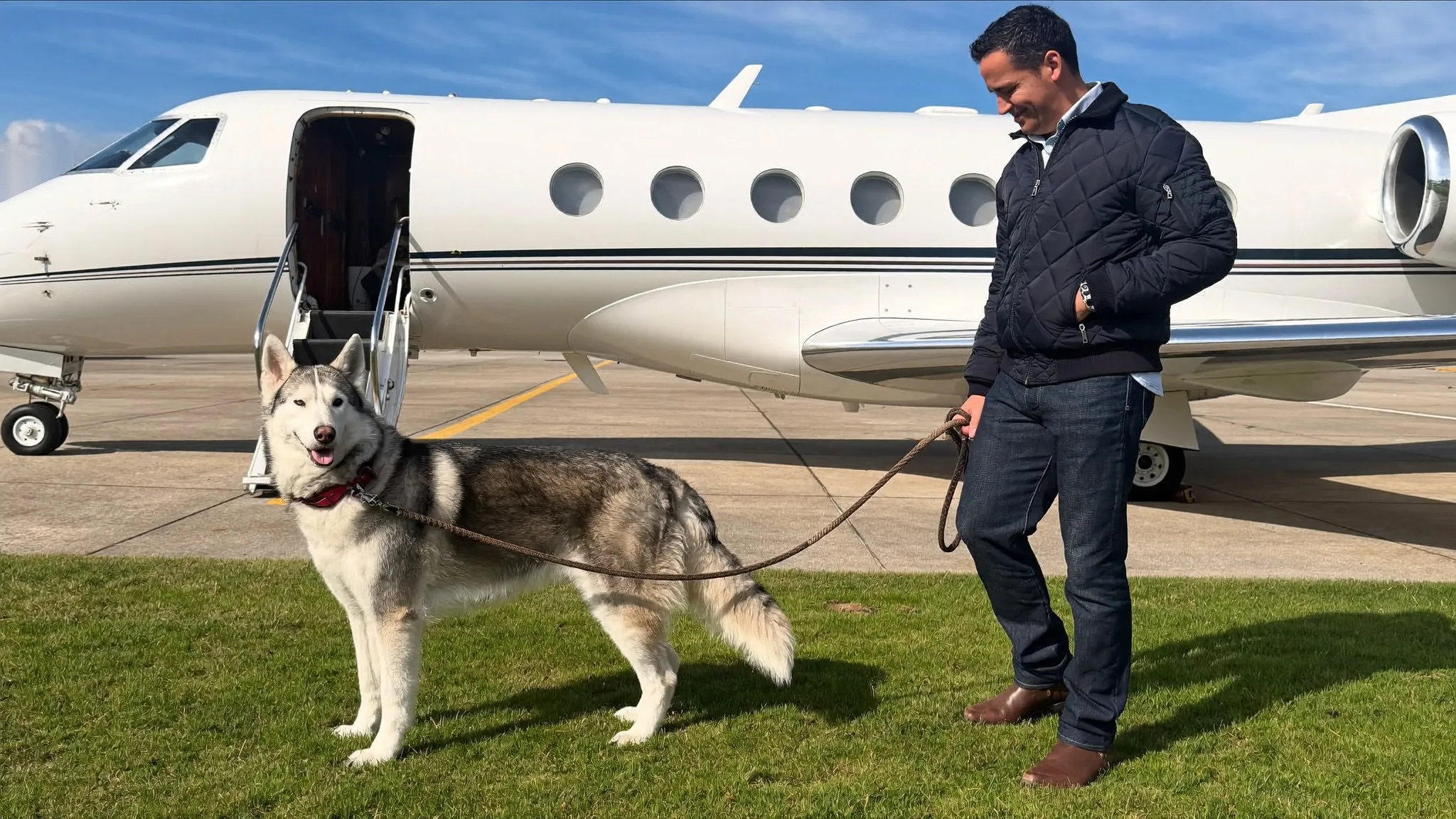
That is what Loulou Air does. Loulou Air is a brand of AEROAFFAIRES, a private aviation broker since 1991: Pay-per-Seat private jets for your dog and you. You pay for your seat, not the jet, and each ticket covers a seat for one human and their dog, who travels in the cabin with you, never in the hold. None of the weight limit imposed by scheduled airlines applies: capacity depends on the aircraft and on how many animals are on board, and a broker clears each dog case by case. Boarding is through a private aviation terminal, with no queues, and the flights are operated by certified airlines.
Our New York flights are here: see the open flights, and the route is described on our private jet Paris to New York with your dog page. Entry rules apply on every flight, private ones included, and our brokers check every dog’s file before departure, so it is worth talking to a broker before you fix the date of your move.
Frequently asked questions
How many dogs can you bring when you move?
The CDC sets no limit on how many dogs you may bring into the United States, provided each one meets the entry requirements. Each dog needs its own import form. The state you arrive in may set requirements of its own.
Can a four-month-old puppy move with me?
No: the CDC requires a dog to be at least six months old at the time of entry. A younger puppy has to wait, or join you later. New York State additionally asks for a current rabies vaccination from three months of age.
Is the EU pet passport enough to settle in New York?
No. The New York State Department of Agriculture and Markets does not accept the EU pet passport: it asks for a Certificate of Veterinary Inspection or health certificate, in English, issued no more than 30 days before entry. The passport remains useful for the French paperwork and for a return to Europe.
Sources
Rules change: check them against these sources before every trip.
- CDC - Entry Requirements for Dogs from Dog-Rabies Free or Low-Risk Countries
- CDC - High-Risk Countries for Dog Rabies
- CDC - CDC Dog Import Form and Instructions
- CDC - Frequently Asked Questions on Dog Importations
- USDA APHIS - Bring a Pet Dog into the United States
- USDA APHIS - How To Bring Dogs into the United States for Commercial Sale or Adoption
- USDA APHIS - U.S. State and Territory Animal Entry Requirements
- USDA APHIS - Traveling From Another Country
- New York State Department of Agriculture and Markets - Companion Animal Import and Export
- NYC Health - Dog Licenses
- U.S. Customs and Border Protection - Bringing Pets and Wildlife into the United States
- service-public.gouv.fr - Travelling abroad with a pet